Finch covering The Eagles is borderline genius, but even better, their balls-out take on Out Of Control out-struts Strutter in the shameless Kiss-worship stakes - at least, it would do if it didn't precede the first Kiss LP by a whole year! The flip sees them bust out a rifftastic original that gets heavy when it needs to and swings nicely when it doesn't. The overall vibe leaves no doubt that Finch were no strangers to the bong, but alas, there are no overt weed references this time around - they were probably too buzzed on sugar and caffeine from winning the 1973 Pepsi Pop Poll (the first prize being this one-off deal with Picture Records. EMI Custom enthusiasts, note the unrelated catalogue prefix).
Things have been pretty quiet around here of late, and updates will continue to be sporadic over the next few months as we concentrate on the upcoming Ulsers 7" reissue and archival LP. More news about those soon.
We're off to an inauspicious start with that title, inasmuch as blues in anything is seldom a good thing. The Warm & Genuine label, erstwhile home to Jon English, is another turn-off, not to mention the fact that the (Stephen) Housden credit you see on the label is the same fella from Little River Band. Yikes. That pedigree can be heard all over For Me Or For You, the weak flipside to Nitro's only single. Not so the A-side, a neat boogie/glam rocker with its titular 12-bar chug offset by a chorus that's no riff and all embellishment, and bonus nonsense lyrics about starchildren and stardust - the latter being a missed opportunity for the title, says us. Housden contributes some nice guitar work throughout, particularly as he starts to unclench from the last verse on, and the rhythm section of Mal Wakeford (drums) and Peter Deacon (bass) is suitably solid and understated. Housden and Wakeford's hard-rockin' side presumably sprang from their brief tenure in Rachette with a post-Easybeats/pre-solo Stevie Wright; sadly, there seem to be no recordings from that period. We wish the same could be said for later collaborations, investigation of which will require stronger stomachs than ours.
Look, we know nothing about Lightwell Jones, but we have even less clue what they're on about with Magazine Scene, a succession of fluff headlines from women's lifestyle magazines set to an equally lightweight boogie backing. On planet Htrae this might be the theme to Bizarro Paper Giants, but back here on Earth the juxtaposition of manly grunting and lyrics about being single and pregnant is pretty damn awkward. In other words, it's pretty great. "It comes out on Tuesday with a free plastic cyclotron" - inspired free association, or a reference to the kind of plastic cyclotron given away by Creative Recording And Sound Services? Nah, in all likelihood they're describing one these doohickeys, which makes it all disappointingly mundane. I guess grillfat-lite about Women's Weekly is one of those things that's better if you don't think about it too much.
On the flip, Jeffery - whoever he is - shows his more serious side with stab at the more succinct end of West Coast psych rock. Not bad, but let's be honest, Tripsichord Music Box it ain't. Probably shoulda reserved side 2 for a sub-Quo boogie about Reader's Digest.
Along with such weighty topics as which of the 2013 fake Black Flags is the best (answer: this one), grillfat as a cultural touchstone is a subject close to our hearts, meaning that we're prone to running our mouths. It was on one of those grill-advised rants that we speculated that grillfat would be an unlikely candidate for KBD-style comp-age, given that grilldom is primarily the domain of the dollar bin ripper. So when we got wind of a boot being compiled from - where else? - The Boot, we thought we'd have to eat our words. Yes, contrary to predictions, Killed By Grillfat now exists (well, kinda. It's a Sharpie comp, so forgivably a few selections stray from the brief). But it turns out that even when we're wrong, we're right - at least half of the comp's track listing can be found languishing in dollar bins country-wide.
In that spirit, today we bring you a bang-for-your-buck grillfat knuckle-dragger, a relatively easy find for the tightwad digger. From their beginnings as the Bootleg Family Band, to their final single as Front Page and almost all of the Avalanche records in between, this band's output is uniformly turdly. The lone exception is Sweet Baby Brown Eyes, the second Avalanche single and a genuine butt-kicker. Lyrics about brown eyes are treacherous waters - was it really kicking that was on their minds? - but Avalanche navigate that minefield and emerge pretty much unscathed, leaving behind a song that is up there with the best of Fat Daddy and Taste in the Bootleg label discography.
The scuttlebutt is that other Killed By Grillfat comps are in the works, at least one of which promises to delve beyond the dollar bin into the realm of obscuro Australian hard rock mind-melters. Never have we so much looked forward to being 100% wrong.
Cases of sexual mistaken identity aren't unheard of in the world of grillfat, but you'd be hard pressed to find a more clueless bunch of longhairs than Sydney's The Ash Band. Along with Sidewalk Teaser by U-Turn, Let's Go from The Ash Band's only single is our favourite grillfat tale about the world's oldest profession. The difference is that U-Turn know exactly what they're getting themselves into, while Ash Band vocalist Paul Flood is such a dope, he doesn't realise that his date expects a gratuity until after he drops his drawers. Amazing. He's got a pretty face, and it ain't going to hell - when he sings about "making whoopie", you know he's never made anything of the sort. Backing him are Danny McCarthy (drums), Dave Flood (bass), and Zac Zinic (guitar) who may or may not be Alex "Zac" Zytnic from the Sunsets/Tamam Shud/Blackfeather.
One of the more interesting threads to emerge from our posts here is the sheer number of (largely undocumented) records from Sydney's Western suburbs. Kanangra was a 24 track studio based in Westmead; it is perhaps best known for tracking the Numbers' Govt. Boy EP, although Wallaby Beat bottom feeders may also recognise the name from the Replicas 45. As a label, Kanangra's discography runs the gamut from suburban mystery bands to mystical singer-songwriter types to one-man-band Hammond organ lounge-dwellers. While later releases have the air of a genuine label about them, the earlier records seem to be drawn from the studio's client base who simply wished to delegate the drudgery of pressing their own records. Even taking that into account, it's a strange discography, peppered with oddball one-sided 12"s, and with packaging that ranges from the professional to the perfunctory. The sleeve for the Ash Band single - a nifty silver screen printed job - is certainly one of the better ones. It also doubles as a public health campaign up there with the federal government's plain packaging legislation. Never have cigarettes seemed less glamorous.
Brace yourself for more Oz Rock idiocy from Newcastle, as Jukebox convince us that they're the only band in grilldom with body image issues. On the A-side (Summertime Fun - no relation), the singer tells us that when he goes to the beach, 98 pound weaklings kick sand in his face. Flip the record over, and he'd have us believe that he's so puny, a case of full-body gangrene and an elocution lesson from Bobcat Goldthwait could only improve his sex life. Those may sound like the words of someone who has taken a few too many rads of gamma radiation to the brain, but a quick gander at these fine specimens reveals that he might be on to something. The production - courtesy of Rabbit's Mark Tinson - is equally emaciated.
Unlike Dr Bruce Banner, the Incredible Hulk's alter-ego, Jukebox were no rocket scientists. That's cool though, rock and roll ain't rocket science, and to prove it the lads present their second single (Cordial Factory 13129, 1981) which: a) titles the B-side Rock 'n' Roll Lady, thereby plumbing the depths of grillfat's dumbest; and b) lifts one of the most iconic riffs in rock as if no one is going to notice. Conceptually, that's two thumbs up, so it's unfortunate that the result is so pedestrian. This time, Tinson produces it to sound like the Oz Rock record it is, which of course is to its detriment. That cavernous sound of The Hulk turns out to be the sound of rock and roll reverberating inside empty heads - perfectamundo.
Once again, we raid our secret stash and invite you to mull over this offering from the wastoids of Newcastle's Kiss Army. By their own admission, Strutter barely set foot out of bed in the morning before hitting the bong, so its a minor miracle that their creative energies were channeled more productively than the foot soldiers down the New England Highway, and with more sincerity than the Section 8 even further south. Unfortunately, motivation ran dry before the important matter of punctuation was dealt with. Perhaps they should have asked to borrow an apostrophe from the So+So's.
Mary Janes Rainbow World celebrates the time honoured tradition of getting baked outta one's gourd with Kiss on the turntable. Hats are doffed to Ace Frehley and his "lead guitar from outer space"; synaesthesia ensues. Yup, Mary Jane - Strutter know a couple of things about her. The riffing's tough and the drumming is simple and pounding, so the lads know a thing or two about rock and roll as well. They're even happy to tell us as much on the flip, but can't help doing so by paraphrasing the title of Kiss' Rock and Roll Over LP.
The Newcastle Bands Database has some basic information about band membership fragmented across a few different pages, some of it contradictory, but hey, it's not like our research has been able to clarify things. However, we can say definitively that this record dates from 1976 rather than the earlier timeframe referenced; 500 were pressed, but we've seen just a single copy over a ten year search. Mary Janes Rainbow World [Download]
Record collecting isn't a competition, except when it is. Immersed in the dusty, mouldy, rancid stacks of 45s at Gould's Book Arcade, I'm suddenly aware of a new presence lurking around the racks - the gent responsible for releasing the D.A.s flexi, who just happens to be Sydney's (other) most ardent grillfat collector. Usually a chance meeting would mean a lengthy discussion about Buffalo rehearsal tapes and the greatness of the Toxic 45, but digging is serious business so pleasantries are foregone for a quick nod of recognition before it's back to the trenches. Time passes - minutes? hours? days? - with nothing for our troubles but blackened hands and the early signs of mesothelioma. For Mr Grillfat, the tedium becomes too much and he throws in the towel. Literally at that very moment, the Ginger single peers out of an unlikely handful of sleeveless oldies 45s. I laugh loudly - it's more of a cackle, really - wave the record over my head and taunt Mr Grillfat with a cry of "Lightweight!" as he walks off into the distance. It's a sense of superiority unique to a man standing knee deep in filthy garbage to kill time while his wife's at the gym. I pay the requisite 95 cents and leave feeling smug and in desperate need of a decontamination shower.
Fast forward a few years and a copy of the Ginger 45 appears on eBay UK as part of a killer glam collection. Condition is listed as VG, which is less than ideal but undoubtedly better than the G (for Gould's) copy filed at Wallaby Beat HQ, so I pull the trigger. And here we are, 35 quid later, yet again wondering why we've seen just two copies of a major label Australian glam record in the last decade.
Suzi Quatro had greater and more prolonged chart success in Australia than just about anywhere else, so covering a track from her debut LP probably seemed like a safe bet in 1974. Get Back Mamma is a fine song in its original incarnation, but when we feel the urge it's Ginger's reworking that's more likely to hit the turntable. With a symbolic dropping of an "m" from the title, Ginger's arrangement is tauter and the attack more basic; not only that, the amateurish take on Suzi Q's bass solo is endearingly sloppy, and the replacement of the original's electric piano with a bleeping, pulsing analogue synth adds to the over-the-top feel.
We suspect that Ginger was initially a studio project in the finest Euro-glam tradition, but a touring version of the band was assembled to promote the single. Among those involved were two-thirds of unrecorded Sydney band Today, Chris Brockbank (a.k.a. Chris Phantom) and a young Michel Brouet (later of The Press). Sadly, the attempt to coattail ride on Suzi Q's popularity was a resounding failure, sealing the single's fate as a low-lying layer of the Gould's crust.
If there's one question we've fielded more than any other over the last two years, it's "What is grillfat?". A while back, we bit the bullet and uploaded grillfat's year zero, an article by Johan Kugelberg from Ugly Things #24, to deal with that specific inquiry - check it out via the sidebar. More recently, we've read some incredulous comments about our preference for grillfat over long-established and, ostensibly, perfectly good genre descriptors like Oz Rock (as used by Murray Engleheart in his grillfat guidebook Blood, Sweat and Beers). "Why bother trying to reinvent the wheel?", we hear the naysayers naysay.
In Retromania: Pop Culture's Addiction To It's Own Past, Simon Reynolds dedicates some time to discussing "invented genres", i.e. "retroactively creat[ed] genres that never actually existed as recognised entities during the period in question", primarily driven by record collectors reclaiming, reinterpreting, and recategorising the detritus of pop culture. Examples cited include relatively recent developents like minimal synth and junkshop glam, though Reynolds argues for garage punk and Northern Soul as the first instances of "genre-as-retroactive-fiction". In fact, the history of invented genres probably extends back further still. In her book In Search of the Blues, Marybeth Hamilton argues that the Delta blues wouldn't exist if it were not for the personal taste of James McKune, a record collector whose wants list of obscure 78s curated the genre's defining artists, thereby establishing a roadmap for subsequent collectors and reissue compilers - a sort of pre-war NWW list.
Reynolds ascribes an economic imperative to the development of invented genres - the creation of markets upon which to foist rare records and compilations of such. Variations of that theory have done the rounds for a while (recounted here and, if you can bear it, here), but a quick search of eBay for the keyword "grillfat" suggests that there's more to it than that. We're happy to report that grillfat suffers from a dearth of genuinely rare records - good news for dollar bin hounds, not so good for potential compilers of Killed By Grillfat. Instead, the main advantage of grillfat has been to allow us to talk about Australian hard rock minus the cultural baggage that we associate with the term Oz Rock - a pejorative catch-all for leaden, lifeless, commercial beer-barn rock. Grillfat is shorthand to differentiate Geeza from Australian Crawl.
Which brings us to Geeza's Sydney City Ladies, one of the genre's OGs (that's Original Grillers). Described by The Kuge as one of the greasiest records in his collection ("The kind of track that would leave an oil skid on your turntable"), this mildly brain-damaged hard rock reinterpretation of California Girls is archetypal grillfat. The version in question is the flipside to Geeza's second 45 (Run 'n' Hide), a rougher take than that featured on Streetlife, the band's lone LP (Laser VXL1-4046, 1977). Apart from a slicker recording, the LP version also takes on a more expansive arrangement, extending the song by a full two minutes. We prefer the medium-rare cut, but the well-done version is presented below for those situations when three minutes of grillfat isn't enough.
DJK stands for Dave Scotland (guitar, vocals), Joe Lee (bass), and Ken Wylie (drums), three-fifths of Canberra's Baby Grande. The Baby Grande story makes for an interesting read - we encourage you to do so at the relentlessly centre-aligned Canberra Musicians website. The gist is that the band formed in 1974, first in a pre-Scotland incarnation as the infinitely preferable Far-Q-2, then as Baby Grande in 1975 when the line-up was finalised. Oh, the other members? Their names may be familiar: Steve Kilbey (vocals, bass, synth), and Peter Koppes (guitar).
Initially an intellectual take on glam rock, Baby Grande evolved as the summer of hate dawned in the UK; Koppes quit, and at Kilbey's behest, the band amped up the guitars and pursued a direction more aligned with the Pistols and the Dolls (note that Kilbey's take on "daggy" local guitarists in the Canberra Musos piece is consistent with our own). Through connections and coincidence - notably, EMI Australia being wrongfooted by the UK parent company's directive to sign the Saints - Baby Grande found themselves under contract with EMI, and in January 1977, five songs were recorded with (I'm) Stranded producer Rod Coe. Unfortunately, the session was rejected by EMI for lacking commercial appeal, and the recordings remain unissued to this day. Dejected, Scotland, Lee and Wylie jumped ship.
Kilbey's post-Baby Grande trajectory is a matter of public record - after a dalliance with Tactics, a realignment with Koppes led to The Church and worldwide acclaim. The remaining Baby Grandes quickly regrouped as DJK Band, and issued this self-financed single in an edition of "about 500" copies (note the sly nod to former glories on the label). It's a worthwhile record, and one that gets better with each listen, but absent Kilbey's stewardship it lacks any trace of punk; instead, Venus Flytrap evinces a regression to inventive grillfat with glammy overtones. It's a description that applies equally to the lyrics - we'll leave you to listen for yourself, but let's just say that "a venus flytrap in a bed of daisies" is Canberran for "dude looks like a lady".
How could you go wrong with a song called Kill The Warden? That's what we thought when we first picked this up in a Newcastle op shop in the 1990s. It's a tasty grillfat tale of prison murder, with blood and guts and oh, a hooky chorus!
Meccalissa existed from 1974 until around the time of this release in 1979, when they became DV8. In fact, some copies of this have DV8 stamped on the labels (see below). From what we've heard of the DV8 records, you don't need to hear them (Dead Baby from the Stab In The Dark live LP is OK, but not as good as this).
We try to approach our work here with something approximating scientific rigour. It's an approach which clearly also informed The Professor's earlier research at the Australian Punk Discography. Budding practitioners of the scientific method will note that the Discography follows the general format of a peer-reviewed academic publication: Introduction, Methods, a series of Results paired with Conclusions, and a Reference List for good measure. Indeed, it is "in the interests of Science" that The Prof subjected himself to the "metal-tinged pub-rock" of La Femme. Why? Because a credible source once described them as "punk", of course. Hypotheses are there to be tested.
Like the eligibility criteria for a randomised controlled trial, the Discography's Methods section establishes the scope for inquiry. It is from the list of exclusions that scholars of that work are likely to be familiar with Brisbane's Mr Meaner, a band ignored for being "so...unpunk that they don't deserve comment". But wait! What was that about metal-tinged pub-rock? Loose application of the description "punk"? Check! And check! It seems that the peer-reviewers at Collectorscum.com were on the bong the day The Prof submitted his manuscript, as that methodological inconsistency has remained unchallenged.
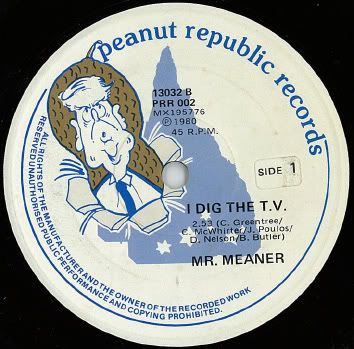
So today, in the interests of gender equality, we apply the old adage that what's good for La Femme is good for Mr Meaner (or something like that). The latter's sole single, the second and final release on Peanut Republic, delivers two slices of metallic grillfat in the vein of the Angels - palm-muted twin guitar riffing akimbo, and in I Dig The T.V., liberal use of our old mate the four-on-the-floor. What's missing is the Angels' melodic sense and knack for a hooky chorus. Still, the songs are carried by brisk tempos and energetic performances, and as metal-tinged pub-rock goes, the single has established itself as a keeper. We've presented the songs in the order determined by the single's matrix numbers as the A and B sides, but note that an alternative pressing exists which has stickers reversing the labels. This version has an EMI Custom catalogue number on the labels (in addition to the CBS number) with a corresponding matrix etching.
Mr Meaner were: Chris Greentree (vocals); Chris McWhirter (bass); Jim Poulos (drums); Brian Butler (guitar/vocals); and Dave Nelson (guitar). More from this line-up can be found on the That's Queensland compilation LP, released in 1980 by radio station 4IP (YPRX 1742), which includes the song Russian Roulette. Neil Coombe from Bad Habit joined the band after these recordings, but later line-ups weren't documented with vinyl releases.
June 2012 update: check out an article on Peanut Republic Records here.
In theory, Rose Tattoo and Lobby Loyde jamming out a tribute to the Hippie Love Weed* should be a stoner's wet dream. The reality is somewhat different; Realise Legalise's go-nowhere noodling is all leaf and stem, and - much like being dared to drink the bongwater - it'll leave you with a bad taste in your mouth. Fortunately, primo stoner grillfat is out there and findable if you have the right connections. Today, we open our secret stash.
Finch was active from 1973 to 1979, initially as Stillwater, then later as Contraband to avoid confusion with a similar ornithologically-inclined Dutch band. A number of releases document each phase throughout the '70s, but our focus here is on Finch's mid-period, a relatively brief window when three records were released on the band's own Eagle label. A debut LP, the well-regarded Thunderbird, appeared in May 1976, and was ushered in a month prior by a 45 with an album track as its A-side. Stay is not a bad song, highlighting the proggy tendencies noted elsewhere, but for Wallaby Beat purposes it's the non-LP B-side which delivers the goods.
Roses, an excellent sub-Quo dotted-rhythm crunch, first appeared in 1974 as one of three Finch contributions to the Drouyn soundtrack LP. The rawness of the original is appealing, but the re-recording showcases a more forceful performance from a band in its prime, captured perfectly by crisp and heavy production. Of course it's the lyrics, with their singular preoccupation and paranoia about the fuzz, which are the icing on the hash cookie. We can't vouch for the horticultural accuracy of the chorus, but there's no arguing the catchiness of its hook. And thankfully, the original's pre-solo declaration - one of grillfat's cooler exclamations this side of "Stick this in your fuse box" - is retained from the Drouyn version. Download it, pack it in your iCone, and get real, real gone for a change.
A second single from Finch's self-released era followed in December 1976 (Short Changed Again / One Nighter, Eagle ES 1002). Regular readers will know that we're as partial to the odd piece of long-haired misogyny as the next bogan, provided selves are not taken too seriously and sick riffage abounds. Alas, Short Changed Again falls at the first hurdle. Don't these dorks know that they'll keep getting cock-blocked until they learn to stop tripping over their own knuckles? As for the riffing, the song presages Finch's descent into mersh hard rock - decent enough, but proceedings would benefit greatly from knuckles and musical balls occupying adjacent real estate. Compared with Roses, you will certainly feel like you got less than you bargained for. A live version of the song, featured alongside AC/DC and Radio Birdman on 2JJ's Long Live The Evolution LP (AA9042, 1977), is included here for educational purposes only.
After the release of Short Changed Again, Finch moved south to Melbourne and embarked on a tour with Supernaut. Line-up reshuffles ensued, including guitarist Bob Spencer exiting for Skyhooks (and, eventually, the Angels), and Mark Evans, freshly ejected from AC/DC, joining the fold. The new-look Finch released the major label Nothing To Hide LP in 1978, along with a number of singles. There are a handful of passable songs on the LP (Nothing To Hide, Leave The Killing To You; both issued as 45s), but on the whole it's characterised by a lack of inspiration and tepid production. 1979 saw more rotations in the line-up, the name change to Contraband and a final LP which continued the downward trajectory. Grillfat ultra-nerds can keep themselves entertained with pressing variations on these records, but that's a level of It-Never-Ends mania beyond even us. We'll leave the grilling to you.
This biker band verges into punk territory with impressive results. One might think that there are lots of similar hard rock/punk crossovers from this period. There aren't.
For a country with such a strong track record in both kinds of music (punk and hard rock), Australian collisions of the genres were surprisingly rare. Yes, we have our proto-punkers; our pub, glam, and hard rockers who jumped ship; and our teen grillfat so amateurish as to achieve a punky edge. That's not what we mean. We're talking about wilful, artful combinations of punk and hard rock conventions, hybrids that have equal footing in both camps. Songs that can hold their own when viewed through the lens of either tradition. Though the opening quote was penned for Cleveland's Strychnine, it applies equally to anomalous Sydney Westies Invader, and their standing among the early Australian punkers. (It's just a happy accident that both play the Blame game).
In Don't Blame It On Me, the superficial trappings of genre cross-pollination are obvious - the Pistols' Submission re-routed through Marshall stacks. But if there's one characteristic that exemplifies the no-man's-land between punk and hard rock, it's the drumming. (If the mechanics of punk drumming make your eyes glaze over, you might want to skip ahead). Inherited from the likes of Slade, the four-on-the-floor drumbeat - in which every beat in the bar is accented by the kick drum - became a staple of Oz hard rock (check in here at around 1:55, or here at 4:13, or here whenever you damn please). At this tempo, it's usually accompanied by eighth-notes on the hi-hat - that's two hi-hat hits for each thump of the kick drum - propelling the song and, when played slightly behind the beat, making it "swing". Not here. Invader's four-on-the-floor lumbers instead of swings, delivering the sort of heavy-handed quarter-notes reserved by punk drummers for tempos of twice this speed and beyond. Ordinarily, a rhythm stripped of feel and pace is a bit like a gluten-free vegetarian pizza - what's the point? - but here it's perfect. Hey, true art ain't always pretty.
Don't Blame It On Me
For years, Invader was among the coldest of cold cases. Then, in October 2008, this website appeared out of the blue, prompting conniptions among collectors prone to daily Google searching. Suddenly, the mystery unravelled before our eyes. We'll hand over to Invader's Noel Thompson (guitar/vocals) to take us through the who/what/when/where/why:
Invader was a 3 piece outfit, the bass player was Jon Wilson and the drummer was Peter Borg. Jon played both a Rickenbacker and a Fender Precision bass and Peter, from memory played a Ludwig kit. I had a 1975 Gibson SG.
I hadn't played professionally in any band before Invader. I had auditioned for about 5 or 6 bands but none of them played the hard heavy stuff that I was interested in. I decided to form my own band. This was about 1978. I advertised in the newspaper for band members and got a response from Jon first. We both lived in the western suburbs of Sydney and so we joined up and then auditioned drummers and singers. We finally got Peter as the drummer who was an excellent fit for what we wanted to do. Singers were difficult and in the end I decided to take on the singing role myself. So the band eventually got up and going about late 1978, early 1979. We played around the pubs in Sydney and were particularly popular at two biker pubs. The bikers like their music hard and loud.
We recorded the single at Albert Studios in King Street Sydney on the [Australia Day long] weekend of January 24-25 1981. I wrote Don't Blame It On Me in 1979 and Anastasia in 1980. We were playing the songs live long before we hit the studio so we knew them backwards by the time we got to Albert's. The recording was done to try and attract some attention from the higher echelons of the recording industry. The record was a limited pressing of about 100 or 150, I can't recall the exact number. [The confirmed pressing size is 250 - Ed.] It was pressed at EMI. We sent them to many radio stations and music management companies. I have no idea which radio stations actually played the record but did hear that it got some airplay on the BBC in London.
I deliberately set out to write Don't Blame It On Me as a Sex Pistols style song. I really dug the Sex Pistols and all three of us liked our rock hard and heavy. Jon and I particularly liked and were influenced by Black Sabbath. Jon was a Geezer nut and I was an Iommi fan (hence the SG).
An old friend used to engage in a party game designed to test the wits of unsuspecting houseguests: ambush said visitor with a copy of Blue Öyster Cult’s Secret Treaties LP, and request the back-story to the before/after sketches on the front and back cover. Why does the plane's pilot bear a striking resemblance to Skeletor? Who and/or what is Lopez? How did Eric Bloom’s Alsatians meet their demise? And most importantly, how did five BÖCs, four dogs and a skeleton fit into a two-seater jet?
The back cover of Desert Rat’s Home From The Front LP presents a similar vehicular seating conundrum, but the real mystery concerns drummer John Drak. Who slammed his foot in the car door? And why? Perhaps, like most drummers, the guy just had it coming to him.
Though the sepia-tone image on Home From The Front’s inner-sleeve is reminiscent of Secret Treaties (substitute the plane with a tank), that’s where the similarities end. Yes, both bands peddle a brand of ‘70s hard rock, but Desert Rat’s is more leaden and less conceptual. That is to say, it’s kinda plodding and more than a little bit dumb. F’rinstance, Eric Bloom plans to steal your wife, pick your brain and spend your money; in Rock And Roll Lady, Desert Rat’s Jerome Speldewinde has already had his way with your wife, but rock and roll has made him so braindead he can’t even remember her name.
Desert Rat’s members had already been around the block a couple of times by the time of the LP’s release - guitarist John Moon and bass player Ian Ryan had both been in Buster Brown (with a pre-Rose Tattoo Angry Anderson and a pre-AC/DC Phil Rudd), among others. Though not featured in the line-up that recorded Home From The Front, Stephen Lazaros' tenure is also worthy of note. Lazaros had previously played with Wallaby Beat gap-fillers Lois Lane/The Benders, but more significantly, would later be re-christened as Smeer and feature prominently in Melbourne's hardcore punk scene as guitarist for Depression and drummer for Gash.
The level dumbness is fairly uniform across the LP, but there are moments that are less plodding than others, highlighted by side one's closing track, Take Me On. Home From The Front also spawned a single (Need Your Love / Reach For The Sky [Champagne CHS 603, 1978], both on the LP), the A side of which is presented below.
Need Your Love
Take Me On
"This will teach sir not to play 20 minute drum solos". SLAM!
As promised in our recent screed on Ipswich nogoodniks the Upsets, here's another barnstormer (literally!) from the same locale.
Like many bad habits, this one was formed as a product of teenage boredom - a 15 year old Neil Coombe (g) and buddies Paul Wilton (b,v) and Neal Ward (d) first began making a racket together in 1975. By 1977, after a couple of years of gigging (including a support slot for AC/DC at Brisbane's Festival Hall), Wilton had been replaced by Steve Arthurson (v,g) and John Pankof (b), and the expanded line-up retreated to a rural chicken barn to record Stormchild, Bad Habit's one and only LP.
An online bio of sorts fills gaps in the timeline and provides more detail about the recording of this LP, including the factoid that vocal takes were often ruined by the sound of gumnuts falling from an overhanging tree onto the barn's tin roof (from the sound of Arthurson's voice, those were the only dropped nuts in the vicinity of the vocal mic). It also promulgates some outrageous hyperbole about the record's punk-ness, the most noteworthy claim being that Stormchild was one of only two '70s Queensland-recorded punk LPs ((I'm) Stranded, of course, being the other). To our ears, the teenage amateurism and lo-fi recording herein certainly warrant the adjective "punky", but only as a qualifier to "hard rock". If these kids had heard the Sex Pistols, or ventured in to Corinda to catch The Saints, then it didn't osmose into their own efforts. Tsk tsk, TrippyHippy, if indeed that is your real name.
Punk rock or no, there is much to appreciate across Stormchild's ten tracks, which showcase a fairly advanced sense of composition for those so young. There are quieter passages and lengthier songs - all worthy, mind - but to comply with the Wallaby Beat remit we focus here on the most straight ahead rockers. The astute listener will note that all three songs plunder the same basic chord progression, yet each is distinct in its own right. To a degree, this is testament to the band's creativity in making the most of a limited palette, but the inventive lead work of guitarist Neil Coombe is deserving of particular credit. Coombe's playing runs the gamut from tasteful economy (the stellar dual lead interplay in Don't Touch) to tasteless bombast (see Burning Yearning, surely the most effective use of the chipmunk guitar solo this side of the Bob Seger System, and a WTF? moment that surpasses even our old friends Toxic), but is never anything less than great.
Neil Coombe himself is dismissive of Stormchild and his own contribution to the record:
"It's far from being my best work (I was 17) and I never know what to make of it...it was far down the track before I thought I did anything 'great'. It was my first album and I always dismiss it, but apparently there are some people out there who took to it...Truly bizarre".
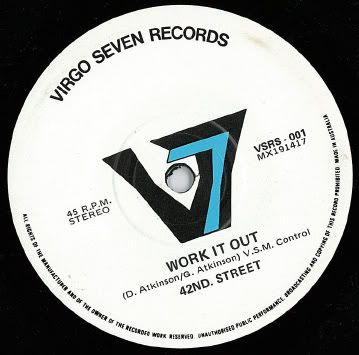
Coombe subsequently played with the likes of 42nd Street and Mr Meaner. Though both have their appeal, we respectfully disagree about their relative merits vis a vis Bad Habit (nothing personal - as a general rule, musicians are the last people we trust to appraise their own work).
Scum stats: either 250 or 300 copies (depending on who you ask) pressed through EMI Custom, but it's more elusive than contemporaneous records pressed in one third of that quantity. Where did all of those records go?
From delicate, fluttering insects to loud, lumbering mammals in the space of a week - talk about biodiversity. Befitting of a blog named Wallaby Beat, we're about to get all anthropomorphic-like.
The Tasmanian mock variety notwithstanding, Walrus is yet another example of an Australian hard rock band named after a non-native species (see also: Buffalo, Rabbit, Bengal Tigers). As anyone who has endured an episode of the Crocodile Hunter would know, Australia has a vast array of beasties capable of reducing your life expectancy, so we're not sure why the unpatriotic nomenclature held such sway (Steve Irwin would surely have approved of this exception). In the case of Walrus, it's possible that the appeal lay in a ready-made theme song, a cover of I Am The Walrus included on the band's lone 12". On the plus side, their version gives the song a tough HM arrangement and is surprisingly listenable. On the negative side, it's still a Beatles cover, so it doesn't appear here as a matter of general principle.
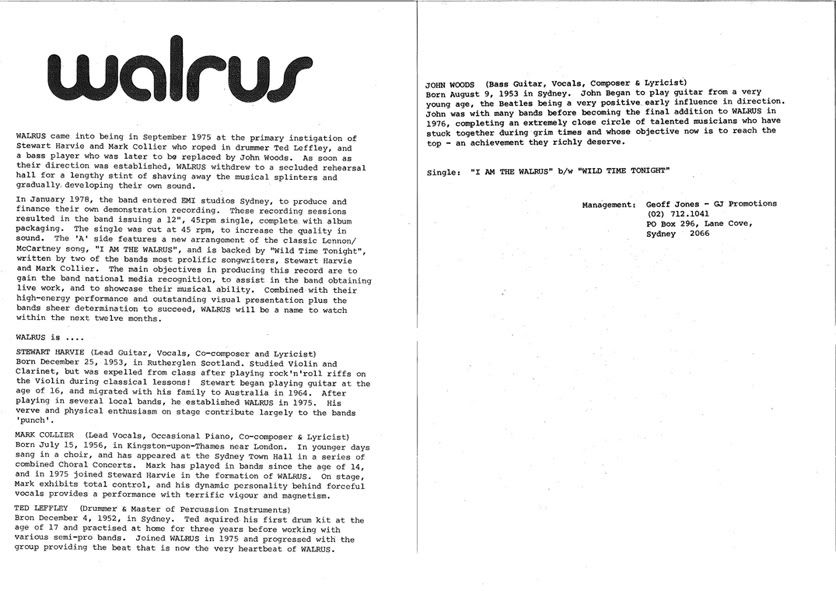
The 12" was recorded in January '78 and released mid-year (three years after Walrus formed in Sydney's western suburbs - click here to read more biographical details in the band's own words). The recording date is remarkable given the musical approach of the standout track, Wild Time Tonight. The tempo, double-tracked guitar riffing, and overall attack are nothing short of NWOB(A?)HM a whole year before the genre's defining bands made it to vinyl in the UK. Add a second kick drum and we're in territory mined by Jaguar three years hence. We can only assume our Westie hairfarmers were dialled in to the same Budgie tunes (Breaking All The House Rules..., especially) as their limey counterparts, and were possessed of the same impulse to trim the fat and hit the accelerator.
Walrus, Jaguar, Budgie...it's like a fuckin' zoo in here.
Props are also due to the band for dispensing with pragmatism and opting for the 12" format, a decision that clearly enhances the power of the tunes. Spread out over a whole 12" side, Wild Time Tonight hits like a brick to the erogenous zone - reason enough to consider the supplied mp3 a placeholder until you chase down the vinyl. Largely used as a promotional tool, copies sometimes surface with the aforementioned bio and/or the promo photo pictured below.
Though there were no more official releases, a number of other recordings exist which confirm that Wild Time Tonight was something of a one-off - the remainder of the band's repertoire tended towards sluggish hard rock, without the personality or taut execution evident here. With a change of name to The Lads around 1980, the band remained active to varying degrees throughout the following decade (mainly confined to the western Sydney pub circuit, including one memorable afternoon gig at the Viking Tavern on September 2, 1984), but never did reach the level of like-minded long-hairs Boss or Heaven. Or Finch.
Wild Time Tonight
Photographic evidence against the bio's claim of "a lengthy stint of shaving". Seconds after this pic was taken, vocalist Mark Collier deployed his chute.
Think you know a lot about Australian records in the punk era? We promise to astonish you with stuff off everybody's radar. We apply quality control so our powerpop has power, our glam has prominent balls, our punk is spiky and our DIY is far, far out there. We'll also do it-never-ends exposés of sleeve variations and inserts you didn't know existed. Strap yourself in and enjoy the ride.