Showing posts with label Brisbane. Show all posts

Saturday, 1 February 2014

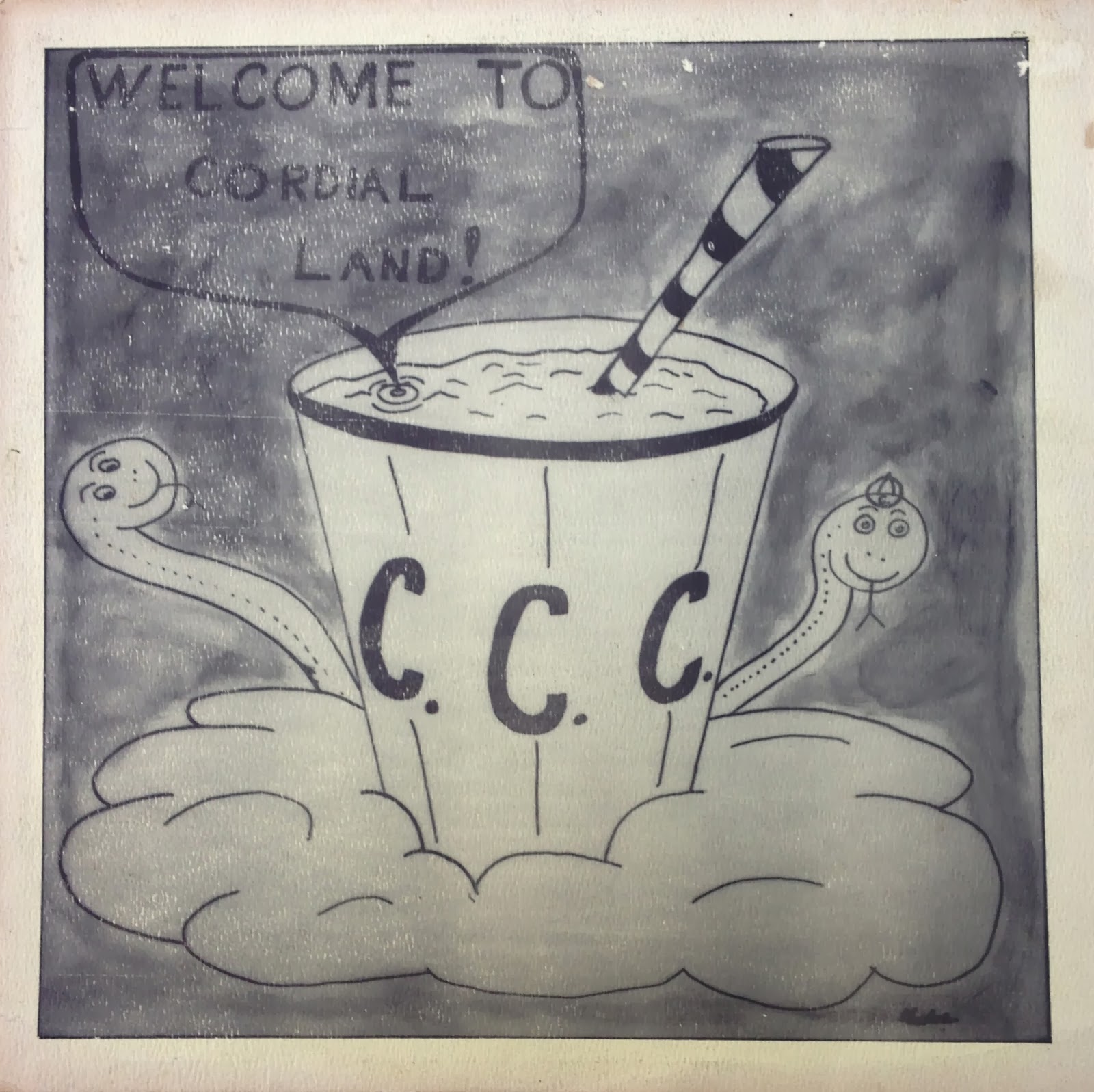
C. C. C. - Welcome To Cordial Land LP Starlight, 1976

So what else was happening in Brisbane in 1976? Apart from the unusual score in the Grand Final, orthodoxy says not much and we’re pretty sure that this time it’s right. If you couldn’t stomach 4IP approved cover bands, country, bluegrass or blues then you’d have been making a beeline for Club ‘76 with the rest of the uplifting gourmandisers.

But what’s this? Coming out of the upper levels of the Penney’s Building at 210 Queen Street (now in the mall), the CCC Band released this obscure LP in yes, 1976.

We’ve long been dubious about a Brisbane Sound – a twee, thin shouldered, short-sleeved shirt and short-wearing light pop. Sure, post ’83 there was a bunch of bands that could be viewed as having taken the Go-Betweens ball and run with it (to use a completely non-apt sporting analogy) – Let's Go Naked, Leap In The Dark, Birds Of Tin, Antic Frantic, Dog Fish Cat Bird, Too Green For Summer, Tangled Shoelaces and others. But prior to that the sounds of Brisbane were way too varied for us to find much of a common denominator (world class punk rock aside).  The Striped Sunlight Sound of the first two Go-betweens always seemed a one-off.

CCC though, at least on parts of their LP, showcase a lethargic, sun-affected whimsy that makes us at least reconsider our stance. Songs about cordial, the Golden Circle cannery (which every Brisbane schoolchild visited at least once), lollies and other childhood signposts make us wonder if those mid-80s era bands were actually riffing off copies of this record found at op-shops rather than Send Me A Lullabye and Before Hollywood. Probably not.

Elsewhere on the album there’s some fairly dire electric blues, and some aimless jamming but the charming faux-innocence means it’s mostly likeable. Faux? Well, Eating Snakes is clearly about fellatio. We’ve picked our favourite tracks below. If we’re really stretching our long bow we could posit Lemon Tree, which appeared on the Left Of The Middle cassette, as early minimal synth.


We once thought CCC were one of those bands who had a Department of Education gig touring schools and playing shows. Doing it for the kids, literally. But we can’t actually find any evidence of that, or of anything really. For now P. Richardson, D. Brown, G. Peters and T. Mullooly remain obscure.

Captain Cordial Rock [Download]


Eating Snakes [Download]


Lemon Tree [Download]

Sunday, 11 August 2013

It Never Ends: The Numbers and The Riptides - Sunset Strip 7" Able AB-003 and AB-004, 1978, 1979

One of the finest Australian records of the punk era is this 'un, Sunset Strip by The Numbers. There seems to be some latter day criticism by wooden ears that this is too poppy or sixties influenced. Those critics should take off the dunce cap and listen again - the pace is definitively 1978, the vocals disaffected, and the band smashing into each other in a completely endearing fashion. If you were born on Mars and haven't heard it you'll know straight away it's from Brisbane courtesy of the handclap solo - all the Briso bands feature 'em. Since this is an it-never-ends feature we're duty bound to point out the film like card the boys used for the sleeve and the miniscule chance of finding one without ringwear at this late stage. After a few decades we found the one above which had been stored separate to the record. It still shows a visible scratch though, ugh.


At some point word filtered in from down south about another Numbers and the band decided to change their name. This was not a major problem as they had already used and discarded The Grudge and Neon Steal (rumours persist of recordings from this version of the band). The Riptides were born. The Numbers single had been taken to Melbourne and Sydney by Robert Vickers and had been well received, so first point of business was to reissue the record under the new name. 
 

There's been much supposition over the years as to whether this version is re-recorded, remixed or simply remastered. Starting with the easy ones even the tinniest of tinnitus affected ears can hear the recording is the same. Remastered is a yes - The Numbers has a DB matrix scratch indicating Don Bartley at Studio 301 in Sydney. He captured the energy well. The Riptides version is an EMI Custom pressing plant job - new plates and a softer mastering job. Which leaves remixed. After some intense A/B-ing plus study of the waveforms we're gonna say yes. You can compare below but at the very least the hi-hats are way more prominent on the Numbers version. Mark Callaghan explained in Andrew Stafford's Pig City:
The main difference with the remix was we turned off Dennis’ hi-hat microphone, because at that stage he didn’t realise you were supposed to clamp the hat down when you did a drum roll, so you have the cymbals spilling out over everything!
Once again the band went with easily scratched glossy stock and even with 2000 pressed finding one without ringwear is a frustrating exercise. Bomp took 300 copies so our American readers should be well placed. Ours above still has the slightest hint, ugh. After the band moved to Sydney the last few copies were sold through stores there with the stamped sleeve below, a nice piece of it-never-ends to end with.

Well not quite - don't neglect the two b-side tracks! 

Sunset Strip [Download]


Magic Castle [Download]


Rules Of Love [Download]


Sunset Strip (Riptides) [Download]


In case you haven't seen it - the video. Handclaps at 2:26.

Sunday, 2 June 2013

Leap In The Dark - Samurai 7" Sundown SUN 0087, 1984

It was about 10 years back - a heady time when people actually read music blogs - that Dave Lang coined the useful phrase "record-collector-rock". Back then, he used the concept to mean music that is "drool fodder for collector/obsessive dorks: you know, not the kind of music 'regular' folk buy" (or more succinctly, records that are "good to show off but not to listen to"). What he didn't anticipate was the emergence of "meta-record-collector-rock": music made by record collectors, released by record collectors, for a target audience largely made up of record collectors. It's not exactly news that there is overlap in the collector/musician Venn diagram, but that kind of closed cultural feedback loop is a relatively recent phenomenon, right? Hmm, what of the Australian punk collector who, in 1983, created a limited edition of his own band's record with a cover directly referencing the Victims' handpainted 7" EP? What could possibly be the point, other than to amuse said collector and appeal to the OCD of similarly afflicted obsessives? Three decades later, that party trick has worked a treat - the self-aware tribute is even tougher to find than the Victims' original.

We'll come to the Victims EP and its simulacrum in due course, but what intrigues us today is the "anti-meta-record-collector-rock" of the Leap In the Dark 7". Vocalist Mark Overett was a year-zero participant in the Brisbane punk scene, documenting future legends in real time in his fanzine, Fad. These days, Overett is a self-described "anoraky guy who collects Aussie punk records 1976-1981". We applaud the tightness of those parameters, but dig the recording dates of Overett's own work - December 1983 to January 1984! Talk about hiding your light under a bushel. Luckily for Mark, others find worth in music made outside the classic '76-'81 timeframe - Samurai is a neat, punky powerpop track, and yet another example of the endearing tweeness that pervades many a Brisbane record from the Go Betweens on. The EP's two remaining tracks sit at opposing extremes of the tweeness spectrum, and are less endearing as a result. Other band members were Wayne Harvey (drums), Bob Reeves (guitar), and Adrian Mengede (bass).

Samurai [Download]

Sunday, 26 May 2013

The End - My Confession 7" 13199, 1981

The Gap is a suburb in Western Brisbane named after the hole in its inhabitants' aesthetic sensibilities. It takes just one person to break the cycle and that person was Gap High student and guitarist, Brett Myers.
I used to play bass in high school bands. The End started in late 1979, I had just bought my first electric guitar.  I had a friend called Andrew Massey who was a bass player and he lived in my street. He came over and asked me if I wanted to join a band. I said as long as it wasn't with the guy down the road. I used to hear him playing Led Zeppelin songs!
The guy was drummer Colin Barwick, who with Massey on bass and Murray Davis on keyboards formed the first line-up of The End. Barwick was re-educated. Myers :
I wasn't into jamming, so to play anything I had to teach them all these Velvets songs. We played lots of parties, but we'd finish an average of about one song out of ten. It was a real thrash but it was coming from a different direction to everyone else. In those days no one was playing the sort of music I liked. If there had been another band playing it, I probably wouldn't have started.
In the end though, there was.
We used to do a lot of Stooges stuff as well, and New York Dolls. Then I saw the Fun Things and they were doing that stuff really well, so we stopped.
The new, "wimpy" End, started exploring space and dynamics rather than power. In most cases such a development would have us running fast in the other direction, but if there was one guitar player whose non-obvious choices we enjoyed the challenge of watching through the eighties, it was Mr Myers. The End took on Malcolm Cole on violin and keyboards, and swapped Massey for Johnathon Liekliter on bass. Their only single is a sometimes tentative, sometimes assured venture. We like its indirectness, though will champion their more powerful tracks like Birthday Boy, which saw release on a posthumous cassette that Citadel were due to issue on CD last decade before the arse wore out of the pants of the reissue market.

The End moved to Sydney and Myers got together with Ron Peno in Died Pretty. With Peno he could marry more direct rock and roll (and shred with the best of them, 2:42 on), with his more delicate sensibilities.

My Confession [Download]


White World [Download]


Thanks to X-change #4 (1981), and DNA #49 (1986) for the quotes.

October 2013 Update The long promised CD on Citadel is now out. It's not exactly the Hot cassette but it looks great, and Birthday Boy is disc 1 track 1. Buy it here.


Sunday, 31 March 2013

The Screaming Tribesmen 7" EMI Custom 13349, 1982


Mick Medew had been playing in a blues band in Brisbane in the late seventies when he met New South Welshman Ronald S. Peno, who had moved to Brisbane in late 1979 at the behest of Bruce Anthon of the Survivors. The aim was to audition for The Credits, but the first rehearsal didn't work out so Peno hooked up with Tony Robertson and they grabbed Medew and eventually Chris Welsh to form the 31st. The 31st married Peno's interest in midwest and New York American rock with Medew's love for '60s punk, via a common interest in Radio Birdman and The Hitmen.

The 31st played for about a year and here it gets complicated, so hold on tight: Brad Shepherd (ex-Fun Things but at this stage post-The Aliens' final line-up) joined briefly before he and then Robertson decamped to The Hitmen. Michael O'Connor from The Apartments joined on bass and the band played a few gigs around August 1981 as Died Pretty. Peno and Medew then grabbed the rhythm section of the Fun Things and The Aliens, John Hartley and Murray Shepherd, and became The Screaming Tribesmen for a small number of shows in December 1981.

So if you learn nothing else today it's that Mick Medew was in Died Pretty and Ron Peno was in the Screaming Tribesmen. Hopefully there's a rock'n'roll pub trivia near you that you can ace with that piece of science.

Peno returned to Sydney at the end of 1981 and the "classic" three piece line-up of the Screaming Tribesmen played around Brisbane with occasional forays to Sydney up until mid-1983, recast as more of a classic '60s punk sounding band. Like other Brisbane garage bands they covered then quite obscure Australian garage - The Missing Links' Some Kinda Fun and the Black Diamonds' See The Way. American songs covered included The Starfires' I Never Loved Her, the contemporaneous Vertebrats' Left In The Dark (from Bomp's Battle Of The Garages LP), and a couple of soul songs as reinvented by the Human Beinz - The Isley Brothers' Nobody But Me and Bobby Blue Bland's Turn On Your Lovelight. The set was rounded out with originals and songs from the 31st. A live set from the time can be heard on Citadel's The Savage Beat CD.

During March 1982 the band recorded four songs at a jingle studio, Speak. In interviews from the time the band bemoaned the fact that there weren't any studios in Brisbane that could capture their sound. I guess Mungo Coats had shut up shop by this point. The sound is pretty thin, and when you hear the massive sound achieved for the next single, Igloo, recorded over 48 hours at Trafalgar in Sydney, you can sympathise with the band somewhat. 500 copies were pressed by EMI Custom and quickly sold out.

I Don't Wanna Know [Download]


Lookin' On [Download]


Love Lite [Download]


Trans 43 [Download]


Sunday, 21 October 2012

Mystery Of Sixes - Skull In My Cave 7" EP Sundown SUN 0045, 1983

Mystery Of Sixes seem to have more rumour and misinformation floating around about them than just about any other band of the era we can think of. Some of the stories are even true. Formed in 1980, with dreams of supporting Razar (who had already split...), the band's first recording, Azaria, was officially banned from airplay by the Australian Broadcasting Tribunal as the Chamberlain case was still sub judice. There's tales of being on the receiving end of bashings and being shot at, both true.

Perhaps the dominant tale of their time was when they were accused of stealing a PA system. Rumours abounded that it was wrapped in plastic and buried in a band member's backyard. The band were subsequently blackballed in Brisbane - 4ZZZ wouldn't play their first single, shops wouldn't sell it (though Skinny's stood by them) and venues wouldn't let them play. Eventually, according to Out Of The Unknown magazine, three other blokes were charged with the theft. With everyone happy again the band was back on ZZZ. Well, no one else was going to play them. To round things off, when the ban on Azaria was finally lifted in 1986, ZZZ made a special point of playing it.

The bans fuelled the song Black Banned on the band's second record, a four track EP from 1983. The record highlights the unique sound of the band, with its complex and jazzy (without getting overly technical) structures setting them apart from other bands from the time. While such a sound would not have been out of place on SST, we need to put to rest one final rumour that has persisted - the EP never came out on Alternative Tentacles, even if the band did slip a copy to Jello when the DKs were in Brisbane. Grong Grong, Hack and The Hard-Ons remain the only Australian bands on Alt Tent.

I Don't Know You [Download]


Skull In My Cave [Download]


Black Banned [Download]


Something Mechanical [Download]

Sunday, 12 August 2012

The Bent Elbows - St. Lucia Road 7" EMI Custom 13152, 1981


Wrong, wrong, wrong. We try to make a habit of not being wrong, but sometimes the mistake was made long ago. This one hurts because I owned this record in the early '80s and purged it almost immediately, deeming the band too suburban, too MMM, too rocky. Ugh, how wrong could I have been.

Fast forward thirty years and a copy of this showed up in an online auction out of all places, Midwest America. Oh no, I thought, another pissweak record being pimped as KBD. But the listing had sound clips and over the next ten or so minutes, well, that's when my walls really started to crumble. Behind rocky vocals is a band coming across like a Brisbane powerpop band, the aesthetic choices being highlighted by short, tight guitar solos, and lyrics about the ups and downs of drinking and enjoying your youth.

Apart from the good time feel what I really like about this record is the stripped back production. Although these guys were aiming to be Oz Rock stars, in the studio their sound was like any other mid-fi inner city sound recording, relying on feel and not modern studio trickery. Given the antiseptic sounds of so many similar bands from the era who "made it", we're left with a what-could-have-been reaction to the whole genre. Bent Elbows, maybe with the aid of the credited "alcoholic adviser", got it right.

So to the songs: St Lucia Road is about the band's home, the road leading from Toowong out to the University Of Queensland at St Lucia, and now renamed Sir Fred Schonell Drive. References are also made to another local landmark, Hawken Drive, Rec week (the first week of the University year), and not dropping out before 4ZZZ's third Joint Effort; Free-way Connection is about joining your friends for a piss-up down the South coast; the plaintive Scoring Sugar is an ambivalent drug song; and the probable highlight - Chip On The Shoulder Boy, the great Queenslander affliction writ small. Here the protagonist is picking fights at the R.E. (Royal Exchange Hotel at Toowong), talking big while on the sauce - one great line "Woodstock is over, throw your beads away".

Band history here.

Knock the top off a cold one, bend your elbow and have a listen.

St Lucia Road [Download]


Free-way Connection [Download]


Scoring Sugar [Download]


Chip On The Shoulder Boy [Download]

Sunday, 17 June 2012

Eleven Eleven - Devastate Me 7" MAC Records J031/S, 1983

Here's a surprise. An Ed Ball-esque mod-pop 7" hailing from Brisbane in 1983. I knew the band and the 7" existed but never picked it up. It took borntobepunched's recent virgin trip to the Sunshine State, and his unjaundiced ear, to open my eyes to this one.  I lived through the Brisbane equivalent to the Paisley Underground  and while it had its moments, it seemed the kicks were harder to find compared to the punk stuff the city is rightly famous for. I was wr-wr-wr-wr-wrong, and it wasn't the only local record I misjudged badly, as we'll find out later in the year.

The hit is the B-side, (Machismo For) What We Need. Sure, the song title is as clumsy as they come, but the tune is great! Starting with guitar stabs, it launches into a critique of materialism over a really good piece of Anglo-pop. That's not to deny the A-side: a plaintive, disaffected love song with gurgling bass lines and clunky solo. We'd prefer power pop to have straight ahead punk guitars but, when it's done well, we'll take this dainty, priggish, tight-laced substitute any day.

So who was Eleven Eleven? We were intrigued too, so we visited the musty Paisley wing of the archives and found a manila folder with some gig flyers and a photo (see below). Turns out there's an Ipswich connection! A while ago, when discussing the Toy Watches, we mentioned The Colours, whose song Blue Shirt is etched in the memories of those who were there. It turns out one of them continued to write great songs in his next band. Stand up Mitchell Kunde, on guitar and vocals. Andrew Palmer on rhythm was also in The Colours. Dale Jones on bass and Scott Austin on drums rounded out the lineup. Eleven Eleven played from 1983 to 1985 before half the band rebranded as The Nasties.

(Machismo For) What We Need [Download]

Devastate Me [Download]


Debut performance: midnight shift at the New Exchange
"What we need is a new hairdresser..."

Sunday, 18 March 2012

JFK & The Cuban Crisis - Am I A Pagan? 7" Two Possibilities 13274, 1981


We've spoken before about the relative placement of the powerpop protagonist and the distant object of their desire. John (Francis) Kennedy was unable to lift himself from worshipping the ground upon which his gal walked, thus prompting his question to himself in the song title, which we've always shortened to Am I Pagan?

Kennedy was a bouff-haired (but, unfortunately, not boof-headed) popster who plied a trade in earnest Elvis Costello influenced pop in Brisbane from 1980 to 1982. The vehicle was his first band, JFK and the Cuban Crisis, with school friend James Paterson. Paterson, in a contemporary piece in X-Change fanzine, pitched the band as inhabiting a space in Brisbane between "new wave jukeboxes and arty, underground bands". Talk about missing the point, or at the very least, placing yourself on the wrong side of history.

Their first release was a cassette called Over The Underpass + Under The Overpass... (hear a version of Juliet Jones from that here). Then there was this. All mealy-mouthed piss-taking aside, we're featuring it because the song is good. Tight, clipped rhythms from drummer Steven Pritchard and bassist John E. Xero's typical musical bass playing underpin a good melody. Kennedy's voice is a bit of an acquired taste but again, the song is good enough to look past that. Perhaps somewhat unusually the verse slightly outshines the chorus, musically but also aided by the notion that in the verses he's putting up a fight, before the slightly downer profession of loserdom in the chorus.

Following this the band, or at least Kennedy and Paterson, moved to Sydney. While we can muster a slight endorsement for the Careless Talk Costs Lives 7" on Waterfront (1982) after that you're firmly on your own.

Am I A Pagan? [Download]

Sunday, 22 January 2012

Mr Meaner - Ripped Off Again / I Dig the T.V. 7" Peanut Republic PRR 002, 1980

We try to approach our work here with something approximating scientific rigour. It's an approach which clearly also informed The Professor's earlier research at the Australian Punk Discography. Budding practitioners of the scientific method will note that the Discography follows the general format of a peer-reviewed academic publication: Introduction, Methods, a series of Results paired with Conclusions, and a Reference List for good measure. Indeed, it is "in the interests of Science" that The Prof subjected himself to the "metal-tinged pub-rock" of La Femme. Why? Because a credible source once described them as "punk", of course. Hypotheses are there to be tested.

Like the eligibility criteria for a randomised controlled trial, the Discography's Methods section establishes the scope for inquiry. It is from the list of exclusions that scholars of that work are likely to be familiar with Brisbane's Mr Meaner, a band ignored for being "so...unpunk that they don't deserve comment". But wait! What was that about metal-tinged pub-rock? Loose application of the description "punk"? Check! And check! It seems that the peer-reviewers at Collectorscum.com were on the bong the day The Prof submitted his manuscript, as that methodological inconsistency has remained unchallenged.

So today, in the interests of gender equality, we apply the old adage that what's good for La Femme is good for Mr Meaner (or something like that). The latter's sole single, the second and final release on Peanut Republic, delivers two slices of metallic grillfat in the vein of the Angels - palm-muted twin guitar riffing akimbo, and in I Dig The T.V., liberal use of our old mate the four-on-the-floor. What's missing is the Angels' melodic sense and knack for a hooky chorus. Still, the songs are carried by brisk tempos and energetic performances, and as metal-tinged pub-rock goes, the single has established itself as a keeper. We've presented the songs in the order determined by the single's matrix numbers as the A and B sides, but note that an alternative pressing exists which has stickers reversing the labels. This version has an EMI Custom catalogue number on the labels (in addition to the CBS number) with a corresponding matrix etching.

Mr Meaner were: Chris Greentree (vocals); Chris McWhirter (bass); Jim Poulos (drums); Brian Butler (guitar/vocals); and Dave Nelson (guitar). More from this line-up can be found on the That's Queensland compilation LP, released in 1980 by radio station 4IP (YPRX 1742), which includes the song Russian Roulette. Neil Coombe from Bad Habit joined the band after these recordings, but later line-ups weren't documented with vinyl releases.

June 2012 update: check out an article on Peanut Republic Records here.

Ripped Off Again [Download]


I Dig The T.V. [Download]


Alternative (second?) pressing with EMI Custom catalogue number and stickers on the labels.

What's seen cannot be unseen.

Sunday, 13 November 2011

It Never Ends: Everybody Loves Just Urbain 7" Shake SM4 (PRS-2815), 1980


Here's another it-never-ends which is guaranteed to send OCD collectors polishing doorknobs in their record cribs over, and over, and over again. Actually we toyed with starting a new tag, it-never-starts, for this one because just finding a copy, let alone one with a sleeve, any sleeve, is a conviction-challenging conundrum facing many an Aussie completist. What we're looking at today is the second record by Briso punks Just Urbain. Released in 1980 as part of the second batch of Savage/Shake 7"s, it appeared in a mind-bending brace with the also amazing second Young Identities 7", New Trends.

This is a great record and one well worth the time and effort to track down. One thing that sets it apart is Rod McLeod's filthy guitar sound running through all three tracks. A feature which has only really hit us recently is John K's belting piano on The End - probably the same set of crazy 88s used on the Fun Things EP, which was recorded at the same North Coast hinterland studio. Singer Peter Miller's lyrics are always interesting - sometimes reflecting on darker topics (here, failed suicide (on Hospital Bed), and capital punishment on the first Just Urbain record), and other times adolescent railing against the trend following Brisbane music scene (Everybody Loves).

What you see up above is how we think the first batch of copies appeared: naked, no band name. The front silk screened picture is glued to the inner bag as is the classic JU symbol rear sleeve (right), thus making a standard, two-sided, pocket picture sleeve inside which the record sits. Remember you can click on any of our pictures for full size versions.

Hand-numbered inserts should appear in all copies. As it says on the insert - 200 copies. The CD reissue says 300 and we've never got a straight answer on the actual amount.

Insert, "Your number" is in pen on originals.

We've had a few copies of this record cross the Wallaby Beat desk over the years and noticed there was a batch of copies with a somewhat differently constructed set up. These ones start by having the EP name (and thus band name) written on the front sleeve in highlighter pen. Highlighter pens had been around since 1963 but got a kick along in 1978 when fluorescent inks were introduced. There's a fluorescent yellow variation to a Victims sleeve, but, uh, we'll get to that. Anyway, we think these are later versions as they answer the question obviously worrying the Savage/Shake executives - how do you sell a record with no band name anywhere?


This time the front part of the sleeve stands alone as a one-piece, single sided print. These copies also have the insert pictured above (albeit with higher numbers), but also have another mini-insert repeating some of the information. Again, this mini-insert helpfully has the name of the EP and the track titles, thus ensuring mega-sales around Brisbane, and the world, or not. Here's how the rest of the sleeve works - the red and black silk screened JU symbol sheet sits inside the die cut inner sleeve so the JU appears through the die cut label hole. Then the little mini-insert slides in horizontally below the hole. Clever! Here's how it should look:


Phew, landed both of those variations. Mission accomplished. Then things like this appear in the mailbox, with penwork (allegedly) by Peter Miller:


The tracks on Everybody Loves can these days be heard in two places. First track down the Shakedown CD released by Dropkick (BEHIND022). This compiles the entire output of Savage/Shake and also features two great sets of liner notes by Rod McLeod and drummer Dave Holliday. A slightly different version of Dave's piece can be found at the essential Break My Face Just Urbain page. Secondly, 540 Records from Austin, TX, is reissuing all the Shake/Savage gear on 7"s, with awesome photos inside the gatefold sleeves and nice, clean mastering from the CD versions. Everybody Loves is available as we speak, late 2011.

Which brings us to today's track. As told to us over the years some kind of mistake was made when the tapes were sent down to EMI Custom in Sydney and an unedited version of Everybody Loves (the song) made it on to the original EP. The wailing guitar goes on for nearly a full four minutes and the song unnecessarily repeats a verse towards the end. The Dropkick and 540 releases have a 2 minute 40 second version which is how the band would have liked it to originally appear. We're not arguing with the band's preference for the shorter version but thought you'd like to hear it all:

Everybody Loves (1980 edit) [Download]


Everybody loves.... hunting thylacines.