So what else was happening in Brisbane in
1976? Apart from the unusual score in the Grand Final, orthodoxy says not much
and we’re pretty sure that this time it’s right. If you couldn’t stomach 4IP
approved cover bands, country, bluegrass or blues then you’d have been making a
beeline for Club ‘76 with the rest of the uplifting gourmandisers.
But what’s this? Coming out of the upper
levels of the Penney’s Building at 210 Queen Street (now in the mall), the CCC
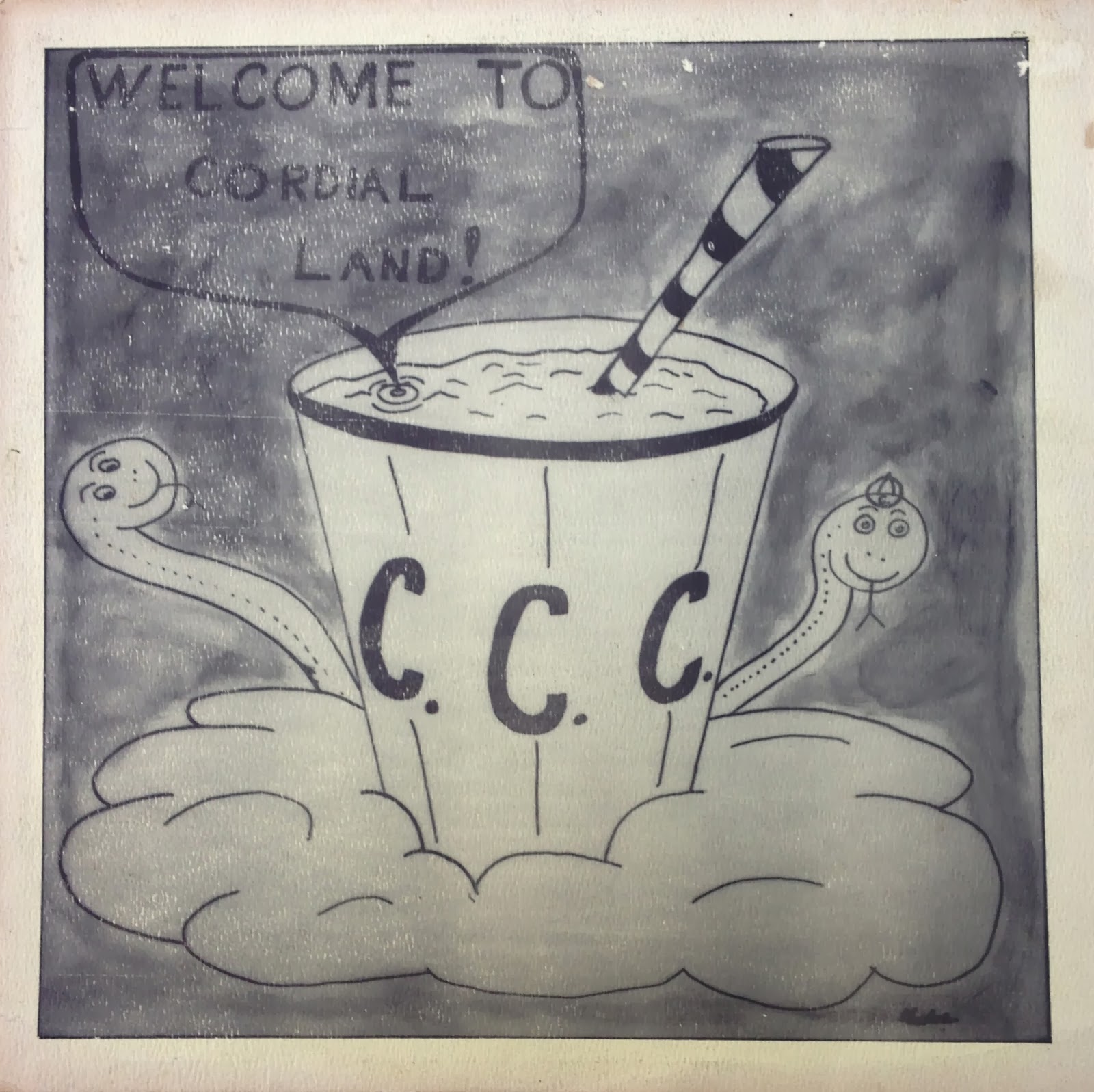
Band released this obscure LP in yes, 1976.
We’ve long been dubious about a Brisbane
Sound – a twee, thin shouldered, short-sleeved shirt and short-wearing light
pop. Sure, post ’83 there was a bunch of bands that could be viewed as having
taken the Go-Betweens ball and run with it (to use a completely non-apt
sporting analogy) – Let's Go Naked, Leap In The Dark, Birds Of Tin, Antic Frantic, Dog Fish Cat Bird, Too Green
For Summer, Tangled Shoelaces and others. But prior to that the sounds of
Brisbane were way too varied for us to find much of a common denominator (world
class punk rock aside). The Striped
Sunlight Sound of the first two Go-betweens always seemed a one-off.
CCC though, at least on parts of their LP, showcase
a lethargic, sun-affected whimsy that makes us at least reconsider our stance.
Songs about cordial, the Golden Circle cannery (which every Brisbane
schoolchild visited at least once), lollies and other childhood signposts make
us wonder if those mid-80s era bands were actually riffing off copies of this
record found at op-shops rather than Send Me A Lullabye and Before Hollywood.
Probably not.
Elsewhere on the album there’s some fairly
dire electric blues, and some aimless jamming but the charming faux-innocence
means it’s mostly likeable. Faux? Well, Eating Snakes is clearly about
fellatio. We’ve picked our favourite tracks below. If we’re really stretching
our long bow we could posit Lemon Tree, which appeared on the Left Of The Middle cassette, as early minimal synth.
We once thought CCC were one of those bands
who had a Department of Education gig touring schools and playing shows. Doing
it for the kids, literally. But we can’t actually find any evidence of that, or
of anything really. For now P. Richardson, D. Brown, G. Peters and T. Mullooly
remain obscure.
Along with such weighty topics as which of the 2013 fake Black Flags is the best (answer: this one), grillfat as a cultural touchstone is a subject close to our hearts, meaning that we're prone to running our mouths. It was on one of those grill-advised rants that we speculated that grillfat would be an unlikely candidate for KBD-style comp-age, given that grilldom is primarily the domain of the dollar bin ripper. So when we got wind of a boot being compiled from - where else? - The Boot, we thought we'd have to eat our words. Yes, contrary to predictions, Killed By Grillfat now exists (well, kinda. It's a Sharpie comp, so forgivably a few selections stray from the brief). But it turns out that even when we're wrong, we're right - at least half of the comp's track listing can be found languishing in dollar bins country-wide.
In that spirit, today we bring you a bang-for-your-buck grillfat knuckle-dragger, a relatively easy find for the tightwad digger. From their beginnings as the Bootleg Family Band, to their final single as Front Page and almost all of the Avalanche records in between, this band's output is uniformly turdly. The lone exception is Sweet Baby Brown Eyes, the second Avalanche single and a genuine butt-kicker. Lyrics about brown eyes are treacherous waters - was it really kicking that was on their minds? - but Avalanche navigate that minefield and emerge pretty much unscathed, leaving behind a song that is up there with the best of Fat Daddy and Taste in the Bootleg label discography.
The scuttlebutt is that other Killed By Grillfat comps are in the works, at least one of which promises to delve beyond the dollar bin into the realm of obscuro Australian hard rock mind-melters. Never have we so much looked forward to being 100% wrong.
Once again, we raid our secret stash and invite you to mull over this offering from the wastoids of Newcastle's Kiss Army. By their own admission, Strutter barely set foot out of bed in the morning before hitting the bong, so its a minor miracle that their creative energies were channeled more productively than the foot soldiers down the New England Highway, and with more sincerity than the Section 8 even further south. Unfortunately, motivation ran dry before the important matter of punctuation was dealt with. Perhaps they should have asked to borrow an apostrophe from the So+So's.
Mary Janes Rainbow World celebrates the time honoured tradition of getting baked outta one's gourd with Kiss on the turntable. Hats are doffed to Ace Frehley and his "lead guitar from outer space"; synaesthesia ensues. Yup, Mary Jane - Strutter know a couple of things about her. The riffing's tough and the drumming is simple and pounding, so the lads know a thing or two about rock and roll as well. They're even happy to tell us as much on the flip, but can't help doing so by paraphrasing the title of Kiss' Rock and Roll Over LP.
The Newcastle Bands Database has some basic information about band membership fragmented across a few different pages, some of it contradictory, but hey, it's not like our research has been able to clarify things. However, we can say definitively that this record dates from 1976 rather than the earlier timeframe referenced; 500 were pressed, but we've seen just a single copy over a ten year search. Mary Janes Rainbow World [Download]
Band forms; songs are written; band members part company; songs migrate to new band, usually - but not always - via the songwriter. It can be an interesting test of a song's mettle, not to mention the songwriter's. Will a drive to out-do former bandmates take things to a new level? Will lightning refuse to strike twice? Will it be the same, but different? Will it be different, but the same? Will the situation turn grown men into giant titty-babies? This week we turn our attention to an interesting dead-end of Australian powerpop, a hand-me-down by the name of The Big Beat which had remarkable longevity, bouncing between Adelaide, Melbourne and Sydney in the latter half of the '70s. Before going on, we note that much of the detail below comes from Dave Laing's excellent liner notes for the reissued Young Modern LP (buy it here), and his accompanying interview with John Dowler at the I-94 Bar. We've referred readers to the latter at least once before for context on Melbourne pub rock; consider this another nudge if you didn't take the hint the first time around.
Spare Change allegedly formed, at least in concept, among Adelaide ex-pats in Amsterdam. Back in Adelaide, the band coalesced in 1973 as a pre-punk powerpop unit, as much in thrall to the MC5 and the Flamin' Groovies as the art rock of Sparks, songs by all of which featured in the band's early repertoire. The initial line-up included John Dowler (vocals), Chris Langman (guitar), Bob Kretschmer (guitar), Tony Murray (keyboards), and John Wilkenson (drums). Wilkenson was soon replaced by Graeme Perry, and this would remain the definitive Spare Change line-up. After a solid couple of years playing Adelaide pubs, Spare Change relocated to Melbourne in early 1975, becoming a fixture of the Carlton scene. There, the band recorded The Big Beat, penned by Murray, which was issued as a single at the tail end of 1976 (b/w Classified Ad, Champagne CHS 601). Aided and abetted by Henry Vyhnal, the band continued recording until March 1977 with the intention of an LP release, but broke up before that eventuated. The posthumous Lonely Suits LP (Cleopatra CLP 202) was eventually released in late 1979, and included both sides of the earlier 45.
In its first incarnation, The Big Beat presents as infectious, melody-laden pre-punk powerpop, but compared with Spare Change's influences it sure does sound like it has a stick up its arse. Dave Laing described the overall effect as "pretentious and stilted"; we hear a catchy and relatively simple song cluttered by compositional tricks, highlighted by the series of brazen truck driver's gear changes which bookend each chorus. Purists may say that semitone modulation around the chorus isn't a true gearstick workout, but they probably haven't heard The Big Beat's gears crunch as its key pivots from A to B-flat and back again. Add to the equation some very literal drumming which only picks up when the chorus kicks in ("The Big Beat comes on loud and strong..."), and someone is guilty of over-thinking things a touch. Usually that someone is us, but here the evidence points closer to home.
After Spare Change called it quits, Dowler returned to Adelaide determined to pursue "a more straight forward guitar-based pop style" indebted to Big Star and the Flamin' Groovies. In November 1977, Young Modern - featuring Dowler (vocals), Mark Kohler (drums), Andrew Richards (bass), Michael Jones (guitar), and Vic Yates (guitar) - debuted as support for Radio Birdman at Adelaide's Unley Town Hall. In May 1978, among newly-penned originals, the band demoed an updated version of The Big Beat - an unusual case where the vector between bands is not the songwriter. Like Spare Change before them, Young Modern moved to Melbourne and recorded their first single (She's Got The Money/Automatic, Top Gear MA-7216, 1978), before relocating again to Sydney where the band folded in June 1979. Again, echoing Spare Change's discography, the posthumous Play Faster LP (Local LOCAL 5, 1980) was cobbled together from Young Modern's lone single and the '78 demos.
The second time around, The Big Beat benefits from a more direct approach. "Ultimately, Young Modern played like punk never happened", says Laing in the Play Faster reissue liners, but comparing the pre- and-post '77 arrangements is instructive. Gone are the unwieldy key changes, and in comes more propulsive 4/4 drumming; punk it's not, but it's hard not to hear punk's influence, if only by osmosis of the prevailing mood. In addition, the less polished recording and performance are likely to make it the preferred take for listeners with a punkier ear.
The final chapter is one about which we know relatively little. After Dowler's return to Adelaide in 1977, it appears that the remaining members of Spare Change recruited Carlton stalwart Rick Grossman (bass, ex-Bleeding Hearts), and continued under the name Parachute. True to form, Parachute recorded two songs in 1978, neither of which saw the light of day until compiled on Missing Link's Round and Round the Melbourne Club LP (ING 003), a 1981 compendium of otherwise unreleased Carlton bands. Both songs were old Spare Change numbers, The Big Beat of course being one of them. As another updated take, it's interesting to note the similarities between Parachute's and Young Modern's versions; no key changes, and a new-found rhythmic directness. After years of gravitating towards Young Modern's reworking, we've recently come around to this version as a perfect compromise, retaining melodic elements from the original but played with renewed verve (though still noticeably rooted in the Carlton milieu). It also has the speediest tempo of all the three, and most importantly, is the only one to weigh in at the three minute mark. "We can really only imagine what Tony Murray's The Big Beat...would sound like with the full-blooded recording [it] deserve[s]", says Mr Laing. Well, imagine no more.
In theory, Rose Tattoo and Lobby Loyde jamming out a tribute to the Hippie Love Weed* should be a stoner's wet dream. The reality is somewhat different; Realise Legalise's go-nowhere noodling is all leaf and stem, and - much like being dared to drink the bongwater - it'll leave you with a bad taste in your mouth. Fortunately, primo stoner grillfat is out there and findable if you have the right connections. Today, we open our secret stash.
Finch was active from 1973 to 1979, initially as Stillwater, then later as Contraband to avoid confusion with a similar ornithologically-inclined Dutch band. A number of releases document each phase throughout the '70s, but our focus here is on Finch's mid-period, a relatively brief window when three records were released on the band's own Eagle label. A debut LP, the well-regarded Thunderbird, appeared in May 1976, and was ushered in a month prior by a 45 with an album track as its A-side. Stay is not a bad song, highlighting the proggy tendencies noted elsewhere, but for Wallaby Beat purposes it's the non-LP B-side which delivers the goods.
Roses, an excellent sub-Quo dotted-rhythm crunch, first appeared in 1974 as one of three Finch contributions to the Drouyn soundtrack LP. The rawness of the original is appealing, but the re-recording showcases a more forceful performance from a band in its prime, captured perfectly by crisp and heavy production. Of course it's the lyrics, with their singular preoccupation and paranoia about the fuzz, which are the icing on the hash cookie. We can't vouch for the horticultural accuracy of the chorus, but there's no arguing the catchiness of its hook. And thankfully, the original's pre-solo declaration - one of grillfat's cooler exclamations this side of "Stick this in your fuse box" - is retained from the Drouyn version. Download it, pack it in your iCone, and get real, real gone for a change.
A second single from Finch's self-released era followed in December 1976 (Short Changed Again / One Nighter, Eagle ES 1002). Regular readers will know that we're as partial to the odd piece of long-haired misogyny as the next bogan, provided selves are not taken too seriously and sick riffage abounds. Alas, Short Changed Again falls at the first hurdle. Don't these dorks know that they'll keep getting cock-blocked until they learn to stop tripping over their own knuckles? As for the riffing, the song presages Finch's descent into mersh hard rock - decent enough, but proceedings would benefit greatly from knuckles and musical balls occupying adjacent real estate. Compared with Roses, you will certainly feel like you got less than you bargained for. A live version of the song, featured alongside AC/DC and Radio Birdman on 2JJ's Long Live The Evolution LP (AA9042, 1977), is included here for educational purposes only.
After the release of Short Changed Again, Finch moved south to Melbourne and embarked on a tour with Supernaut. Line-up reshuffles ensued, including guitarist Bob Spencer exiting for Skyhooks (and, eventually, the Angels), and Mark Evans, freshly ejected from AC/DC, joining the fold. The new-look Finch released the major label Nothing To Hide LP in 1978, along with a number of singles. There are a handful of passable songs on the LP (Nothing To Hide, Leave The Killing To You; both issued as 45s), but on the whole it's characterised by a lack of inspiration and tepid production. 1979 saw more rotations in the line-up, the name change to Contraband and a final LP which continued the downward trajectory. Grillfat ultra-nerds can keep themselves entertained with pressing variations on these records, but that's a level of It-Never-Ends mania beyond even us. We'll leave the grilling to you.
Australia has a proud tradition of spontaneous, crowd-generated epithets, ranging from the vague (see Blood, Sweat and Beers for consideration of "No way, get fucked, fuck off", including its origins and dissemination), to the highly personal (and hilarious: "Wally/Hadlee's a wanker"). When Malcolm Fraser's Liberal opposition blocked supply, leading to the dismissal of the Whitlam government in 1975, it not only marked a pivotal event in Australian history, but also popularised our most acerbic political rallying cry: "Give Fraser the razor".
Chanted by demonstrators at protests in Sydney and Melbourne the day after the Dismissal, in the coming years the phrase would also provide fodder for placards, posters, and graffiti (the internet tells us an example may still be extant on a rail underpass in Wagga Wagga). Inevitably, the slogan was set to music, courtesy of Adelaide's Red Peril - a band formed, appropriately enough, by members of the Communist Party.
Give Frazer [sic] The Razor is not our favourite Australian Gloria rip-off of 1976, but what it lacks in musical grunt it more than compensates for with lyrical bile - not all of which is reserved for the Libs (the former Labor government is damned with faint praise). Notably, in between stock standard pinko invective about bosses and multinationals ("Organise, brothers and sisters!"), Red Peril was ahead of the curve in sinking in the boot/blade to Rupert Murdoch (Murdoch's earliest newspaper and television holdings were in Adelaide, and his News Corp was based there until the mid-2000s). Rumour has it that the lyrics were perceived to be so controversial, no Australian plant would press the record, thus its eventual manufacture in Singapore. The story has an air of the apocryphal, but given the unique look of the vinyl and labels relative to other Australian singles of the era, we don't doubt that it was pressed overseas.
Musically, past comparisons with Jefferson Airplane are not entirely off base inasmuch as they relate to the Grace Slick-like vocals, but instrumentally Surrealistic Pillow is ballsier than this (even at its most acoustic) and is far more creative. The b-side? Well, let's just say we're saving it for our compendium of banjo-led anti-Fraser DIY, due here sometime after 2020.
Interestingly, razors-as-metaphor marked not just the start of the Fraser era, but the middle and end as well. "Razor gangs", originally Sydney criminal gangs of the 1920s, became the designation applied to parliamentary committees charged with reducing government expenditure in the early '80s (the term was also appropriated as a moniker by numerous bands around the country, only one of which made it to vinyl). And one can only imagine the chuckles at Adelaide Communist Party HQ when, after the Liberal Party's election defeat in 1983, future PM Paul Keating described a dejected Fraser as "looking like an Easter Island statue with an arse full of razor blades".
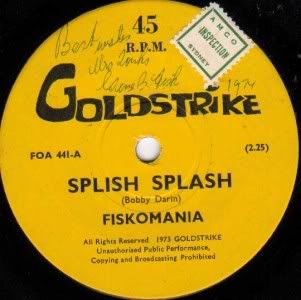
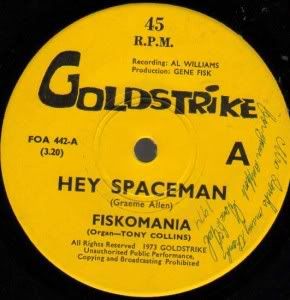
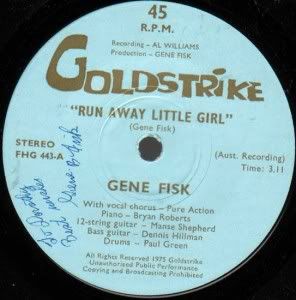
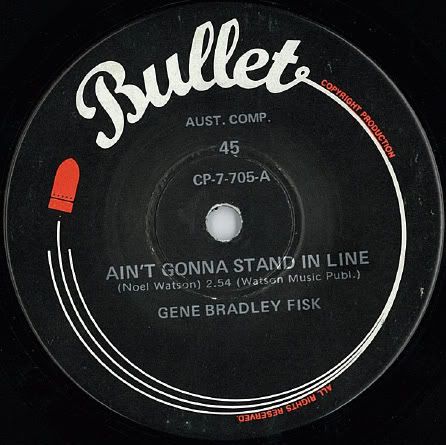
King Of The Block is no idle boast - our hero has been around it a few times. The magnificently named Rikk Krannium and the Smutorks (try spelling it backwards) is in fact highly regarded Australian country musician/broadcaster Gene Fisk, accompanied by his backing band at the time (the somewhat less imaginatively titled Gene Fisk Band) and some friends. Fisko's discography stretches all the way back to 1959, but the Rikk Krannium single is the last of four 45s released in the mid-'70s during his stint at radio 3BO, Bendigo (the others are worth hearing for those with an interest in slightly odd, pre-punk private pressings; see them here, here, and here).
Recorded live to two-track at the tail end of 1975, King Of The Block is an impressive stab at knuckle-dragging hard rock, with a rawness and energy that presages musical developments up north the following year. Sandwiched between screeching tyres and cop car sirens, the song is propelled by a driving, two-note bassline and some unhinged, wah-infused guitar. The band is nice and loose, the kind of performance that suggests supreme unfamiliarity with the material (in the best possible way), and you'd be hard pressed to guess that country and western was the principals' stock in trade. Only the harmonised vocal inflections at the end of each verse betray any country twang, though I'd be willing to bet that the axe-men are slingin' Telecasters, too.
Then there's the synth. Big, nasty, ballistic analogue synth blurts. For no reason. Great.
Imagine Fisko walking into Bendigo's High On Music and asking the clerk, "Just what do these EH driving long-hairs listen to?" And after internalising Paranoid and Machine Head, you can just see him pen in hand, lightbulb above head, pumping out this piece of genius in ten minutes flat. Thank our old mate Beelzebub (and Gabriel, both name checked) he did.
Fisk left Bendigo for a job at Melbourne's 3UZ shortly after the single's release in 1976. With no band to push the record, it fell off the radar almost immediately. Among country enthusiasts who did get to hear it, King Of The Block was not warmly received - entirely the wrong audience, to be sure. We hope it finds its rightful audience here.
After flirting with the dark side, Fisko then merged it with his first love, touring and recording with outlaw country bands over the next decade, first with the backing of Gunslinger, then reverting to nominal literalism as Gene Bradley Fisk's Outlaws. The Williams family took three generations to cover country, outlaw country and hard rock - let's salute a man who did it in one lifetime.
Contrary to the one word review written on the label, Goodbye Judy is an astounding piece of pre-punk powerpop. I'm sitting here reading the Bomp powerpop issue from '78 and feeling this captures every element Greg Shaw talked about within: "short, catchy, hook-filled, built on bright uplifting major chords... the element of urgency, the possibility of (uncontrolled) violence". OK, while the beat is thuggish, there's little threat of violence (unlikethe other notable Judy from 1976).
But what is the story? Chuck Warner wrote eloquently in the Teenline liners on the genre's "basic mise-en-scène: a hopeful but hopelessly single guy, so, so alone in a world where, somewhere, inevitably lurks the perfect girl. It’s just that she’s already going out with someone else - or she’s one or more of the following: hiding, vain, spiteful, oblivious, older, unapproachable, unaffordable, too shy, too pretty…or simply a little too boy-crazy to settle for just our hero!"He stresses he's writing about America, 1973-80, and yes, we hope a band playing suburban Melbourne halls and high school dances was a bit tougher than that... our singer here has at least loved and lost. And while it's not exactly a put-down song at least he's showing a bit of spine and self esteem - it's her loss!
What about some of the musical and production elements? Horns, great multitracked vocals punctuating the lines, the whispered backing vox "Is that you?", the glorious "iiiiiiii, I don't want you" chorus, again - the keep-it-simple proto-thug drumming, and the delicate acoustic guitar under the third verse. All up a tip of the hat to the songwriters, producer and arranger.
While Judy is the undeniable hit, Paper Chains is no slouch either – great innocent 1970s pop, this time with a glammy, power-chord driven middle-eight stomp. Evocative of pashing your main squeeze after a spot of BMX riding in the bush near the creek. One can imagine this going over well on Beaut’s support slot for the Bay City Rollers’ November 1976 tour. Anyone willing to own up to being there?
Goodbye Judy
Paper Chains
Unfortunately, the second and final Beaut 45 (Infinity K-6715, 1977) doesn't match the success of the first (creatively, at least – I’m sure sales were roughly zero for both). The horns, piano, even the acoustic guitar embellishments of the first single are no more, in favour of more pared-back production. One can only speculate that the Infinity coffers slammed shut after Goodbye Judy bombed. Why Baby Why attempts to compensate for the lack of additional instrumentation with dense vocal harmonies and some interesting guitar interplay throughout the chorus. The problem is that it’s saccharine as all get-out – bittersweet, sure, but this stuff will rot your teeth. And let’s face it, the band’s balls aren’t exactly dragging on the ground in Goodbye Judy, but at least they’re not stuffed into a purse.
Over And Out is the stronger cut, and is the closest thing we have to the sound of Beaut belting it out live. Ordinarily something to be lauded, but one can’t help but wonder whether the production values of the first single would have elevated it to something special. Overall, the whole affair comes across somewhat flat, a bit of an afterthought. Still, a Burnett-Cutelle afterthought is better than many a band's A-game, and there's evidence that the suits at Festival had ongoing faith in our dynamic duo...but that's a story for another day.
Why Baby Why
Over And Out
A Beaut promo sheet for the Goodbye Judy single. There's another one floating around proclaiming Scheaut Beaut! Onto your playlist!. Wishful thinking, and dangerous waters for those with English as a second language.
I see ex-high school Rugby League players flouncing down Oxford Street in 1975 in stacks, tight pants and blouses. I see them stopping at Taylor Square and swapping mascara tips with Rob Younger who is sticking up posters for his new band at the Oxford Funhouse ("hey, grouse name, man, but The Rats was better"). I see them shooting shit on the pros and cons of the New York Dolls and Keith Moon's solo album.
1976 sees our heroes releasing one of the pinnacles of Aussie glam, a camped up, Dollsy version of a song off Moon the Loon's '75 LP. Awesome. The flip is a lesser offering - not bad, but those with punk sensibilities may find these honkies overdoing the tonk, and underdelivering on mental illness (a la Napoleon XIV). Still, some nice guitar throughout.
Anyway, the truth is probably more mundane - there's a brother and sister from Perth involved, but the band was based in Sydney. This is their one and only...
The Infinity label has some real hidden treasures, but I wouldn't buy the label willy nilly, you'll get burned.
Think you know a lot about Australian records in the punk era? We promise to astonish you with stuff off everybody's radar. We apply quality control so our powerpop has power, our glam has prominent balls, our punk is spiky and our DIY is far, far out there. We'll also do it-never-ends exposés of sleeve variations and inserts you didn't know existed. Strap yourself in and enjoy the ride.