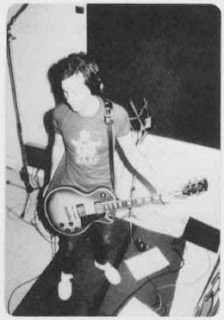
Clint(on) Small was a contemporary of Rowland S. Howard and Au Go Go label chief Bruce Milne at the Swinburne Community School. His first named band, apart from the various freeform jam bands that played at the school, was Tootho and the Ring Of Confidence, shortened to TATROC, in 1975, with Howard on sax and Graeme Pitt of Champagne Edge on bass. You can see photos in the extras on the DVD of Autoluminescent.
After that Small remained a somewhat mysterious figure. We don't think we've ever seen anything written about him contemporaneous with his early records, which seems strange given his connections with the Melbourne punk mainstream, such as it was.
The facts are thus thin on the ground and are deduced from the record covers. Small played in an early lineup of the Little Murders, he's on their second 7". His own first 7" from 1979 is a great record: high energy, tough riffing, good solos and impassioned vocals. Clint plays guitar and sings and Wallaby Beat favourite Jarryl Wirth (News, Lonely Boys, etc.) is on bass and guitar - his classic guitar sound can be heard on Wyvern Parsons, Where Are You?, which also sounds like it could be a News song. Mark Graeber plays drums.
There's two sleeves for this one, both feeding off Milne's taste for 3-D postcards - he used to ask people to send them to him in the early shop mail order catalogues. The horse sleeve seems to turn up less then the camels sleeve, althought we're told there's equal numbers of both.
The same lineup put out a second 7" in 1980. It's a slightly more relaxed affair but still worthwhile. The A-side, On The Fourth Floor, is most similar to the previous record, but really only cuts loose for about ten seconds at the end. Daeng sounds like an outtake from The Rise And Fall Of Ziggy Stardust And The Spiders From Mars. After that Small's next release was the Steel 12" from 1983 - it starts moving in a more hard rock direction and suffers from Jarryl Wirth's non-involvement. There were more self-released records through the eighties, which we've never investigated.
Usually we'd jump at the chance to be smart-arsed pricks about an apostrophecatastrophe, but in describing themselves as "ordinary persons rock and roll" we reckon Frank Savage and co. knew exactly what they were doing, pub rock being music made by ordinary people as much as it is music for ordinary people. Besides, you don't get to play in not one but two bands with Johnny Topper without being something of a smart arse yourself. Little Boy Lost is a decent Sports-a-like, but the punkier Helicopter is the real winner, its near-perfect 60 second length spoiled only by that same smart-arsed-ness - a jokey label plug tacked on at the song's end.
This is the best of the three records known to us on the Mambo label, the others being singles by (in descending order of listenability) Japanese Comix and the Dynamic Hepnotics.
Along with such weighty topics as which of the 2013 fake Black Flags is the best (answer: this one), grillfat as a cultural touchstone is a subject close to our hearts, meaning that we're prone to running our mouths. It was on one of those grill-advised rants that we speculated that grillfat would be an unlikely candidate for KBD-style comp-age, given that grilldom is primarily the domain of the dollar bin ripper. So when we got wind of a boot being compiled from - where else? - The Boot, we thought we'd have to eat our words. Yes, contrary to predictions, Killed By Grillfat now exists (well, kinda. It's a Sharpie comp, so forgivably a few selections stray from the brief). But it turns out that even when we're wrong, we're right - at least half of the comp's track listing can be found languishing in dollar bins country-wide.
In that spirit, today we bring you a bang-for-your-buck grillfat knuckle-dragger, a relatively easy find for the tightwad digger. From their beginnings as the Bootleg Family Band, to their final single as Front Page and almost all of the Avalanche records in between, this band's output is uniformly turdly. The lone exception is Sweet Baby Brown Eyes, the second Avalanche single and a genuine butt-kicker. Lyrics about brown eyes are treacherous waters - was it really kicking that was on their minds? - but Avalanche navigate that minefield and emerge pretty much unscathed, leaving behind a song that is up there with the best of Fat Daddy and Taste in the Bootleg label discography.
The scuttlebutt is that other Killed By Grillfat comps are in the works, at least one of which promises to delve beyond the dollar bin into the realm of obscuro Australian hard rock mind-melters. Never have we so much looked forward to being 100% wrong.
Euan Thorburn was a fringe dweller in the early Melbourne scene and is vaguely remembered by various participants we've polled. As we hope you'd figured out by now, we love fringe dwellers, especially to the fringe scenes we cover. We'd like to be able to pinpoint exactly where he fit in but he hasn't answered our emails! Work with us, Euan. Anyway, Thorburn was a graphic artist (one of his better pieces appears below), who diversified into recording in 1978, the wonderfully loony Brick Wall / Charlie being the result. With its unique, DIY take on R'n'B, Brick Wall is the kind of thing that would have appeared on Charly, or Stiff, or maybe even Chiswick, had our man been in London, rather than the bleak city. We're also partial to the downer B-side.
Brick Wall eventually reappeared on Missing Link's Inner Sanctum LP, Keith Glass being a fan of the record through his record shops.
Thorburn still sits on the fringe, plying his trade as an artist - you can shop for his art here.
We've discussed before meta-topics like songs changing hands between bands. If you're fishing for thesis topics there's a need for a Carducci-like discursion on bands changing genre through their life, and the almost universal deleterious effect on quality. I mean, we wouldn't read it, but go ahead and write it. Here's our minimal datapoint contribution.
The Marching Girls were Kiwi transplants to Melbourne who recorded a pop-punk high water mark in 1980. Following a few years playing around they lost Brendan Perry, took on a new vocalist in Debra Schulze and set about changing their sound. The recorded result was a 12" laid down at Richmond Recorders in January 1983, and only released in New Zealand later that year. Despite leaving True Love way behind and generically falling in the new wave camp we can't hate it unreservedly. There are some good ideas at play on the record, nowhere more so than on track 3, Plain Jane. Slow tempoed, with interesting percussion and a pretty great refrain, we're happy to champion it. The rest of the EP is less to our taste, being more gothy, atmospheric and dare-we-say-it, dull. If so inclined, youtube is yourfriend.
Plain Jane resurfaced in 1985 on an Australian 7" (EMI, EMI-1438). Re-recorded, and a minute shorter, points are deducted for the 1980's drum sound. On the plus side however the guitar under the chorus is much heavier, placing the song as a precursor to the sound labelled shoegaze in England some years later. The flipside of the 7", The Man Who Knew Too Much, appears to date from the 12" sessions, based on the production credits. It's an instrumental, and we'll leave it to you to search out. There was one further 7" in 1987.
Two weeks ago we covered the excellent News flexidisc that featured Sweet Dancer Au Go-Go, and many moons ago we looked briefly at Kim Fowley's visit to Australia. Today we tie them together with the tale of Jarryl Circus's flirtation with the animal god of the streets, via the Lonely Boys.
Prior to News' initial breakup, Circus had made his way to the Melbourne Hilton to play some tracks for Fowley. The News website takes up the story:
As Gavin was preparing to vacate Faraday St in December, intelligence reached him that before the band went bust, Jarryl had been setting up (on the sly) a solo career with US producer Kim Fowley. Fowley was then a name, having worked all around the world, successfully often enough, since the early sixties. He was making a well publicised visit to Melbourne and Sydney looking for bands to produce. Among the flow of hopeful artists was Jarryl, who played Fowley some News material. The material went down well and Fowley set Jarryl up with sessions at AAV studios from December into 1979. He recruited a backing band and they were recording as the Lonely Boys.
The backing band was centred around Jim Manzie, who had had considerable local success in the mid-seventies in Ol' 55, a fairly weak fifties revival act. Manzie played bass and recruited Ol' 55 drummer Geoff Peterkin, kiwi session muso Martin Fisher on keyboards, and Scott Douglas on rhythm guitar. Circus, back under his real name Wirth, sings and plays guitar. The sessions, which Inner City Sound says were actually at Armstrong's, yielded four songs which appeared over the next eighteen months on various Fowley sponsored compilations.
The first tracks to appear were in August 1979 on the Vampires From Outer Space LP (USA Bomp 4005 1979). The LP also had a release in the UK (London SH-Z 8543) and in Germany (Line LLP5013) featuring the garish cover at the top of the post. Fowley raves in the liner notes:
Underworld rumors led me to the Lonely Boys in darkest Melbourne, Australia. The bold diplomat, Jarryl Worth, on "Phantom Poster Man", screams of the new falcons, the subhumans demanding their place in the race. Vegetable Minds who have heard this slice of life decree "It's Got Industrial Action".
Whatever. The tracks, the above mentioned Phantom Poster Man (more likely a tribute to the ubiquitous street poster company) and Ugly Girl, bleat the Oz rock past of the band over anything Wirth might have brought from News. Fowley sneaks a co-writing credit on both.
Where Is The Sun was the next to get a guernsey, on the Waves (An Anthology Of New Music Vol 2) LP (USA Bomp 4008, also Germany Line LLP5063, and Canada Bomb 124) in 1980. This song is a bit better, sounding like it was recorded in the wee early hours of darkest Melbourne. In fact this was recorded the night that the News' Faraday St home/base/recording studio was fire-bombed (January 3, 1979). Once again Fowley's liners are hysterical. Potted highlights include that the band started as an "anti-disco group", "their code is alienation plus radiation, the expectation of desperation. They're in control of their rock 'n' roll, they're not old, and they're not on the dole", "the group plays motorcycle club parties and hospital charity dances. Among their influences are Gary Gilmour, the Trashmen, the Dead Boys, and Octavius Caesar".
Finally Sweet Dancer A Go Go turned up on the Kim Fowley's Hollywood Confidential LP (USA GNP Crescendo GNPS 2132, also in Greece on MusicBox SMB 40130), later in 1980. Ross Wilson is credited with arranging and he and Keith Glass sing backing vocals. You will recognise the song from the News flexi, though now with more doctrinaire drumming and restrained guitar. Still, a good song is a good song. Although Fowley doesn't cop a credit here, Gavin Quinn did take issue with the Wirth songwriting credit:
It seems that at their meeting, Jarryl claimed that he wrote and arranged what Fowley was hearing. When Gavin heard this much through friends in the business, he was predicably not happy. In the beginning, he had written all Babeez/ News material. He was a skilled and prodigious writer: "Gavin had this pop/punk vision and his rate of churning out songs was really fast" [John Murphy]. But Jarryl began writing with Gavin and compositions were collaborative from then on: "I'd lay down the parameters, he would work out the hard stuff. He had a much better appreciation of key and chordal structure than I did. He knew what I wanted, so between the two of us we managed to perfect it. He wasn't too good with melody, so developed a lot with melody. Towards the end it was all a group effort. Regardless of whose songs they were, the band arranged them and made it happen." [Gavin].
The story doesn't quite end there. The band then rebranded as The Breakers and after supporting the B-52s on their tour released one 7" on Powderworks in 1980. This is pure Countdown new wave, over-produced and over dramatic. The choruses are OK.
Though apparently publishing and even recording deals were signed for overseas it appears that was it. The band's swansong was a brief appearance in the background half way through the film that popularised the phrase "slack-arsed molls" (chime in at 6:08):
Bruce Milne and Clinton Walker published 3 issues of their fanzine Pulp through 1977 (the third was a double issue numbered 3/4). For issue 5 Milne planned to include a flexidisc by our good friends News. Milne had had a relationship with the members of News pre-dating their days as Babeez, having been in various party bands with them in the nascent Melbourne punk scene. Around March 1978 the band thus recorded two of their songs at the Faraday St house they used as band base and recording studio. As recorded at the excellent News pages, they used "the same gear as for the Babeez EP. It was all one take, straight down." The flexis were then pressed at Sydney manufacturer Ambassador Records.
Then things went cold. In April, while putting together their first actual release - the Dirty Lies 7", Milne told them the zine wouldn't be published. Clinton Walker elaborated:
...a fifth was almost completed when the concept folded early in 1978. Roadrunner magazine had been started in Adelaide, and we got involved doing what we could for them in Melbourne. But we both harboured an ambition to put out Pulp 5 somehow, sooner or later. It was a matter of finding a couple of hundred dollars which, of course, we couldn't.
News put together a Pulp benefit at Bernhardt's on 30th April, "a six hour spectacular including News (natch), Young Charlatans, Boys Next Door, Two Way Garden, Fiction, and Spivs. An epic show, but for some reason or other, it didn't resuscitate the ailing Pulp". Eventually Pulp 5 became a Best Of Pulp which eventually saw light as the book we all know and love, Inner City Sound.
The flexi also eventually surfaced in 1979 as part of the Dirty Secrets (a.k.a. The History Of News) pack put together by Bruce Milne, coupled with a one sided vinyl 7" containing one side of the Babeez EP (with Dowannalove and Hate). Nobody Wants Me wasn't included as it was earmarked for a Missing Link compilation, Inner Sanctum.
Dirty Secrets was an excellent package and it sold well, at least partly due to the fact that while many in Melbourne were aware that Babeez / News had pioneered local Punk, few knew how or why. This was down to many factors, but especially their practice of avoiding the 'above ground' live circuit and their patchy press coverage. The package also indicated Bruce Milne's continued interest in News, although it marked the end of his 'professional' involvement.
The two songs, by the John From-The-Suburbs, Joy Relentless, Adam Five and Jaryl Circus line-up, are both excellent examples of News' poppy but dirty punk. Both have excellent 1-2-3-4 count-ins, reminiscent of the Babeez' Dowannalove. All in all the sound reflects Five's reaction to The Ramones:
The big changeover was when we heard the Ramones, we incorporated that style into what we were already doing; stopped using 5/4 feels, which we'd been experimenting with, we'd been kidding ourselves (it wasn't necessarily more expressive or musical); and we didn't want it to be as undynamic as the Ramones; if you look at their music through a level-meter you'll find it's flat we wanted more dynamics. We actively made sure there were no spaces in the music; that was one of the definitions.
By now, regular readers will be well acquainted with The Relatives' great first single, and in particular its hilarious diss of art dealers and collectors. Written from the perspective of a former art collector, Picasso (Private Collector) reflects on the absurdity of the collecting world. Among its many pointed observations, the sentiment that "auctioneers should be kicked in the face" is one that still has some currency with today's punks. The song's conclusion - in which the cynical ex-collector ends up making counterfeits - may ring bells for some, too.
The theme is continued on Uncle Theo Comes to Visit, The Relatives' second and last single. The Prof has been known to complain that it lacks humour, but we'll put that down to its standout song, The Collector, cutting too close to the bone. It's a cracking song, a cautionary tale about the all-consuming record collecting impulse. Riffs cycle through a progression of truck driver's gear changes, ramping up the tension as the obsession takes hold, and only returning to baseline once the collection has gone up in flames. Most hardcore record collectors have, at one time or another, fantasised about being released from the burden of a collection by destroying it. We ourselves have often contemplated the therapeutic benefits of putting a match to our 50-count box of Hilton Bomber EPs. Hmm, tomorrow's a public holiday - might be a nice day to fire up the barbeque.
We put some questions about Uncle Theo (and Uncle Theo) to Simon Kain, Relatives bassist and all-round nice guy. Not only did he answer them graciously, he also made available an unreleased song from the Uncle Theo sessions. Ultimate Fridge embodies everything that's great about The Relatives - inventive songwriting, unique and funny lyrics, lots of energy - and would've been a highlight had it been included on the record.
There were formative pre-punk versions of The Relatives going back to 1975 or so, but by 1977 your set lists had already incorporated Saints and Sex Pistols tunes. Dave Graney has spoken of seeing a news report about the Pistols as the key event in his introduction to punk - was there a similar pivotal moment that pushed The Relatives in that direction?
Reading Anthony O'Grady's Funhouse editorial in RAM Magazine really gave a sense of momentum of a pre-punk movement especially the Sydney scene. By this time our listening was extending to Patti Smith, Lou Reed, Velvets etc. There were snippets about the Ramones, Blondie and the CBGB scene coming through, and then the UK scene started getting mentioned. The Pistols getting signed and dropped by EMI was making the local papers, and the first plays of the video were on TV, from Countdown to Flashez to the news. I think I missed the LWT report Graney mentions but the release of Anarchy was highly anticipated and I bought it on the day of release. The Saints were also getting name checked after their Sounds review, however I (and we) didn't get to see either them or Birdman as we were still too young to get into the gigs and we missed the Punk Gunk gigs as well.
If there was a seminal moment I guess it would have been in early 1977 when the Boys Next Door played a house party over the road from our house. Their equipment van had broken down so the host, who knew we had a band, dragged them over to our place looking for amps. We had tiny little practice amps at this stage but they gladly borrowed them. Having supplied the gear we were invited to the party which was a rabble of the St Kilda scene absolutely tearing the place up. Chris Walsh of The Negatives was filling in on bass for Tracey and I had a long chat to him about music etc. On the turntable they played Alice Cooper's Killer and Funhouse by The Stooges, both I heard for the first time and really right then my direction was set. The band played a great early set of the Lethal Weapons tracks plus covers of I'm Eighteen and possibly the Ramones. Cave was in torn jeans and a cadet shirt with a (Caulfield Grammar?) school tie and a holey jumper over that. It was a great gig and the fun, pace, mayhem and energy of the night really set us on the trail to play punk classics in first gig as The Velvet Underpants in 1977.
Babeez/News seem to have been influential in giving a hand to younger bands in Melbourne, the Proles in particular. News gave you an early gig at Bernhardt's - how influential were they on The Relatives?
In 1978 I was at Melbourne University with John Murphy, who was a school friend of a guy I knew from Scotch College. John was drumming in News and I often ran into him in Lygon Street outside of Readings, which was then the number one place in Melbourne to get all the new singles coming out of the UK and USA. They used to get the shipment on I think a Wednesday morning and then pin them up on a large cork board. I'd drool trying to work out which ones to get each week and was never disappointed.
Back to John - of course we discussed music and he kindly offered to try to get us a support at News' Bernhardt's residency. Bernhardt's was the still-standing disco better known as the Thumpin' Tum in the '60s. It still had the old decor of black and white striped wallpaper and red light coverings. It was a mad crowd of guys in garbage bin liners and was a lot more "punk" than the scene at the Tiger Lounge in Richmond where the Boys Next Door had a residency on Tuesday nights.
By the time we got the support we'd changed the band's name to The Nooney Rickett IV, which we pinched from a combo in a kitsch '60s teen flick called Winter A-Go-Go. Jason and Rodney were still at school and I think for this gig we had dropped the second drumming, retaining Ashley Thompson. We had a lot of nerves playing our first public gig, especially to a real punk audience. My memory of the gig was a blur of noise, we hadn't used foldback before and we couldn't hear what the other guys were playing. It was a slow death that couldn't end sooner and there was a real sense of disappointment afterwards. Not shared by all the band, but I really felt down after that and we didn't play in a "punk venue" again until 1980.
The Relatives released two singles within the space of 6 months in 1979. A common lyrical thread between them has always intrigued me: collectors and collecting. The lyrics seem to reveal an inside knowledge of The Sickness. What was the inspiration there?
I wrote The Collector for the Theo EP. It was directly inspired by a guy I knew who had the most incredible collection of records, all beautifully arranged in his bedroom. He'd order boxes of releases each month, it really was an obsession. Going as far as getting every different country's release of the same record. I mean really! Spending another $20 on a record you already have just to know you have the Spanish version. Years later he'd sold the lot (bar his fave 45s) and replaced them all with CDs (no doubt still getting each release with different country of origin!). I had my own vinyl Jones going (see Readings above) so it was really a warning that the obsession can overwhelm you in the end, hence the burning of the collection at the end of the song.
Who is Uncle Theo?
The relative you love to visit.
You pressed more copies of Uncle Theo than your first single (500 vs 300). It certainly seems to be easier to find. Tell us about how Uncle Theo was distributed - did copies make it elsewhere in Australia, or even overseas?
The vast majority of Uncle Theo singles (and almost all the badges that went with them) were given away on the night with the extras given to band members, sent to whatever radio stations, press, bookers or industry connections we could find. Only a few were put on sale in shops, I dropped off five I think to Readings (of course) and our local Brighton record shop took 10 copies or so. I was too embarrassed to ask for any money for them - that is, if they ever sold. None were sent to overseas press or labels that I can remember. One copy did end up with Molly [Meldrum]. We were at the taping of Countdown when the Police played and whilst he wasn't looking I flung a copy onto the pile of records he was about to review. Unfortunately the ruse failed and we missed out on our one Countdown moment.
After the two singles, The Relatives went in a more post-punk, Fall/Gang of Four direction. How do you rate the songs from this period compared to the singles? Did this incarnation of the band do any studio recording?
The music changed fast and the amount of influences swirling around were so exciting to soak up. Both the Gang of Four and Fall were big influences as well as the Birthday Party, Wire, Mekons, Pop Group, PiL to name a scant handful. It was a natural progression to keep harnessing the aggression of punk and explore the rhythm and jaggedness of the sounds that were around. We were not going to be a Sham 69.
Once Andrew and Ashley left the group (1979) Rob took over all the vocal duties and we drafted Bruce in on drums. He was a sheet metal worker with long hair and a real prog rock drum kit with multiple toms etc. The kit shrunk over time and he became a real beast of a player which drove the beat of the group.
Another change at this time was that Rodney Howard began writing songs prolifically. Songs such as Trade Secret, Philosophy and Golden Rule are some of my fave tracks we ever played. Intricate staccato-like riffs with a propelling beat and great lyrics. It's such a shame these were only recorded to demo stage and not properly released. With Rod writing so many great songs I think it was about six months before Rob, Jason and myself (the Kain brothers often collaborated) began offering new songs. All the recordings of this era are well documented in the tapes that are at Inner City Sound. There are no other recordings from that period that I recall. It being the era of the cassette we did plan to release cassette only versions of some recordings, live and studio (RAP 003 and 004), but didn't get around to doing so.
You seem to have done a great job documenting The Relatives' history. Was it apparent at the time that you were involved in something important, something worth documenting and preserving?
See answer to the Collector! I have always hoarded stuff about bands I enjoyed, from the early days of scrapbooks to Go Set to programmes from live shows. It seemed only logical to extend this to any band(s) I was in and yes I knew it was important, possibly not to anyone else but certainly to the members of the band. As I've probably shown in my rants above, that era was incredibly special. There was a new inspiration with every NME, gig, visit to a record store and every new Relatives rehearsal. It all went by so relatively quickly (say '77 to '82), I'm glad I kept it all.
The Kain brothers both continued to play music after The Relatives broke up. What are you currently up to musically?
Jason is more active than I. After Chad's Tree broke up in 1989 I did a few gigs with Juliet Ward (Lighthouse Keepers) and Jason in a band called Skullduggery, but I gave up playing live altogether. I got into band management and booking and the bug has never bit again.
Back when we only listened to punk rock there were just five Australian powerpop records that would get turntable time around here - the Numbers/Riptides' 77 Sunset Strip, The Scientists' first, The Marching Girls, The Zorros and this puppy. News' third single, fourth if you count the Babeez, contains perhaps the purest pop song amongst all of those, I'm So Confused. It's a brilliant track with strawberry melodies, the requisite self-doubt about a girl in the lyrics, and a downtempo bridge lifting to a powerful finish. It's also another example of piano being used to good effect in early Australian punk (see Leftovers, Fun Things, Just Urbain). That Girl is a fast-paced and somewhat demented new wave track, lent a certain uniqueness with an analogue synth solo and count-ups in two languages (to eight, mind you). In some ways the pop slant was no accident. While political, buzzsaw punk dominated the band's early sound, there was more than a nod to pop as well. As retold at the excellent Babeez/News website, (well worth starting at page one and reading the whole thing), "revved up" bubblegum covers had appeared in News' set quite early on.
People step on our toes, as the Fraser Government has; but we're not going to take it lying down, we're going to fight back. But, we want to keep it Pop!
The end of the first phase of the band started with John From The Suburbs' departure to drum for Crime and The City Solution. Things started to fall apart with Julie Relentless also leaving and Jarryl Circus following Kim Fowley to L.A. Around the same time they had recruited a second guitarist in Russell Urban (né Irvine).
Singer Adam Five took Urban and grabbed some new members in Kim Morton on bass and Limp Member (Dorland Brey) on drums. Gigging solidified the band and then Missing Link offered them the chance to record a single at Richmond Recorders with Tony Cohen. Prior to recording they added a keyboard player from the Carlton scene, Graham Lewis. Keith Glass and Ross Wilson provided backing vocals. The single eventually sold 1500 copies but after an East Coast tour with mixed results the band called it a day.
Five continued to make music but as the quality went down he had the decency to rename the band, slightly, to New 5; unlike Chris Bailey who should have considered the Saint 5, or the Shit Saints, or something equally apt.
This spry, otherworldly piece of punky Melbourne DIY packs more gibberish-per-minute than even our pal Plastic EP, but unlike Mr EP and his Miscalculations, Microfilm vocalist Lisa Gerrard turned the baby-babble into a career, leading Dead Can Dance through an extensive discography throughout the '80s and '90s. Even more impressively, if we're to believe Gerrard's Wikipedia page, all of this lyrical nonsense actually means something. Perhaps we should ask Plas to translate.
Gerrard's collaboration with Microfilm/Dead Can Dance co-founder Brendan Perry arose from the fertile Little Bands scene, spotlighted in recent years by Chapter Music's Primitive Calculators reissues. Fittingly, Centrefold from Microfilm's lone single can be found on Chapter's Can't Stop It 2 CD. The 7" was released by Unforgettable, a label founded by Melbourne post-punk iconoclast Ron Rude (careful not to confuse yer Rudes, trendsetters); it was issued individually as well as packaged in the Carboard Box set along with the two other 7"s in Unforgettable's catalogue, Ron Rude's Piano Piano and the Fabulous Marquises. Two Ron Rude LPs (with the Unforgettables and Piano Piano, respectively) round out the Unforgettable label discography. Summer House, another good Microfilm track, was included on From Belgrave With Love (Cleopatra CLP 204, 1981), a compilation LP based around Rude's home studio recordings.
We're in Melbourne again, trying to pin down a record so undocumented we have to divine what we can from the sleeve. Clue one is the photo: three norms (Melbourne, '79 style), and a bloke channelling Lou Reed's arsehole phase with his all black getup and mirror shades. Clue two is the dedication to Kim Fowley on the rear sleeve and label. Now we don't know if the Slugs got on their knees before the animal god of the streets when he visited Melbourne but the August 1979 recording date is about right so we like to think they may have. We also imagine him screaming "get these old fucks out of here and bring me some malleable teenagers!".
Putting those clues together we imagine a band taking bits from Rock'n'Roll Animal, Fowley's mid to late '70s LPs, and perhaps those mirror shaded greats, the Blue Oyster Cult. But the reality is probably a bit more mundane, and comes from clues three and four: the thanks to Tinsley Waterhouse, Melbourne blues legend; and the production by David Pepperell (and the thanks to "mystery guitarist Keith" (Glass?)). Effectively, our boys are rubbing shoulders with Melbourne's rhythm and blues royalty.
The tough, sinewy riff to the A side, Catch My Breath is certainly placing us in rock'n'roll territory, but the flipside is effectively an electric blues song. The guitar sound is filthy, but, you know, it's still just the blues...
All up we have a record that sits just on this side of the good/bad line, just on this side of the rock/blues line, and just on that side of the getting laid/not getting laid line. We'll let you listen to the lyrics for that last bit. Let's just say Makeshift sound like they have more pull with the ladies than this crowd.
Think you know a lot about Australian records in the punk era? We promise to astonish you with stuff off everybody's radar. We apply quality control so our powerpop has power, our glam has prominent balls, our punk is spiky and our DIY is far, far out there. We'll also do it-never-ends exposés of sleeve variations and inserts you didn't know existed. Strap yourself in and enjoy the ride.