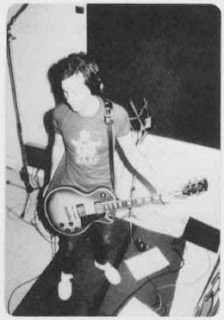
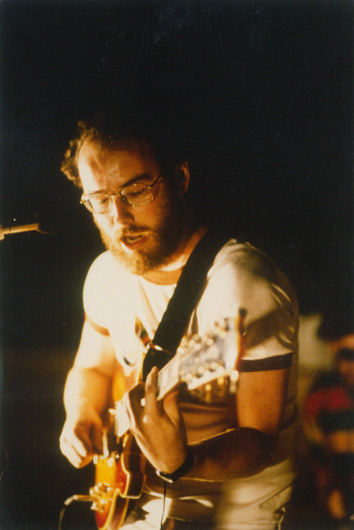
Hitmen's second 7", I Want You / Tell Tale Heart (WEA, 100129) sees them start the move from the perfect powerpop of the first 7" to the less interesting macho hard rock of the LPs. The band were nothing if not a great singles band however, and all the 45s are well worth getting. It was said at the time that the A-side, I Want You, was inspired by Kiss' 1979 hit I Was Made For Loving You. Hmm, we can't really hear it. Even down the decades that smells like Record Company bullshit, riding off the popularity of that year's hit. Further, we're pretty sure a man of taste like songwriter Warwick Gilbert would have ripped off prime era Kiss, like Deuce, Strutter or Cold Gin, if he was so inclined.
What is true though is that said Record Company were too cheap to stump up for a picture sleeve, so the band had some printed themselves and hand distributed them to at least the Sydney shops.
On the other hand, through WEA's worldwide reach, the single also got issued in Italy (WEA, Y 70005) as part of The Sound Of The 80s series. Both white label promos and coloured label stock copies exist.
There are mentions on the web of a German issue with the same catalogue number but we're dubious to the point of saying it doesn't exist.
What is maybe less known is the alternative version of I Want You which appeared on a K-Tel greatest hits LP called Squeezed Out later in 1980, alongside The Aliens, The Angels, The Reels and, um, Christie Allen. K-Tel mastering renders the song two seconds shorter but it's the same version with a different mix - louder rhythm guitar post-chorus (an improvement) and big '80s sounding drums (sad slide whistle).
Clint(on) Small was a contemporary of Rowland S. Howard and Au Go Go label chief Bruce Milne at the Swinburne Community School. His first named band, apart from the various freeform jam bands that played at the school, was Tootho and the Ring Of Confidence, shortened to TATROC, in 1975, with Howard on sax and Graeme Pitt of Champagne Edge on bass. You can see photos in the extras on the DVD of Autoluminescent.
After that Small remained a somewhat mysterious figure. We don't think we've ever seen anything written about him contemporaneous with his early records, which seems strange given his connections with the Melbourne punk mainstream, such as it was.
The facts are thus thin on the ground and are deduced from the record covers. Small played in an early lineup of the Little Murders, he's on their second 7". His own first 7" from 1979 is a great record: high energy, tough riffing, good solos and impassioned vocals. Clint plays guitar and sings and Wallaby Beat favourite Jarryl Wirth (News, Lonely Boys, etc.) is on bass and guitar - his classic guitar sound can be heard on Wyvern Parsons, Where Are You?, which also sounds like it could be a News song. Mark Graeber plays drums.
There's two sleeves for this one, both feeding off Milne's taste for 3-D postcards - he used to ask people to send them to him in the early shop mail order catalogues. The horse sleeve seems to turn up less then the camels sleeve, althought we're told there's equal numbers of both.
The same lineup put out a second 7" in 1980. It's a slightly more relaxed affair but still worthwhile. The A-side, On The Fourth Floor, is most similar to the previous record, but really only cuts loose for about ten seconds at the end. Daeng sounds like an outtake from The Rise And Fall Of Ziggy Stardust And The Spiders From Mars. After that Small's next release was the Steel 12" from 1983 - it starts moving in a more hard rock direction and suffers from Jarryl Wirth's non-involvement. There were more self-released records through the eighties, which we've never investigated.
Before the Cosmic Psychos, there was Rancid Spam. That's some crucial science we learned from the new Cosmic Psychos documentary, Blokes You Can Trust, screening in all discerning theatres around the country. Rancid Spam featured a teenage, pre-Psychos Ross Knight plus - according to Knighty - the two other punks in the small town of Kyneton, rural Victoria. Along with some cool happy snaps, the film also shows a tantalising glimpse of a 1977 Rancid Spam demo tape. Surely we can't be the only ones wondering what treasures might be found on that cassette. The fine fellows at Aarght are giving the early Cosmic Psychos records the reissue treatment - perhaps they might be persuaded to look into it.
The last of those records, Go The Hack, is notable not only for featuring the best Australian song ever to sport a D-beat, but also for being the last release by the line-up with guitarist Peter Jones. Jones was soon replaced by Robbie "Rocket" Watts, allegedly after an audition at which Watts blew up two amplifiers. You won't often find us quoting Ian McFarlane's Encyclopedia of Australian Rock and Pop, but his conclusion that the change in personnel didn't alter the Cosmic Psychos' sound might be the most insightful analysis in that book. Yup. Watts had previously played in I Spit On Your Gravy and the Quivvering Quims. And, before that, Sharp Toys.
Um, who? Just as Rancid Spam included the only three punks in Kyneton, Sharp Toys must have been the four biggest freaks in neighbouring Castlemaine - the kind of freaks Rancid Spam would have beaten up as a matter of general principle. Among said freaks were Robbie Watts and older brother Rex. The only trace of Sharp Toys' existence is a handful of tracks on a 1980 compilation LP, Goldfields Rock, released as a fundraiser for community radio station 3CCC-FM in Castlemaine. Of the four songs, Nuclear Daisy is our favourite, a world away from the wah-drenched fuzz-storm of the Cosmic Psychos, but even at this early stage Robbie possessed a nimble set of fingers and the song really opens up when he rips his solo. A song-ending explosion wins brownie points, too.
There are a number of places on the web where the remaining tracks on this LP can be heard, so we'll leave interested readers to explore that for themselves. On second thought, we'll direct you to the Rock On Vinyl blog, which tells us of the band members that "I suspect they didn't go onto bigger and better things". Hmm, perhaps Rock On Vinyl should stick to cutting-and-pasting its information directly from Wally Beat [sic].
If by choice or circumstance the subculture you swam in was Sydney mod revival, then we hope you have a good memory of the time. Mind you, if the purple hearts did do a number on your bonce, you can relive it all through the excellent Stark Raving Mod book and website. We say all that because the physical records (i.e. discs, 45s, singles) of the scene are, by and large, an underwhelming lot. This is typical of scenes which are backwards looking, and where the music isn't the prime aesthetic focus.
One particular example which slightly pre-dates the more formalised union jack/scooter scene is Jump Vision's only recording. Though commonly described as a soul/ska band, the prominent bass, echo and guitar effects on the A-side come across more as a slightly (more) anaemic Cure fronted by a pre-tantric Gordon Sumner. The Sting inflections aren't as obvious as on fellow scenesters The Personnel's effort, but still there. It's alright though. The flipside is a ska instrumental; you know by now we'll save you the few minutes.
The band were Richard Knott on bass, David Rowley on drums and Mark Bradridge on guitar. All shared vocals. Rowley ended up in the last line-up of The End, and all three went on to Watusi Now with Peter Mengede. Organ was provided by Russell Handley of Popular Mechanics.
Usually we'd jump at the chance to be smart-arsed pricks about an apostrophecatastrophe, but in describing themselves as "ordinary persons rock and roll" we reckon Frank Savage and co. knew exactly what they were doing, pub rock being music made by ordinary people as much as it is music for ordinary people. Besides, you don't get to play in not one but two bands with Johnny Topper without being something of a smart arse yourself. Little Boy Lost is a decent Sports-a-like, but the punkier Helicopter is the real winner, its near-perfect 60 second length spoiled only by that same smart-arsed-ness - a jokey label plug tacked on at the song's end.
This is the best of the three records known to us on the Mambo label, the others being singles by (in descending order of listenability) Japanese Comix and the Dynamic Hepnotics.
Cases of sexual mistaken identity aren't unheard of in the world of grillfat, but you'd be hard pressed to find a more clueless bunch of longhairs than Sydney's The Ash Band. Along with Sidewalk Teaser by U-Turn, Let's Go from The Ash Band's only single is our favourite grillfat tale about the world's oldest profession. The difference is that U-Turn know exactly what they're getting themselves into, while Ash Band vocalist Paul Flood is such a dope, he doesn't realise that his date expects a gratuity until after he drops his drawers. Amazing. He's got a pretty face, and it ain't going to hell - when he sings about "making whoopie", you know he's never made anything of the sort. Backing him are Danny McCarthy (drums), Dave Flood (bass), and Zac Zinic (guitar) who may or may not be Alex "Zac" Zytnic from the Sunsets/Tamam Shud/Blackfeather.
One of the more interesting threads to emerge from our posts here is the sheer number of (largely undocumented) records from Sydney's Western suburbs. Kanangra was a 24 track studio based in Westmead; it is perhaps best known for tracking the Numbers' Govt. Boy EP, although Wallaby Beat bottom feeders may also recognise the name from the Replicas 45. As a label, Kanangra's discography runs the gamut from suburban mystery bands to mystical singer-songwriter types to one-man-band Hammond organ lounge-dwellers. While later releases have the air of a genuine label about them, the earlier records seem to be drawn from the studio's client base who simply wished to delegate the drudgery of pressing their own records. Even taking that into account, it's a strange discography, peppered with oddball one-sided 12"s, and with packaging that ranges from the professional to the perfunctory. The sleeve for the Ash Band single - a nifty silver screen printed job - is certainly one of the better ones. It also doubles as a public health campaign up there with the federal government's plain packaging legislation. Never have cigarettes seemed less glamorous.
Brace yourself for more Oz Rock idiocy from Newcastle, as Jukebox convince us that they're the only band in grilldom with body image issues. On the A-side (Summertime Fun - no relation), the singer tells us that when he goes to the beach, 98 pound weaklings kick sand in his face. Flip the record over, and he'd have us believe that he's so puny, a case of full-body gangrene and an elocution lesson from Bobcat Goldthwait could only improve his sex life. Those may sound like the words of someone who has taken a few too many rads of gamma radiation to the brain, but a quick gander at these fine specimens reveals that he might be on to something. The production - courtesy of Rabbit's Mark Tinson - is equally emaciated.
Unlike Dr Bruce Banner, the Incredible Hulk's alter-ego, Jukebox were no rocket scientists. That's cool though, rock and roll ain't rocket science, and to prove it the lads present their second single (Cordial Factory 13129, 1981) which: a) titles the B-side Rock 'n' Roll Lady, thereby plumbing the depths of grillfat's dumbest; and b) lifts one of the most iconic riffs in rock as if no one is going to notice. Conceptually, that's two thumbs up, so it's unfortunate that the result is so pedestrian. This time, Tinson produces it to sound like the Oz Rock record it is, which of course is to its detriment. That cavernous sound of The Hulk turns out to be the sound of rock and roll reverberating inside empty heads - perfectamundo.
In August 1979, Perth's Manikins became the first of that city's Class of '77 to head East. A short tour of Brisbane, Sydney and Melbourne followed on from the good reaction to the band's first two singles. On their return to Perth the band released a great cassette called Live Locally featuring nineteen songs culled from their set. In fact the band had recorded fifty songs, almost their entire (all original!) inventory, in a midnight to dawn session at Sweetcorn Studio following the Talking Heads' February 1979 show at Perth Concert Hall. The cassette was a mixture of the band's favourite songs with those deemed to have featured least mistakes. Should you have trouble finding it, most of the tracks can be heard on the self-titled LP/CD from last decade.
Three of the songs reappeared the next year on the band's third single. These versions were re-recorded at Perth's Planet Studios and were mixed at Paradise Studios in Sydney. Needless to say the pro-studios cleaned up the band's sound and while not completely anodyne, it's a pity that the balls evident on the earlier versions had retracted at least part way inside the band's body. In particular the fantastic, sloppy guitar caught on the tape versions is toned down. Nevertheless, good songs all, and worthy of your time.
Like the Numbers and XL Capris, we can but warn you against approaching the band's later major label stuff. We again thank DNA fanzine for their excellent record of happenings in Australia's South and West; this time issues 7 and 34, the Perth punk issues.
When it comes to Australasian bands covering Texas sixties punk the pantheon probably consists of Robbie Steele's Maid Of Sugar, Maid Of Spice, Tom Thumb's You're Gonna Miss Me and The
Lime Spiders' version of The Liberty Bell's That's How It Will Be. Radio Birdman might be considered but come on, Tom Thumb get points for getting there first, covering Roky in 1967!
Somewhere down amongst the lesser gods are Adelaide's Dagoes, who covered a song by Roky's first band, The Spades, as their first record in May, 1980. The original We Sell Soul is interesting as a song without much structure, so I can see why Spacemen 3 saw fit to cover it. According to Teenbeat Mayhem it's "crude intense moody howlin' punk", which I guess explains why The Lyres covered it too.
We don't know the vector which brought the song to Adelaide in 1979. Boots of the 7" had been around since 1975 so maybe they were ordered from the States. The Dagoes themselves had been going since March 1978, starting as Daryl Breakaway and the Niggers, becoming the Dagoes in May 1978, and spending a few months and lineups as The Tony Rome Band. They settled and stayed as the Dagoes in September 1979.
Around this time they were covering Pipeline, Teenage Head, (This Ain't) The Summer Of Love, Pablo Picasso, Frenchette, California Sun and We Sell Soul. A quick scan reveals the band were looking to America rather than other favoured musical climes of the time, though in 1980 they added covers of English bands the Flys and The Boys. Originals included crowd favourites Little Blackie, Let's Liquidate and This Perfect Band.
Anyway, after breaking up in December 1979 the band got together on February 26, 1980 and recorded the three songs presented here. Earlier recordings, three of them, had been deemed unfit for release. To avoid the risk of another lecture from Harry Butler, I'll quote him (almost) verbatim from DNA 6:
Being typically Daygoes, the whole event was fraught with problems from start to finish. Firstly they hadn't played together for over two months, so a couple of hours of swift rehearsals were in order. Not only to learn to play together again, but also because some members had forgotten how to play some of the songs. Next several guitar leads were found to be missing, and as playing began Johnny Tomato began breaking drum sticks madly. Despite it all, the group won through and the first song (Blackie) was successfully recorded. Then disaster struck. A combination of having forgotten the songs and being totally "out of it" resulted in the bassist cracking up and walking out... They resolved to carry on, and overdub the bass parts later.
The next song attempted was We Sell Soul, and they managed to get it down on almost the first take. Then to Let's Liquidate. No real problems occurred here, but some overdubs were necessary. Firstly the bass had to be put down, and there was deep discussion about what should be played - in the end two bass tracks were recorded. Then some synthesizer was stuck on top. Finally all that was left were the overdubs on We Sell Soul. It was decided that no bass was necessary, so it was just a matter of getting the vocals done. People who listen closely will notice some unusual noises in the background in Dick's rave in the middle of the song. These are the result of the activities of Tony Rome, Frankie Thomas and Harry Butler in trying to inject some humour.
That explains the "who needs a bass player" line, and we assume the Billie Jean King reference is a dig at Doug Thomas's hairdo. In the end, We Sell Soul is probably the weakest of the three tracks, the others displaying a tough yet limber garage sound. As evidenced by this and their later recordings, The Dagoes really only followed their own star anyway, not really caring to sound like anyone else.
Tactics' second single tends to be somewhat overshadowed by the world class art punk of Standing By The Window, which is a shame as it's a good record in its own right. Both songs are spiky, brittle post-punk driven by clean guitars and staccato rhythms. Hole In My Life is the winner of the two, with David Studdert's distinctive vocals playing off particularly effectively against the eerie riffing, and some fine distorted guitar for those of us who prefer that sort of thing. Outdoors is no slouch either, it's crashing minor chords building to an energetic conclusion. As on the first EP, Steve Maughan of Kevin McLaughlin and the Murrumbidgee Orchestra (here aided by Ian Davies) provides perfectly simple and crisp production. Also like the first single, this was pressed in an edition of 500 copies, but seems to appear less frequently than that earlier record; oddly, it is also one of the more seldom sighted (but not thatseldom sighted) of the Doublethink 45s, and is the only single on the label not to sport a picture sleeve.
We've had Oz rock gets once lucky, how about half-lucky? Non-Australians might think this is a pretty neat piece of power pop, and as far as the chorus goes we'd agree with you. In fact the chorus is great! However non-Strines are lucky to probably have never heard a little band called Australian Crawl, who our boys ape a little too closely through the verses, kinda ruining it for us.
Nevertheless, great punky sleeve, good chorus. Worth 2:46 of your time?
Local diggers may stumble across a Moral Support LP from the same year - that's the UK Christian new wave/powerpop band, whose album was pressed in New Zealand.
Back when we only listened to punk rock there were just five Australian powerpop records that would get turntable time around here - the Numbers/Riptides' 77 Sunset Strip, The Scientists' first, The Marching Girls, The Zorros and this puppy. News' third single, fourth if you count the Babeez, contains perhaps the purest pop song amongst all of those, I'm So Confused. It's a brilliant track with strawberry melodies, the requisite self-doubt about a girl in the lyrics, and a downtempo bridge lifting to a powerful finish. It's also another example of piano being used to good effect in early Australian punk (see Leftovers, Fun Things, Just Urbain). That Girl is a fast-paced and somewhat demented new wave track, lent a certain uniqueness with an analogue synth solo and count-ups in two languages (to eight, mind you). In some ways the pop slant was no accident. While political, buzzsaw punk dominated the band's early sound, there was more than a nod to pop as well. As retold at the excellent Babeez/News website, (well worth starting at page one and reading the whole thing), "revved up" bubblegum covers had appeared in News' set quite early on.
People step on our toes, as the Fraser Government has; but we're not going to take it lying down, we're going to fight back. But, we want to keep it Pop!
The end of the first phase of the band started with John From The Suburbs' departure to drum for Crime and The City Solution. Things started to fall apart with Julie Relentless also leaving and Jarryl Circus following Kim Fowley to L.A. Around the same time they had recruited a second guitarist in Russell Urban (né Irvine).
Singer Adam Five took Urban and grabbed some new members in Kim Morton on bass and Limp Member (Dorland Brey) on drums. Gigging solidified the band and then Missing Link offered them the chance to record a single at Richmond Recorders with Tony Cohen. Prior to recording they added a keyboard player from the Carlton scene, Graham Lewis. Keith Glass and Ross Wilson provided backing vocals. The single eventually sold 1500 copies but after an East Coast tour with mixed results the band called it a day.
Five continued to make music but as the quality went down he had the decency to rename the band, slightly, to New 5; unlike Chris Bailey who should have considered the Saint 5, or the Shit Saints, or something equally apt.
Ulsers - Remember Them 7" EP (WBRS-2601)
Deluxe reissue of this DIY masterpiece. Up there with early records by SPK and the Slugfuckers as one of the most original and creative statements of Australian punk.
Ulsers - Forget Them LP (WBRX-2602)
Ten jaw-dropping, previously unreleased songs from the Ulsers in full-band mode. Same mayhem, bonus drums, shouting and electricity.
Over the years, our obsession with the Ulsers has bordered on the pathological. Their Remember Them EP is such a perfect storm of OCD-inducing elements, we've sometimes felt that they made it just to torment us. A whirlwind of one-finger acoustic guitar, cardboard-boxes-as-drums, harmonica and sax, its four songs are so wilfully, uniquely obnoxious that those who "get" it can't help but be equally awed and amused. Putting it over the top are abstract, profane and hilarious lyrics, all delivered by a truly unhinged vocalist yelling as if the vocal mic was in the next suburb. Who the hell were these lunatics?
Conceptual greatness aside, the other factor that had us repeatedly washing our hands and touching every second fence post was Remember Them's utter obscurity. Adelaide scenesters and seasoned record collectors alike were unaware of it; those who knew of its existence had no clues to the Ulsers' identities. Years of solid detective work amounted to nothing. And then, as is so often the case, a stroke of pure luck brought results. An autographed copy of the record landed in our laps, yielding three legible signatures (and one illegible mess). "A Hitler" and "Dick Ulser" proved to be unwise Google search terms. We'll be forever thankful that principal Ulser Terry Wilson chose to scribble his real name.
That the Ulsers' story turned out to be even better than we could have imagined has only added to our grovelling fandom. Existing solely for the amusement of an isolated inner circle, beyond which their record barely circulated, it is no wonder the Ulsers remained unknown for so long. Pressed in a tiny run to begin with, the Remember Them EP suffered from zero formal distribution, rapidly waning enthusiasm from the band, and - just to rub salt into the wound - a box of unsold records disappearing into the aether. In 2012, locating a copy is tough; locating a copy with a sleeve is brutalising. We're grateful to Terry Wilson for leading us through the full story.
Terry Wilson
What was your musical history prior to the Ulsers?
None of us except maybe Richard on the sax were in any way accomplished on our instruments. I could strum chords on a guitar and wrote a lot of songs across my teen years. In the years leading up to the Ulsers, Richard and I listened to a lot of free form jazz which influenced how he played in the Ulsers. Without any particular musical ability, we experimented with playing avant garde music, which was quite abstract and dry - eliminating melody or rhythm or solos or even recognisable instrumentation. This was just something we did in our front rooms when other people went out. It's probably why they went out. Punk music also had a sort of avant garde feeling to it then, in terms of attitude and lyrics. In time this influenced us. We had plumbed the free form music as far as we were able and it was a relief to do something more structured and recognisable and fun, like songs.
When did the Ulsers start playing together, and how did this come about?
Maybe 1978. The early Ulsers songs were written at work and the group grew out of a work context. So other than Richard who I'd played music with in the past, the Ulsers were friends from work, and even the audience was substantially the larger work group. I basically cobbled together six songs and we got together in my lounge room and played them onto a cassette recorder.
The EP recording comes across as having almost a "one-man band" feeling about it. Was the Ulsers a full band as such?
I was the one who brought most of the material along. I was interested in accidental elements coming out in the music and perhaps had a purist view of what the music should be. So we tended not to work on the details of songs, and we never came to a polished or tight version. Also because we weren't really musicians, the possibility of building a more integrated sound probably wasn't available.
The Ulsers were: David Banbury - drums (actually cardboard boxes for the recording and many of the shows); Tony Lang - harmonica and bass; Richard Lees - sax; Terry Wilson - vocals, guitar. Also, John Packer - roadie.
Music to cut your ears off by.
L-R: David Banbury (note cardboard box), Terry Wilson, Richard Lees, Tony Lang.
I'm curious about what you were listening to at the time - whether there were other bands which informed the Ulsers' sound or approach?
I was enthusiastic at the time about the Sex Pistols. Also liked The Fall, the Clash, PiL, the Smiths, Joy Division - mostly British bands. Liked the Saints. Reggae. Didn't follow the local scene. There was an ethos of do-it-yourself non-musicians that was part of punk, and the instrumentation of the Ulsers was just what people had or did already. There was no decision made - this was the only configuration available. Later I bought an electric guitar, and there were drums (rather than cardboard boxes) and a bass. At the time, it was our impression that it wasn't as together as the original sound because having electric instruments shows up the lack of musicianship more than a more contained acoustic sound. But in hindsight it actually sounds rather good.
Were you involved with the Adelaide punk scene at the time?
No. We weren't a public commodity. Friends or friends of friends set up parties at their houses and we played shows there. Often we had an audience of 40-50 people, though sometimes it was only a few people. We did about 12 shows.
How did the Ulsers' record come about?
We always performed to a cassette recorder - we always wanted to play it back and hear how it came out. This was the case even with the early free form playing prior to the Ulsers. The first two Ulsers practices were taped and passed around work. It was natural that in time we would want to make a record.
Where was the EP recorded?
In the front room of our roadie's house.
How many copies were pressed?
250. I don't know how many record covers we did - it may have only been 10 or 20. Most went out in the blue sleeve from EMI. Even I never had a copy with the cover. A friend of ours, Ross, drew it. In a way, we were a bit of a collective where a number of other people made contributions of their own. So John provided his speakers and bought mics and he was our roadie, Ross was inspired to do a cover for the record, Ross let us do a show at his house, etc. Probably every band is the same, the boundaries to what the band is are more widespread than just the four playing the instruments.
Do you know whether the EP was reviewed in fanzines or street press at the time? Did it receive any airplay on the likes of 5MMM?
It wouldn't have surfaced to the notice of the street press. It was submitted by someone to a mainstream radio station as part of the worst record ever made contest - and won! So it got airplay through that. They wanted us to play at a function in a shopping mall but we said no.
How was the record distributed? Were copies circulated beyond Adelaide?
People bought them at work or at shows. We took some in to Andromeda Records - he put it on, laughed and said not totally negatively, "This is so bad".
The point is there was no distribution method as such - after a while we just gave them away at shows, if we even brought them along. The record sort of lost its interest for us - it was something we did as a bit of slightly expensive fun, the next logical step, and then the band moved to something else. I went overseas, came back, we picked up again at a new point, and did some more rehearsing and shows, and then shows without rehearsing. The record was back there and we'd lost focus on it.
When did the Ulsers disband?
I went overseas in late 1980. That was just after a show where the audience rang the police to stop us playing. We put it out that I had to leave the country for a time. I wrote a whole new batch of songs while in England. We worked on them on my return and the group got a little more "serious", got proper instruments, etc. Then it drifted apart for about 18 months. Later we reformed for one show. We had about 40 people there. We decided to play the earlier material and keep it fast and more punk in style. It was our best show. We hadn't played together for 18 months and there had been no rehearsal. Some songs the group only heard for the first time that night as they played them. That was the last show.
Julius Sumner Miller
I'm An Italian
Sounds like the back cover looks.
Like the Last Words, the Ulsers had a prominent German connection.
This spry, otherworldly piece of punky Melbourne DIY packs more gibberish-per-minute than even our pal Plastic EP, but unlike Mr EP and his Miscalculations, Microfilm vocalist Lisa Gerrard turned the baby-babble into a career, leading Dead Can Dance through an extensive discography throughout the '80s and '90s. Even more impressively, if we're to believe Gerrard's Wikipedia page, all of this lyrical nonsense actually means something. Perhaps we should ask Plas to translate.
Gerrard's collaboration with Microfilm/Dead Can Dance co-founder Brendan Perry arose from the fertile Little Bands scene, spotlighted in recent years by Chapter Music's Primitive Calculators reissues. Fittingly, Centrefold from Microfilm's lone single can be found on Chapter's Can't Stop It 2 CD. The 7" was released by Unforgettable, a label founded by Melbourne post-punk iconoclast Ron Rude (careful not to confuse yer Rudes, trendsetters); it was issued individually as well as packaged in the Carboard Box set along with the two other 7"s in Unforgettable's catalogue, Ron Rude's Piano Piano and the Fabulous Marquises. Two Ron Rude LPs (with the Unforgettables and Piano Piano, respectively) round out the Unforgettable label discography. Summer House, another good Microfilm track, was included on From Belgrave With Love (Cleopatra CLP 204, 1981), a compilation LP based around Rude's home studio recordings.
Think you know a lot about Australian records in the punk era? We promise to astonish you with stuff off everybody's radar. We apply quality control so our powerpop has power, our glam has prominent balls, our punk is spiky and our DIY is far, far out there. We'll also do it-never-ends exposés of sleeve variations and inserts you didn't know existed. Strap yourself in and enjoy the ride.