Hard not to respect a record that so prominently displays a smashed 45 of the The Seekers' The Carnival Is Over. While we fully endorse that sentiment, it's a shame the same can't be said for Smashing Records, the lead song from this obscure single by Perth's Hooker (PJ Hooker on the label; PJ Hooker Band on the back cover; Hooker Band elsewhere). Quality control prevents us from posting it here, but the curious may want to check out this particularly noxious version, recorded live in 1982 at the Nookenburra Hotel. Be warned that it is 3:05 of your life you will wish you could get back.
Thankfully, the keyboards and new wave affectations which blight the live footage are largely absent from the single. Recorded two years earlier, its B-side is a creditable exercise in powerpop/rock. In fact, as a suburban Oz Rock take on the Marshall-amped powerchords of fellow Perth-ites The Manikins, Don't Stop fits neatly into the accidental powerpop genre discussed here previously. Though the musical terrain overlaps, we hasten to emphasise that the two bands approached it from very different angles. Their respective odes to the commercial radio DJ speak for themselves - compare Smashing Records ("I am a DJ...the greatest hits, the hottest licks", delivered without irony) with Radio World from the first Manikins 45 ("You like the way the DJ speaks but he just gives me the shits"). The artwork accompanying both singles further highlights differences in approach, but for now we'll leave Hooker's back cover to your imagination.
Despite plugging away on the local scene for another few years, there would be no further releases. After calling it quits in 1983, various members turned up in other Perth bands throughout the remainder of the '80s and into the '90s - Phil Foord surfaced briefly as bassist for well-regarded local rock band The Jackals, while at the other end of the spectrum, singer Steve Letch joined the much-maligned Kaper (scan back-issues of Party Fears zine for the headings "The three worst bands I've ever seen" and "Bands I would rather not have suffered"). Guitarist Marcus Sturrock looked further afield, rubbing shoulders with a who's who of Oz Rock out-of-towners, as documented extensively on his website.
A theme that runs through a lot of what we're doing here is that 1977 wasn't quite the Year Zero many may have thought. The strands and threads running through punk era Australia can often be followed back to the godawful tapestry of the early '70s, and sometimes back even further to the tattered afghan jackets of the late '60s. Late '70s Sydney punks The Press are another case in point.
Bassist Michel Brouet is sometimes listed in an early Band Of Light lineup, though we think this is some sort of mixup with Norm Roue. Brouet and guitarist Bruce Cumming first stood astride Sydney stages together in Submarine XI in 1975. We don't know anything about them, so let's move quickly on to where they next lobbed up - Southern Cross, one of the many hard rock bands cranking watts '76 grillfat style.
Gene Pierson was an Australian singer who moved to New Zealand when his draft card arrived. He continued his singing career there and became a star. His version of I Ain't No Miracle Worker is highly spoken of by garage aficionados but the phased version of Reach Out is perhaps his finest moment, and the Bandstand video with wild interpretive dancers is well worth checking out - see it at the top of this page. Back in Sydney in the '70s he began managing venues and in particular used one of them, Chequers, to showcase the thriving Sydney hard rock scene (AC/DC debuted there in 1973). Around the same time he started a label called Living Sound, who put out Southern Cross's single Queen Of Rock And Roll / Stormy Lady. Living Sound morphed into the Laser label, which released Southern Cross's rare and well regarded album. Laser scored disco, nostalgia and novelty hits, but still at least paid lip service to hard rock, being home for a while to Geeza and U Turn.
Then along came punk rock, and Cumming and Brouet liked what they heard. Based in the Western Suburbs they had difficulty finding other punk rockers so they chose Steve Kot (vocals) and Rick Doolan (drums) based on “an undeniable wildness in the resultant chemistry”.
Gig poster detail
A set was worked up featuring both originals and covers (Ramones, Dolls, Damned). Gigs took place in late 1977 at the Wiley Park Hotel in Sydney’s West. There they met a mix of enthusiasm and hostility as punk’s visceral effect wasn’t immediately obvious to all of the suburban audience. City and Eastern suburb gigs followed including one at the Bondi Lifesaver where they were asked to leave the stage. At least one country tour also took place.
As far as recordings go, a demo was recorded in 1978 and then this album at Atlantic Studios, Earlwood, in late 1978. It was a year before it appeared, on their old mate Pierson's Laser label, and after a few gigs to promote it the band started to fall apart, Kot was asked to leave and a few final shows as a three piece led to the end of the band in December 1979.
Although a solid LP there's really only two keepers. Had Trapped In The Wreckage and Alcoholic been a single pairing you'd be chasing it hard. As it was, Alcoholic did get a 7" release, which sank like a stone, despite its great opening riff. Trapped In The Wreckage is a particularly strong track with its driving pace and Kot's best vocal performance (though look out for the lyric fluff around 1:50). There's some solid bass playing and guitar elsewhere but the songwriting or vocals seem to let the tracks down. The LP itself is reasonably easy to track down, though if you're a condition nazi just take our advice and give up on ever owning a mint sleeve.
Let’s close with a hit of invective from Cumming’s blog (photos there too), specifically directed at folks like us who push the 'coupla tracks' line. As evidence we've also included the next strongest track - extrapolate downwards at will.
“I will tell you something here, just for posterity. We were not bandwagon jumping onto the punk thing. I was 20 when this was recorded and the punk explosion/phenomena/music/attitude/ etcetera had had a massive impact on me. It was only natural, really. None of this shit - from me or the other three guys - was a put on. We never said we were 'punk'. We played Ramones and New York Dolls and Damned songs coz we dug the music AND we were doing 3 sets a night pub gigs and needed a bigger repertoire than my songwriting could keep up with. Sorry for not being fucking kool enough to fall into one of your little punk, new wave, garage or Detroit niches. We never gave a fuck what you thought of us suburban boys then and I sure as hell don’t give a fuck now."
Memorise the label, you'll be flicking past a lot of Dark Tan, Patterson and Peaches 7"s on it before you see a Geeza or one of these.
An old friend used to engage in a party game designed to test the wits of unsuspecting houseguests: ambush said visitor with a copy of Blue Öyster Cult’s Secret Treaties LP, and request the back-story to the before/after sketches on the front and back cover. Why does the plane's pilot bear a striking resemblance to Skeletor? Who and/or what is Lopez? How did Eric Bloom’s Alsatians meet their demise? And most importantly, how did five BÖCs, four dogs and a skeleton fit into a two-seater jet?
The back cover of Desert Rat’s Home From The Front LP presents a similar vehicular seating conundrum, but the real mystery concerns drummer John Drak. Who slammed his foot in the car door? And why? Perhaps, like most drummers, the guy just had it coming to him.
Though the sepia-tone image on Home From The Front’s inner-sleeve is reminiscent of Secret Treaties (substitute the plane with a tank), that’s where the similarities end. Yes, both bands peddle a brand of ‘70s hard rock, but Desert Rat’s is more leaden and less conceptual. That is to say, it’s kinda plodding and more than a little bit dumb. F’rinstance, Eric Bloom plans to steal your wife, pick your brain and spend your money; in Rock And Roll Lady, Desert Rat’s Jerome Speldewinde has already had his way with your wife, but rock and roll has made him so braindead he can’t even remember her name.
Desert Rat’s members had already been around the block a couple of times by the time of the LP’s release - guitarist John Moon and bass player Ian Ryan had both been in Buster Brown (with a pre-Rose Tattoo Angry Anderson and a pre-AC/DC Phil Rudd), among others. Though not featured in the line-up that recorded Home From The Front, Stephen Lazaros' tenure is also worthy of note. Lazaros had previously played with Wallaby Beat gap-fillers Lois Lane/The Benders, but more significantly, would later be re-christened as Smeer and feature prominently in Melbourne's hardcore punk scene as guitarist for Depression and drummer for Gash.
The level dumbness is fairly uniform across the LP, but there are moments that are less plodding than others, highlighted by side one's closing track, Take Me On. Home From The Front also spawned a single (Need Your Love / Reach For The Sky [Champagne CHS 603, 1978], both on the LP), the A side of which is presented below.
Need Your Love
Take Me On
"This will teach sir not to play 20 minute drum solos". SLAM!
Let's begin at the beginning. Mick Flinn (a.k.a. Mick Flynn) first rose to prominence as bass player for the Wild Colonials, a tough Melbourne beat group which issued three singles on HMV in the mid-'60s. The last of these, a version of The Pretty Things' Get The Picture, has become something of a classic of Australian '60s punk thanks to its inclusion on the first Ugly Things comp LP. For those unfamiliar, we suggest you get acquainted post-haste. Unfortunately, Flinn's discography over the ensuing decade is likely to present as a bit of a wasteland for those whose tastes run to the more ragged. However, elements are instructive for what was to come, hence the digressions into non-Wallaby Beat territory which follow.
After the demise of the Wild Colonials, Flinn joined the Mixtures in 1967, eventually hitting paydirt in 1970 courtesy of that year's "radio ban" - a dispute over royalty payments between commercial radio and Australia's six largest record labels, which led to radio denying airplay for major UK and Australian pop songs. In this climate, many Australian bands re-recorded songs by UK artists which had been successful overseas, and were able to parlay them into local hits unhindered by competition from the originals. Ron Tudor, owner of Melbourne's small Fable label, suggested the Mixtures re-record Mungo Jerry's recent UK hit, In The Summertime - the song became wildly successful, topping the national charts and staying there for six weeks. The Mixtures' follow-up for Fable, a novelty-tinged tune called The Pushbike Song, eclipsed the success of its predecessor, again reaching #1 locally, and charting in the UK (#2) and US (#44). The importation of a demonstrated UK hit, along with the Australian record buyer's appetite for a novelty tune, were lessons that would not be lost on Mick Flinn.
The Mixtures travelled to the UK in 1971, where Flinn remained after the band's break-up. Subsequent UK projects included Springfield Revival and Pussyfoot, but since we practically dozed off just typing the names, we'll skip forward to 1978 and the first of the two records to be considered here. Flinn, backed by UK musicians, joined his contemporaries in updating his sound to a post-'77 world, issuing Doin' It Right and Do What You Wanna Do as a single under the name Mick Flinn Band. 45 Revolutions describes the record as "a rare and rather enjoyable platter", featuring "two Glam Rock songs, updated with Punk re-touches". We certainly hear the punk, but microscopic examination reveals very little trace residue of glam, at least to our ears. However, we will accede to 45 Revs when it notes that sales of the single were "close-to-zero" - this perhaps explains why demo copies proliferate while stock copies are elusive (but do exist, as seen in the second edition of 45 Revs).
Mick Flinn Band 7" (EMI 2805 [UK], 1978):
Doin' It Right
Do What You Wanna Do
In 1980, Flinn found himself back in Australia undertaking production work for Mike Brady and his label, Full Moon. As a member of MPD Ltd., Brady travelled in the same Melbourne beat circles as Flinn, and the two were labelmates on Fable in the early '70s. After some solo success, Brady subsequently pursued a career writing advertising jingles. Up There Cazaly - one such jingle, composed as the theme for a television football programme - was issued by Fable in 1979, and became the biggest selling Australian single of its time. (As noted last week, it was also parodied in an unreleased song by the Assassins). Brady used the proceeds to establish Full Moon, and with assistance from Astor records, succeeded in breaking his own Australian sales record with the October 1980 release of Joe Dolce's Shaddap You Face. With these two records under his belt, Brady, like Flinn, came to understand the commercial potential of a well-timed novelty song. (For more, click here).
In June 1980, Two Pints Of Lager And A Packet Of Crisps Please, a punk novelty tune by London's Splodgenessabounds, reached #7 on the UK singles chart. Upon his return to Australia, Flinn brought the song to Brady's attention (though Two Pints... had received an Australian release, it was not a commercial success). In a turn of events recalling those of ten years past, Brady proposed "covering" the UK hit for the Australian market, this time with lyrical adaptations to localise the song. (Brady's suggestion would prove to be ironic - in early 1981, a legal injunction was taken out against Elton John to stymie an unauthorised UK adaptation of Shaddap You Face, fronted by Andrew Sachs [a.k.a. Manuel from Fawlty Towers], and released by John's production company).
The resulting Two Cans Of Fosters And A Packet of Potato Chips recycled Do What You Wanna Do's existing backing, with the addition of a new vocal track "Australianising" the Splodge lyrics. The flip, The Barman's Reply, is just that - with the backing track replicated, playing the two songs simutaneously creates a call-and-response. Though the second edition of 45 Revolutions states that the music was also re-recorded, we maintain that the original backing track was subjected to a radical remix. Reverb was added, and Do What You Wanna Do's acoustic guitar track was dumped, thereby eliminating the endearing slightly-out-of-tune feel of the original. In addition, the master tape was sped up, resulting in the song's key being a full semitone higher (and its length being 10 seconds shorter). The combined effect is a punchier, arguably tougher sound, at the expense of the original's rough edges.
In the wake of Shaddap You Face, Two Cans... was also released by Astor and Full Moon. Coming out in late December 1980 (just in time to take advantage of the novelty tune silly season), the single entered the Australian charts on December 22, where it spent a solitary week at #93. A video was shot which helped Two Cans... plumb the depths of the charts, but Mick Flinn never saw it, and neither have we. (If you're in possession of a copy, you know what to do). Needless to say, this was among Brady's least successful novelty tunes, but it would not be long before he bounced back, reverting to type with Mark "Jacko" Jackson's football novelty, I'm An Individual. Flinn himself promptly returned to the UK and, despite periodically reviving the Mick Flinn Band name, gave Two Cans... little further thought (when originally contacted by Wallaby Beat in early 2007, Flinn had not heard the record since its release).
Finally, in a neat cultural exchange, Splodgenessabounds' next hit in September 1980 was a punked up version of Two Little Boys, made famous in the UK in 1969 by former West Australian swimming champion, Rolf Harris.
As a sidenote, The Professor has been known to deride Two Cans..., publicly declaring it to be "awful". Click here to watch The Prof in action with his preferred musical backing to two cans of Fosters.
Adelaide, as Danny Decay observed, it's a crazy place. Little did we realise when we planned Malcolm Fraser month that most of the recorded opposition to his nibs originated from South Australia's capital - the city of churches, Australia's serial killer capital, snooze-ville.
The most vociferous of them all is surely this ditty by three members of hometown legends the Dagoes. Although Fraser isn't mentioned by name, there's only one prime minister. Just to nail down the intention here's songwriter Doug Thomas's account of the track from the book Underground In The City Of Churches. Take it away, Doug:
"The lyric that is important is the very last line. 'Australia needs this man dead'. That's all I had to say, that's what the song's about, kill Malcolm Fraser - he's an arsehole. The Dagoes did it once or twice as an instrumental set opener in 1979, called something daft like Party Dress or Party Dance. Something really dumb, certainly not Assassination or Kill The Prime Minister, but it was rejected by the Dagoes, it was knocked back unanimously by Dick, Neil and Beau as a political statement which they didn't want. Dick flatly refused to sing it so it was an instrumental. It didn't unduly worry me until a couple of years later when the prick was still in power, and I still hadn't had my say!"
During one of the Dagoes' many break-ups Thomas got together with two other band members, Otis and The Turk (Geoff Short - brother of Filth's Bob Short), and advertised for a singer. Ian List came through the audition and the band practised under the names Ten Wombats, Electric Soup and Main Feature. Kill The Prime Minister was dusted off (along with another enticingly titled original, Up Yours Cazaly). Eventually the lineup settled as List, Thomas and Short under the name The Assassins.
Thomas, Turk, List, '82, trying not to look like Hüsker Dü
In February 1982 Kill The Prime Minister was recorded, and after some funding difficulties finally released in 1983 on Greasy Pop. It's one of the easier-to-find Australian punk records and as a result is perhaps unfairly ignored. Unfairly because instrumentally and thematically at least it's a little monster. While the guitar is sharp and loud, the vocals are pushed back deliberately - it was List's first go in a studio and Thomas wasn't overly happy with the results. The band never played live as far as we are aware, and anyway soon changed their name again to the Falling Spikes, then the Spikes.
Kill The Prime Minister was also reissued under its original title on a split 12" with Ian List and The UVs in 1990 (GPR 100/152).
Assassination
Suicide
The Assassins disenchantment with the PM by 1982 merely echoed that of the electorate. Faced with a recession, high inflation and rising unemployment, the people were ready to go with the ALP. Fraser called a snap election on 3 February 1983, unaware that that morning Labor had replaced their then leader with the popular Bob Hawke. The Liberals well and truly had their daks removed at the March poll.
Which neatly leads into one last Malcolm Fraser incident. Attending an ex-heads of government junket in Memphis, Tenn. in 1986, he was seen wandering around the foyer of the Admiral Benbow Inn in a towel, discombobulated, and wondering aloud as to the whereabouts of his trousers. Trousers (missing) in action, as it were. Amongst allegations of prostitutes and being slipped a Mickey Finn, Fraser has stayed mum all these years, surely taking the Mickey Bliss one more time.
Malcolm "sporting the mohawk look" on the cover of Trousers In Action 1, 1982.
Diverting briefly from the Adelaide-centric focus of the last two posts (don't worry croweaters, we'll be back), this week we bring you a high-energy post-punk rant from Melbourne. With beginnings as a rehearsal project for bassist Sylvie Leber and guitarist Eve Glenn, the duo quickly expanded to the seven-piece all-female line-up evident on this, their lone single. Lumbering under the uninspiring moniker of the Girl's Garage Band prior the single's release, a new name would present itself after a late-'70s outbreak of illness caused by high-absorbency tampons: Toxic Shock.
Though initial musical inspiration came from the first wave of UK punk (Sylvie Leber: "If Sid Vicious could play with only 3 notes then so could I"), the single showcases influence not so much from the Pistols as subsequent developments of the Rough Trade stripe. Predictable reference points though they may be, we hear the likes of Kleenex and the Slits coming through in varying degrees across the single's three tracks. The standout song, Intoxicated, displays the wiry guitars, vocal tradeoffs, emphasis on non-standard rock instruments (Liliput's whistle is exchanged for a cowbell), and the (thankfully largely unsuccessful) rhythmic funkiness of so much UK post-punk. Furthermore, the recording and pressing costs tabulated on the inside sleeve suggest inspiration from the Desperate Bicycles (by way of Scritti Politti), though absent are the helpful pie-charts provided by the similarly fiscally transparent Slugfuckers.
Toxic Shock in action at La Trobe University, Melbourne.
Intoxicated is a theme song of sorts, detailing as it does the symptoms of toxic shock syndrome, as well as engaging in some finger-pointing directed at Johnson & Johnson and, more obliquely, Procter & Gamble (manufacturer of the offending tampon brand, whose logo is alluded to in the lyrical reference to "a man on the moon"). Buried in the third chorus, among the modern day ills itemised as differential diagnoses, is a creative diss which earns the song a mention in Malcolm Fraser month. Some years later, vocalist Fran Kelly would become a respected Australian political journalist, eventually interviewing Fraser for ABC Radio National. Funnily enough, Fraser's resemblance to life-threatening menstrual sepsis didn't come up as a topic of conversation.
Intoxicated
The Slugfuckers got a better deal at EMI Custom's "Accidents" Division.
Thanks to Scott Henthorn for his assistance with this entry. Stay tuned for the full Toxic Shock story in an upcoming issue of Stained Sheets fanzine.
Australia has a proud tradition of spontaneous, crowd-generated epithets, ranging from the vague (see Blood, Sweat and Beers for consideration of "No way, get fucked, fuck off", including its origins and dissemination), to the highly personal (and hilarious: "Wally/Hadlee's a wanker"). When Malcolm Fraser's Liberal opposition blocked supply, leading to the dismissal of the Whitlam government in 1975, it not only marked a pivotal event in Australian history, but also popularised our most acerbic political rallying cry: "Give Fraser the razor".
Chanted by demonstrators at protests in Sydney and Melbourne the day after the Dismissal, in the coming years the phrase would also provide fodder for placards, posters, and graffiti (the internet tells us an example may still be extant on a rail underpass in Wagga Wagga). Inevitably, the slogan was set to music, courtesy of Adelaide's Red Peril - a band formed, appropriately enough, by members of the Communist Party.
Give Frazer [sic] The Razor is not our favourite Australian Gloria rip-off of 1976, but what it lacks in musical grunt it more than compensates for with lyrical bile - not all of which is reserved for the Libs (the former Labor government is damned with faint praise). Notably, in between stock standard pinko invective about bosses and multinationals ("Organise, brothers and sisters!"), Red Peril was ahead of the curve in sinking in the boot/blade to Rupert Murdoch (Murdoch's earliest newspaper and television holdings were in Adelaide, and his News Corp was based there until the mid-2000s). Rumour has it that the lyrics were perceived to be so controversial, no Australian plant would press the record, thus its eventual manufacture in Singapore. The story has an air of the apocryphal, but given the unique look of the vinyl and labels relative to other Australian singles of the era, we don't doubt that it was pressed overseas.
Musically, past comparisons with Jefferson Airplane are not entirely off base inasmuch as they relate to the Grace Slick-like vocals, but instrumentally Surrealistic Pillow is ballsier than this (even at its most acoustic) and is far more creative. The b-side? Well, let's just say we're saving it for our compendium of banjo-led anti-Fraser DIY, due here sometime after 2020.
Interestingly, razors-as-metaphor marked not just the start of the Fraser era, but the middle and end as well. "Razor gangs", originally Sydney criminal gangs of the 1920s, became the designation applied to parliamentary committees charged with reducing government expenditure in the early '80s (the term was also appropriated as a moniker by numerous bands around the country, only one of which made it to vinyl). And one can only imagine the chuckles at Adelaide Communist Party HQ when, after the Liberal Party's election defeat in 1983, future PM Paul Keating described a dejected Fraser as "looking like an Easter Island statue with an arse full of razor blades".
Q: Is Fraser on the fucking dole? A: No, I don't think so
In every scene there's a band that seems to have a bristly relationship with other parts of the scene. In the case of Adelaide punks The Brats, that included an impressive list including themselves, promoters, venues, journalists, radio stations and political parties (though not the one you might expect from the above lyric).
Starting in May 1979, the band for the first seven months was Bruce Brat (bs), John Brat (dr), Paul Brat (gtr) and Peter Brat (keyb, voc). Bruce (aka Bored Bruce) got bored and was replaced by Stan Brat, and John also left to be replaced by someone named Sticks. All had histories going back to the late '60s and early '70s. Of particular interest are Stan's sojourn in politically inspired Adelaide band Glass Web, whose 1970 7", In A Year Or So, is an early anti-Australian-presence-in-Vietnam song. Their second 7" from 1971, National Hero, reiterated their opposition, this time with striking graphics of military tombstones. Peter had been in Rashamra, who had two singles out in 1972. Look past the band's name and the flute at the start of Antelope to hear some good tuff riffing.
Unusual in punk circles the band also had female backing vocalists, the B-Side Bitches, the roll call of which included Annalissa Vague (also from Rashamra), Brenda Brat, Carol Brat (later Cazzby Brat) and Gay Brat (later remonikered as Gay Wales, one of the great punk names).
So to the feuds. The band's first gig was at a Cannabis Law Reform Society party. On the back of that the Australian Marijuana Party, for which Gay worked as a volunteer, booked them and the Accountants for a benefit gig in July 1979. The potheads then decided punk bands would harsh their mellow and cancelled the whole thing. Major bummer, dudes. A storm in a teacup really, but enough acrimony was generated to break up the band.
In August they reunited and over September and early October headlined five weekly gigs at the Austral Hotel. Now, the Austral was a hangout of the Iroquois bikie gang, and as a result promoters and venues elsewhere in the city branded The Brats a "bikie band" - hence no bookings, anywhere.
In November they did score bottom of the bill at a Scientists show. Nick Pervert (a friend, and guitarist with Exhibit A) got pissed and threw a bottle which hit Peter Brat. Local newspapers reported the story and The Brats were now seen to "have a violent following". While on the media, Roadrunner magazine was also perceived to have dissed the group. "Punkoid thrashers in the style of the Accountants" is the quote which the band felt misrepresented them. Listen to the interesting, jazzy chords driving Life On The Dole and you might admit they may have had a point.
Since no-one wanted to touch the band, their next gig was a self-organised show in January 1980 in a fully lit basketball stadium at a juvie institution called McNally Training Centre. All went well and the kids loved it.
Over Easter, the band recorded six tracks at Noumenon Studios - Life On The Dole / 1, 2, Truro / Explosions / Nobody (Is Really Where They Wanna Be) / Hoodlums / 2002. The tracks were released as a cassette. Life On The Dole had been noticed as the band's strongest track right from the early gigs, and comes across as a piss-taking reflection on the somewhat realistic potential, in 1979, of a life spent on welfare:
I'm gonna go from from the dole to an old age pension,
I wanna be a government sponsored institution,
And when I die, my last cheque,
Will be cashed, and completely spent.
Due to their various reputational difficulties the band was also viewed unfavourably by community radio station 5MMM (one of a string of "public radio" stations, set up as a Whitlam government initiative, which had only started broadcasting in 1979). They wouldn't play the tape. Since this was the band's only realistic chance of local airplay the entire band fronted for a meeting with station management. They managed to nix all the station's objections to the band, most based on rumours and hearsay, and as a result got valuable airplay and gig bookings through the station.
Life On The Dole thus became a local hit, reaching number 2 on the station's charts. 4ZZZ in Brisbane also played the track a lot, as did 2JJJ in Sydney, and in later years the band was told it had also received airplay on Californian college stations. Eventually, it saw vinyl release on 5MMM's imaginatively titled 5MMM's Compilation Of Adelaide Bands 1980.
The gigs came through too, starting with a 5MMM night at the Tivoli in May 1980, where the band finally started to see some live success, with good crowd feedback. The black ban lifted, more gigs followed. This included support for the Ramones, following a push from Roadrunner and 5MMM. The promoter refused to pay the supports, and the band had to join the Muso's Union to get them to fight the case, successfully.
In the end, having challenged rumours and perceptions, and achieved local success, it all suddenly didn't seem worth it. Too poor to move to Melbourne or Sydney, the band broke up, members moving off to Darwin, New York, and their own homes. Apart from a one-off 1985 reunion, that was it for the Brats, though Peter did surface recently to cut a new version of Life On The Dole with the Moulting Vultures.
This month at Wallaby Beat is Malcolm Fraser month, where we feature songs that mention Australia's conservative prime minister for pretty much the period this blog covers. He was named caretaker PM after the Dismissal in November 1975 (then won the followup election in December), and his Liberal Party lost the March 1983 election to Bob Hawke.
Australian bands never really played the name and shame game for our punk-era conservative heads-of-state that the US (Reagan), UK (Thatcher) or the Netherlands (van Agt) did for theirs. But old Malcy-walcy did inspire a few missives - and we'll cover them this month.
At the time this song was written the unemployment rate in Australia was at the mid-range of the historical scale, though it had risen from the postwar average of around 2% (from 1945 to 1974) to around 6% in 1979. Under Fraser and his Treasurer John Howard ("Is Howard on the dole?") it would then rise to 10% by the 1983 election, hence the popularity of the song Australia-wide in the early 80s.
Howard would of course later become Prime Minister, and drag Australia hard to the Right, including work for the dole. In a sense he made the Fraser years look quaint in their conservatism.
Thanks to Harry Butler's DNA fanzine for the photo and for all scurrilous rumour information in this piece.
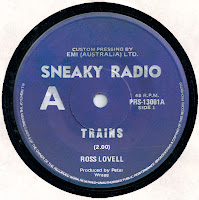
Judging by the number of hits for the last three posts y'all just can't get enough of the approximate vocals which dot the DIY landscape. In which case, have we got a treat for you! Ross Lovell manages to take Plastic EP's rank long hops and bottom edge them into his stumps. For the cricket non-inclined, he makes Plastic sound like Glenn Danzig. Having said that, this one's gonna test even our most diehard followers. All we can say is put it in your personal music device and give it a couple of chances. As much as we are fans of being grabbed by the gonads on the first listen, this one repays more constant attention.
A friend of mine once described Father Yod as Homer Simpson doing Jim Morrison. Here, we have Homer doing, what? Graham Parker? (Wave era) Patti Smith? Video Nu-R? Jerry Rooth? Whatever the influence, there's a magnificent set of lungs bellowing here. We leave it up to the listener whether this kind of thing inspires giggles or awe. We tend to fall on the side of the line that says untutored, outsider art is sincere, and intended to be treated as such, and it's just a happy accident that it comes out so mind-bendingly awful/awesome.
The musical backing here is more than proficient, especially the bass and drums, which scream session muso. The way the guitar gently wails away in the background, and then more forcefully over the rhythm bed for the last minute, is undeniably cool. We're guessing, given the photo below, that Rosco is the guitarist. His playing is pretty good, so it's not as if he doesn't have a musical bone in his body, but that voice...
Long Distance Calls
Like a modern producer pushing a pudgy Dannii wannabe onto Auto-tune, we imagine producer Peter Wragg saying gently, "Why don't we try the vocoder on the next track?". So, on Trains, we have Homer doing Electric Light Orchestra (our first guess, Neil Young's Trans, wasn't out for another year or so). In a bizarre twist, in another decade and a half, Homer himself paid tribute to Styx's vocoder led Mr Roboto. Hard to decipher the lyrics here but we guess the song is about standing on Albion overpass watching trains, or as Ross would portentously have it, "The Trains" da dum da dum da dum.
Trains
Interestingly, the only search engine hit on Ross Lovell in Brisbane lists a contact for a men's choir. Part of us hopes he took lessons to harness and sculpt the magnificent wind coming up from his thorax, but a larger part hopes it still flies forth as free as when he laid down Long Distance Calls.
A few years ago a promo copy of sorts emerged from a Brisbane rock critic's archives, nestled inside was a photo of Ross sitting beside his phone, waiting for that long distance call.
Plastic EP and the Records in 1981 (l-r): Craig, Wally, Chris, Plastic EP
After our initial feature on Plastic EP and the Records' fantastic 1981 single, the band's frontman, Plastic EP, used the comments section to drop a bombshell: Recordings exist for an unreleased second 45. Not only that, the songs were purported to be in the style of that first single, rather than the more polished direction of its follow up. As EPs über-fans, our reaction was predictable: Holy. Fucking. Shitballs.
With thanks to Plastic EP, we're proud to present the songs that would have made up that second 45. The songs were recorded in 1981 - after the session, the band was told to return to the studio at a later time to pick up a master of the final mix. For reasons unknown, the studio never compiled the 1/4 inch master tape, the original reels disappeared, and plans for the single were shelved. ("Isn't it ironic, we recorded a song called Make A Record and we couldn't actually make one", says Plastic EP). Thankfully, the band had the foresight to record rough mixes onto cassette before leaving the studio - that cassette is all that survives from the session, and is the source of the sound files below.
The songs are even more raw than the first single, attributable in part to the unfinished nature of the recordings, but also due to a positively rude guitar sound, courtesy of new member Craig (tremolo is featured heavily on both songs to great effect, and Make A Record's guitar solo is, in a word, savage). In some respects, the recording also represents a transition between the styles of the official singles, most notably in the replacement of At Home's drummer, Brendon Pearse, with a Boss Dr. Rhythm drum machine. With the tempo set just right, there is also that same freneticism that marks so much drum machine driven French punk (Metal Urbain, Dements Tragiques (human drummer, we know), Bla Bla Schmurz Group, etc., etc.).
The band considers Well You Want To Make A Record to be the stronger track - it was the first song co-written by Plastic EP and bass player Wally, and as noted elsewhere, was revived in numerous versions over The EPs' career. Indeed, it's the more immediate of the two songs, but we're hesitant to downplay the merits of I'm Not Coming Back. Its chiming piano lines are an undeniable highlight - in fact, the song is not a million miles away from The End by Just Urbain in its instrumentation and minor key.
Well You Want To Make A Record
I'm Not Coming Back
As a bonus, here are versions of At Home and Three Special Words with different vocal takes to the ones included on the first single. The released versions feature re-recorded vocals; here, we have rough mixes of the original takes. Both have some on-the-fly lyric reshuffles, but At Home is notable for including those "Na na na" lines we love so much, which were replaced with inferior real English language words in the final mix. And dig the DIY Internationale intro to Three Special Words: "Just do it!".
At Home (original vocal)
Three Special Words (original vocal)
Craig flies the flag at Plastic EP and the Records' first gig, Coburg Scout Hall, 1981
Think you know a lot about Australian records in the punk era? We promise to astonish you with stuff off everybody's radar. We apply quality control so our powerpop has power, our glam has prominent balls, our punk is spiky and our DIY is far, far out there. We'll also do it-never-ends exposés of sleeve variations and inserts you didn't know existed. Strap yourself in and enjoy the ride.