Despite all evidence to the contrary, Wallaby Beat is not dead. Shortly we’ll have some exciting news to share on the label front, and there'll be new posts to follow after that. In the meantime, like us on Facebook for more regular updates and additional bits and pieces that haven’t appeared on the blog.
Read below for the skinny on the Remember Them 7" reissue, as well as the Forget Them LP of archival, never-before-released material. They look and sound great - we couldn't be happier with how they've turned out. Both records are pressings of 500, but we'll have 100 coloured vinyl copies of each available only through our Big Cartel site. We trust that Australian customers and internationals who are keen on the limited versions will have already clicked the shit outta that link. For non-Aussies who don't care about coloured vinyl, the black vinyl versions will be carried by Easter Bilby and Florida's Dying in the US, La Vida Es Un Mus in the UK/Europe, and NAT in Japan.
500 copies. 100 on white vinyl, available only from Wallaby Beat.
Four songs of hilariously obnoxious avant-punk from the living rooms of suburban Adelaide. Originally released in a tiny pressing in 1980, Remember Them was (barely) circulated to friends and acquaintances, finding fleeting local infamy as "the worst record ever made" before disappearing from the collective consciousness for 30+ years.
Remember Them is now rightly regarded as a high-water mark of manic Australian DIY, taking punk rock as inspiration and bludgeoning it with the only instruments at the Ulsers' disposal - guitar, saxophone, harmonica, and cardboard boxes in place of drums. Paired with a slew of shouted profanity and stream-of-consciousness ranting, the result is unlike anything else before or since.
This legitimate reissue - reproducing the original and very rare cover, along with photos and a detailed band history - makes Remember Them available beyond the Ulsers' tight inner circle for the very first time.
500 copies. 100 on purple vinyl, available only from Wallaby Beat.
A full LP of previously unreleased recordings from the mighty Ulsers!
The Ulsers didn't manage an album during their loose existence from 1978-1983, but luckily for us, wherever they went a cassette recorder was never far away. Salvaged from the bottom of dusty drawers and long-forgotten boxes in the garage, those tapes survived just long enough for the Ulsers to personally cull their 10 favourite tunes.
Recorded in various Adelaide living rooms in 1981 and 1982, Forget Them captures the Ulsers in full-band mode, i.e. electric guitar, bass and drums. Don't let the conventional instrumentation fool you, though; there is nothing conventional about the sound which ranges from a sped up, punked-out take on their ode to Julius Sumner Miller to the 10-minute endurance test of Nerve Gas (think Flipper with chromosome damage tackling LA Blues). Forget Them's songs are more developed, the vocals more manic and the sax blurts even more spastic than on the Remember Them EP. The band states definitively that it's "better", and we won't disagree.
Comes with full-colour inner sleeve packed with more Ulsers photos than you ever thought possible.
When it comes to Australasian bands covering Texas sixties punk the pantheon probably consists of Robbie Steele's Maid Of Sugar, Maid Of Spice, Tom Thumb's You're Gonna Miss Me and The
Lime Spiders' version of The Liberty Bell's That's How It Will Be. Radio Birdman might be considered but come on, Tom Thumb get points for getting there first, covering Roky in 1967!
Somewhere down amongst the lesser gods are Adelaide's Dagoes, who covered a song by Roky's first band, The Spades, as their first record in May, 1980. The original We Sell Soul is interesting as a song without much structure, so I can see why Spacemen 3 saw fit to cover it. According to Teenbeat Mayhem it's "crude intense moody howlin' punk", which I guess explains why The Lyres covered it too.
We don't know the vector which brought the song to Adelaide in 1979. Boots of the 7" had been around since 1975 so maybe they were ordered from the States. The Dagoes themselves had been going since March 1978, starting as Daryl Breakaway and the Niggers, becoming the Dagoes in May 1978, and spending a few months and lineups as The Tony Rome Band. They settled and stayed as the Dagoes in September 1979.
Around this time they were covering Pipeline, Teenage Head, (This Ain't) The Summer Of Love, Pablo Picasso, Frenchette, California Sun and We Sell Soul. A quick scan reveals the band were looking to America rather than other favoured musical climes of the time, though in 1980 they added covers of English bands the Flys and The Boys. Originals included crowd favourites Little Blackie, Let's Liquidate and This Perfect Band.
Anyway, after breaking up in December 1979 the band got together on February 26, 1980 and recorded the three songs presented here. Earlier recordings, three of them, had been deemed unfit for release. To avoid the risk of another lecture from Harry Butler, I'll quote him (almost) verbatim from DNA 6:
Being typically Daygoes, the whole event was fraught with problems from start to finish. Firstly they hadn't played together for over two months, so a couple of hours of swift rehearsals were in order. Not only to learn to play together again, but also because some members had forgotten how to play some of the songs. Next several guitar leads were found to be missing, and as playing began Johnny Tomato began breaking drum sticks madly. Despite it all, the group won through and the first song (Blackie) was successfully recorded. Then disaster struck. A combination of having forgotten the songs and being totally "out of it" resulted in the bassist cracking up and walking out... They resolved to carry on, and overdub the bass parts later.
The next song attempted was We Sell Soul, and they managed to get it down on almost the first take. Then to Let's Liquidate. No real problems occurred here, but some overdubs were necessary. Firstly the bass had to be put down, and there was deep discussion about what should be played - in the end two bass tracks were recorded. Then some synthesizer was stuck on top. Finally all that was left were the overdubs on We Sell Soul. It was decided that no bass was necessary, so it was just a matter of getting the vocals done. People who listen closely will notice some unusual noises in the background in Dick's rave in the middle of the song. These are the result of the activities of Tony Rome, Frankie Thomas and Harry Butler in trying to inject some humour.
That explains the "who needs a bass player" line, and we assume the Billie Jean King reference is a dig at Doug Thomas's hairdo. In the end, We Sell Soul is probably the weakest of the three tracks, the others displaying a tough yet limber garage sound. As evidenced by this and their later recordings, The Dagoes really only followed their own star anyway, not really caring to sound like anyone else.
For Irving and the U-Bombs, one of Australia's original class of '77, it wasn't always the way. Following an all-too-familiar lightning bolt moment - a chance encounter with the Sex Pistols on TV - Paul Tuxworth (guitar, vocals), Anando "Phil" Bahti (bass, vocals, guitar) and Roy Erzinger (drums, vocals) made the overnight transition from teenage Genesis-obsessed prog rockers to fully-fledged punk rockers. Within weeks, a set of over 20 songs was worked up, consisting mostly of covers with a sprinkling of originals. Soon after, Irving and the U-Bombs debuted at a private party in the Adelaide hills, playing a short, fast and frantic set which was reportedly greeted by dropped jaws and stunned silence. A nine-week residency at the Belair Hotel followed, during which the band cultivated a reputation for fearsome live performances ("Adelaide's premier speed outfit", according to issue #1 of DNA zine).
Within a year, the name was shortened to the U-Bombs and, portentously, the lineup was extended to include Ian Thurnwald on sax and vocals. It was this incarnation which appeared on the Live At The Marryatville cassette, released by Simon Stretton of Black Chrome/Tomorrow Records, which by all accounts still captured the original U-Bombs attack (please drop us a line if you have a copy you'd let go). However, as recorded in the pages of DNA, the addition of sax didn't sit well with many of the band's original fans, who saw it as the beginning of the end. Indeed, the lineup change foreshadowed a move to a more considered, less punky songwriting style and a less frenetic delivery (though the above video shows the occasional flashback to former glories). This era is documented on 1978 and 1979 demos - one released on Tomorrow as 12 Family Favourites From The Golden Years of Protest - and the U-Bombs' only single.
Give Me A Medal has a reputation for being one of the weaker early Australian punk records, and we ourselves have struggled to look past what might have been had the U-Bombs hit the studio just six months earlier. So what is there to appreciate about a record that is, in the words of DNA again, "cleared of the simplistic sludge that is punk"? Give Me A Medal has some interesting lyrics; The New And Improved has tempo on its side (at least to begin with); and (What's) Your Problem? is a pretty good song, plain and simple. The record - with its silk-screened sleeve, poster, stickers and instruction manual inserts - also makes for a nice visual package. Still, we can't help wishing that the instructions for the "groovy 'do-it-yourself badge kit'" (see below) weren't emblematic of the U-Bombs' musical trajectory.
Now before you think we've gone all god botherin' on you, let us explain. After the fact that the first 18 seconds blows most contemporaneous "prog" out of the water, the first reason for posting Sister Jan's groovy 1973 reading is that Clare Moore of The Sputniks is apocryphally playing the freaky drums on it! That's not quite the case though Clare did learn her craft under the Svengali-like gaze of the good sister.
The second point of Wallaby Beat interest is that playing on and writing songs on Mead's records was a guy called Arnold Strals. He's presumably responsible for that analogue synth on The Lord's Prayer and the funky drumbeat. In fact he copped the songwriting credit, nice work for words nearly 2000 years old!
Fast forward a few years and, like Moore, Strals appeared in the Adelaide underground. The band was Systems Go!, and while clearly not a punk band, the photo in Inner City Sound hints at a David Lynch-ian otherworldliness, with a touch of Pere Ubu thrown in.
The band released a pretty obscure 7" in 1978, along with a track on the 5MMM compilation best known for the Brats in 1980. As well as Strals the band featured Huw Lewis on lead and slide guitar,
Liduina van der Sman on sax and flute, Adrienne Sach on piano and harmonica, Keith Newman on drums, Vonni Rollan on congas and Nigel Sweeting on bass.
Van der Sman later played with ...And The Native Hipsters in London, before closing the circle and playing with Moore and Dave Graney on 1997's The Devil Drives. Newman had been in The Warm Jets who became Terminal Twist, who covered several of Strals' songs, including Common Knowledge on their EP. Strals' songs are also listed as an influence on Terry Bradford from Greasy Pop band July 14th, in his interview in Underground In The City Of Churches.
Rollan and Sweeting then spent time in new wavers Nuvo Bloc before Sweeting hooked up with Strals and Lewis through the early to mid '80s as Speedboat. You can hear a Speedboat track, Sex Without Grunting, on Fast Forward 11.
Which brings us to the 1978 single. The less interesting A-side of the single can be heard on Left Of The Middle. The flipside though, is a lumbering beast of a song, really hitting its straps in the choruses, where Strals' take on Tom Waits' take on Captain Beefheart will sit really well with your fifth glögg/umeshu/Fosters on Tuesday afternoon.
We saw last week the perils of choosing a popular band name. Unlike the great, the good, and the ska Leftovers, the Innocents from Adelaide didn't even have the decency to tackle a different genre to their namesakes, both falling under the loose umbrella of power pop. So, after one single in 1980 (Identikit Girl / Let's Get Pissed, Distressing Records PRS-2784), a move east necessitated a sensible change of moniker.
Relocating to Sydney as The Noise, the band - Arturo "Arch" Larizza (bass), Richard Daniel (drums), Chris Purcell (guitar), and John Cavuoto (vocals) - would release just this one record in 1981. Think About Tomorrow, Tomorrow is great, moody, expansive pop; a retort - we presume - to hometown heroes the Master's Apprentices. It also belies our lazy comparison to the other Innocents, showcasing a band intent on stretching itself and squeezing the most out of each song - meaning that the arrangement has everything but the kitchen sink. Those who like things more straightforward and upbeat may get more out of Cold Hard Cash, though it will require a tolerance for brass (provided by the excellently named Mourning Horns). Rat Race follows suit, though it's back to the compositional tricks with an extended switch to 3/4 time.
In the following years, The Noise would revert to their former moniker, releasing two further singles as the Innocents ([I Am Not] A Magic Man / Staying At Home 7", Payer Douze FTW666, 1984; and Strange Cults and Customs / After A Fashion 7", Chase SP5, 1985). Larizza went on to join The Saints, but teamed up again with Purcell to release the You Want Everything 12" as the Tall Poppies in 1987. Think About Tomorrow, Tomorrow [Download]
When Adelaide band Gun Control moved to Sydney in 1984 they changed their name to Funhouse. Being an Adelaide band we revert to our modus operandum and pull out the DNA fanzine stack from the shelf. For balance's sake we'll note that this is our only source as the Wallaby Beat tape deck is out of commission and we couldn't listen to their interview on Public Eye cassette fanzine from 1983.
Singer Rip Savage started in 1979 as a roadie and sometimes vocalist for No Action, a Sex Pistols and Buzzcocks cover band completely lost to history but being the starting point for Ian List (Dagoes, Assassins, Falling Spikes) and Tim O'Connor (of Frente). Rip next moved onto Dead Image with Justin Flint (ex The Victims (no, not those Victims)) on guitar, Phil Perm (né McTaggart) on bass, and Paul Loughhead on drums. They played mostly parties. Flint moved to Perth (still not those Victims) and was replaced by Kelly Hewson from Agent Orange (no, not that Agent Orange, or the other one) and the band rebranded as Gun Control.
The band's first mention in DNA is in May 1980 as bottom of the bill at the Dead Azzaria (sic) & the Dingo Dance, "bring a toy doll and get in 1/2 price", which got cancelled due to adverse publicity in the norm press. Over their first year they developed a set consisting of equal parts punk standards (Sex Pistols - Satellite and Did You No Wrong, Damned - Liar, Ruts - H-Eyes, Dead Boys - Ain't Nothin' To Do, UK Subs - Warhead, Clash - Cheat and White Man, Buzzcocks - Autonomy, Lou Reed - Sweet Jane, Iggy - Funtime) and originals (Political Crimes, Why Are You?, Ignorance, Soldier, Asylum, No Tactics, Clee Chay, Death In An Overcoat). Writing styles were summarised as:
Kelly - non-sensical sort of stuff;
Phil - political (he's Irish);
Rip - about people he knows and their attitudes or various neuroses.
Herein lies the story of the band as laid out over the next twenty odd issues of the magazine, disparate personalities, disparate tastes, disparate interests, and yet a band which stuck together for four years, trying to get the mix right over and over again.
September 1981 sees them recording their first tape, cutting down the number of covers in their set, and aiming for some of the bigger venues (the Tivoli and the Arkaba). In a live review Harry Butler says "they should be producing a wall-of-noise type sound like Never Mind the Bollocks, instead they're pumping out something like the first Clash album (really thin)"; the mix of political punk, guitar hero soloing and metallic influences seemingly proving difficult to combine. They kept working at it and in a review of a New Year's Eve show Butler says the wall-of-sound is coming along.
In the July 1982 issue, over various gig reviews, Butler notes too many metal moves from Hewson ("he claims it's a piss take but it looks bloody real"), at the next gig "a good show but still too many covers" and by a third gig there is only one cover, and good new songs, but "slow, dirgey metal tunes" are spoiling the set. Rip Savage is noted as developing into a great frontman. Seemingly aware of their faults, the band is able to self-correct, a good sign.
In mid-'82 the band recorded a four song tape with No Tactics / Give Me Security / The Boss / Wooden Doll, which DNA reviewed as "coming across like Generation X backed by a semi-hard rock band". In October another four tracks were recorded, Fly The Flag / Mr Callan / She Belongs To Me / Wake Up. Greasy Pop was to release them as an EP but the band deemed them "too commercial". Doug Thomas recalled in Underground In A City of Churches that it was "no great, lost classic", but "four good songs that should have been released". Two of the tracks did turn up on the A Greasy Selection tape in 1985.
DNA records a gig or two each month over the next year, occasionally reporting on the same lines - a mixture of sparks of energy and slabs of turgid dirge. By late 1983 a move to Sydney was deemed necessary. The band recorded two originals in December, Conspicuous Consumption and Retaliation, ditched the turgid originals and covers (but strangely started doing Interzone by Joy Division (and Search And Destroy (oh dear))). Their last three local gigs received good reviews in DNA - being described as tighter, more focussed, and a "non-stop blitzkrieg". In February 1984 they headed for Grong Grong and on to Sydney.
Sydney was somewhat successful, they made progress and got good gigs. They changed their name to Funhouse after being asked too many times in interviews about their existing name (sounds like this time the rock 'n' roll arm of the band won the clash with the political arm). The two tracks came out as a single around September. However, one night after a gig most of their gear was stolen. They got by borrowing gear for a while but couldn't rehearse, and they broke up. One more time on their return to Adelaide for final shows, Butler described them as "punk flavoured hard rock".
Savage next landed in Mushroom Planet, Loughhead as Paul Larsen for two long stints in the Celibate Rifles, and Hewson in any number of Adelaide punk and hardcore bands through the '80s - Skunks, Hot Tomatoes, Raw Power (not that one) and Grunter amongst them. The Too Drunk To Funhouse 12" was by an unrelated Melbourne band from later in the '80s.
While there's a metally guitar tone and solos on the record we really just hear the stronger influences of the Dead Kennedys and the Ruts coming through, and oddly with both tracks being credited to Hewson they are both definitely political, not "non-sensical".
Ulsers - Remember Them 7" EP (WBRS-2601)
Deluxe reissue of this DIY masterpiece. Up there with early records by SPK and the Slugfuckers as one of the most original and creative statements of Australian punk.
Ulsers - Forget Them LP (WBRX-2602)
Ten jaw-dropping, previously unreleased songs from the Ulsers in full-band mode. Same mayhem, bonus drums, shouting and electricity.
Over the years, our obsession with the Ulsers has bordered on the pathological. Their Remember Them EP is such a perfect storm of OCD-inducing elements, we've sometimes felt that they made it just to torment us. A whirlwind of one-finger acoustic guitar, cardboard-boxes-as-drums, harmonica and sax, its four songs are so wilfully, uniquely obnoxious that those who "get" it can't help but be equally awed and amused. Putting it over the top are abstract, profane and hilarious lyrics, all delivered by a truly unhinged vocalist yelling as if the vocal mic was in the next suburb. Who the hell were these lunatics?
Conceptual greatness aside, the other factor that had us repeatedly washing our hands and touching every second fence post was Remember Them's utter obscurity. Adelaide scenesters and seasoned record collectors alike were unaware of it; those who knew of its existence had no clues to the Ulsers' identities. Years of solid detective work amounted to nothing. And then, as is so often the case, a stroke of pure luck brought results. An autographed copy of the record landed in our laps, yielding three legible signatures (and one illegible mess). "A Hitler" and "Dick Ulser" proved to be unwise Google search terms. We'll be forever thankful that principal Ulser Terry Wilson chose to scribble his real name.
That the Ulsers' story turned out to be even better than we could have imagined has only added to our grovelling fandom. Existing solely for the amusement of an isolated inner circle, beyond which their record barely circulated, it is no wonder the Ulsers remained unknown for so long. Pressed in a tiny run to begin with, the Remember Them EP suffered from zero formal distribution, rapidly waning enthusiasm from the band, and - just to rub salt into the wound - a box of unsold records disappearing into the aether. In 2012, locating a copy is tough; locating a copy with a sleeve is brutalising. We're grateful to Terry Wilson for leading us through the full story.
Terry Wilson
What was your musical history prior to the Ulsers?
None of us except maybe Richard on the sax were in any way accomplished on our instruments. I could strum chords on a guitar and wrote a lot of songs across my teen years. In the years leading up to the Ulsers, Richard and I listened to a lot of free form jazz which influenced how he played in the Ulsers. Without any particular musical ability, we experimented with playing avant garde music, which was quite abstract and dry - eliminating melody or rhythm or solos or even recognisable instrumentation. This was just something we did in our front rooms when other people went out. It's probably why they went out. Punk music also had a sort of avant garde feeling to it then, in terms of attitude and lyrics. In time this influenced us. We had plumbed the free form music as far as we were able and it was a relief to do something more structured and recognisable and fun, like songs.
When did the Ulsers start playing together, and how did this come about?
Maybe 1978. The early Ulsers songs were written at work and the group grew out of a work context. So other than Richard who I'd played music with in the past, the Ulsers were friends from work, and even the audience was substantially the larger work group. I basically cobbled together six songs and we got together in my lounge room and played them onto a cassette recorder.
The EP recording comes across as having almost a "one-man band" feeling about it. Was the Ulsers a full band as such?
I was the one who brought most of the material along. I was interested in accidental elements coming out in the music and perhaps had a purist view of what the music should be. So we tended not to work on the details of songs, and we never came to a polished or tight version. Also because we weren't really musicians, the possibility of building a more integrated sound probably wasn't available.
The Ulsers were: David Banbury - drums (actually cardboard boxes for the recording and many of the shows); Tony Lang - harmonica and bass; Richard Lees - sax; Terry Wilson - vocals, guitar. Also, John Packer - roadie.
Music to cut your ears off by.
L-R: David Banbury (note cardboard box), Terry Wilson, Richard Lees, Tony Lang.
I'm curious about what you were listening to at the time - whether there were other bands which informed the Ulsers' sound or approach?
I was enthusiastic at the time about the Sex Pistols. Also liked The Fall, the Clash, PiL, the Smiths, Joy Division - mostly British bands. Liked the Saints. Reggae. Didn't follow the local scene. There was an ethos of do-it-yourself non-musicians that was part of punk, and the instrumentation of the Ulsers was just what people had or did already. There was no decision made - this was the only configuration available. Later I bought an electric guitar, and there were drums (rather than cardboard boxes) and a bass. At the time, it was our impression that it wasn't as together as the original sound because having electric instruments shows up the lack of musicianship more than a more contained acoustic sound. But in hindsight it actually sounds rather good.
Were you involved with the Adelaide punk scene at the time?
No. We weren't a public commodity. Friends or friends of friends set up parties at their houses and we played shows there. Often we had an audience of 40-50 people, though sometimes it was only a few people. We did about 12 shows.
How did the Ulsers' record come about?
We always performed to a cassette recorder - we always wanted to play it back and hear how it came out. This was the case even with the early free form playing prior to the Ulsers. The first two Ulsers practices were taped and passed around work. It was natural that in time we would want to make a record.
Where was the EP recorded?
In the front room of our roadie's house.
How many copies were pressed?
250. I don't know how many record covers we did - it may have only been 10 or 20. Most went out in the blue sleeve from EMI. Even I never had a copy with the cover. A friend of ours, Ross, drew it. In a way, we were a bit of a collective where a number of other people made contributions of their own. So John provided his speakers and bought mics and he was our roadie, Ross was inspired to do a cover for the record, Ross let us do a show at his house, etc. Probably every band is the same, the boundaries to what the band is are more widespread than just the four playing the instruments.
Do you know whether the EP was reviewed in fanzines or street press at the time? Did it receive any airplay on the likes of 5MMM?
It wouldn't have surfaced to the notice of the street press. It was submitted by someone to a mainstream radio station as part of the worst record ever made contest - and won! So it got airplay through that. They wanted us to play at a function in a shopping mall but we said no.
How was the record distributed? Were copies circulated beyond Adelaide?
People bought them at work or at shows. We took some in to Andromeda Records - he put it on, laughed and said not totally negatively, "This is so bad".
The point is there was no distribution method as such - after a while we just gave them away at shows, if we even brought them along. The record sort of lost its interest for us - it was something we did as a bit of slightly expensive fun, the next logical step, and then the band moved to something else. I went overseas, came back, we picked up again at a new point, and did some more rehearsing and shows, and then shows without rehearsing. The record was back there and we'd lost focus on it.
When did the Ulsers disband?
I went overseas in late 1980. That was just after a show where the audience rang the police to stop us playing. We put it out that I had to leave the country for a time. I wrote a whole new batch of songs while in England. We worked on them on my return and the group got a little more "serious", got proper instruments, etc. Then it drifted apart for about 18 months. Later we reformed for one show. We had about 40 people there. We decided to play the earlier material and keep it fast and more punk in style. It was our best show. We hadn't played together for 18 months and there had been no rehearsal. Some songs the group only heard for the first time that night as they played them. That was the last show.
Julius Sumner Miller
I'm An Italian
Sounds like the back cover looks.
Like the Last Words, the Ulsers had a prominent German connection.
Band forms; songs are written; band members part company; songs migrate to new band, usually - but not always - via the songwriter. It can be an interesting test of a song's mettle, not to mention the songwriter's. Will a drive to out-do former bandmates take things to a new level? Will lightning refuse to strike twice? Will it be the same, but different? Will it be different, but the same? Will the situation turn grown men into giant titty-babies? This week we turn our attention to an interesting dead-end of Australian powerpop, a hand-me-down by the name of The Big Beat which had remarkable longevity, bouncing between Adelaide, Melbourne and Sydney in the latter half of the '70s. Before going on, we note that much of the detail below comes from Dave Laing's excellent liner notes for the reissued Young Modern LP (buy it here), and his accompanying interview with John Dowler at the I-94 Bar. We've referred readers to the latter at least once before for context on Melbourne pub rock; consider this another nudge if you didn't take the hint the first time around.
Spare Change allegedly formed, at least in concept, among Adelaide ex-pats in Amsterdam. Back in Adelaide, the band coalesced in 1973 as a pre-punk powerpop unit, as much in thrall to the MC5 and the Flamin' Groovies as the art rock of Sparks, songs by all of which featured in the band's early repertoire. The initial line-up included John Dowler (vocals), Chris Langman (guitar), Bob Kretschmer (guitar), Tony Murray (keyboards), and John Wilkenson (drums). Wilkenson was soon replaced by Graeme Perry, and this would remain the definitive Spare Change line-up. After a solid couple of years playing Adelaide pubs, Spare Change relocated to Melbourne in early 1975, becoming a fixture of the Carlton scene. There, the band recorded The Big Beat, penned by Murray, which was issued as a single at the tail end of 1976 (b/w Classified Ad, Champagne CHS 601). Aided and abetted by Henry Vyhnal, the band continued recording until March 1977 with the intention of an LP release, but broke up before that eventuated. The posthumous Lonely Suits LP (Cleopatra CLP 202) was eventually released in late 1979, and included both sides of the earlier 45.
In its first incarnation, The Big Beat presents as infectious, melody-laden pre-punk powerpop, but compared with Spare Change's influences it sure does sound like it has a stick up its arse. Dave Laing described the overall effect as "pretentious and stilted"; we hear a catchy and relatively simple song cluttered by compositional tricks, highlighted by the series of brazen truck driver's gear changes which bookend each chorus. Purists may say that semitone modulation around the chorus isn't a true gearstick workout, but they probably haven't heard The Big Beat's gears crunch as its key pivots from A to B-flat and back again. Add to the equation some very literal drumming which only picks up when the chorus kicks in ("The Big Beat comes on loud and strong..."), and someone is guilty of over-thinking things a touch. Usually that someone is us, but here the evidence points closer to home.
After Spare Change called it quits, Dowler returned to Adelaide determined to pursue "a more straight forward guitar-based pop style" indebted to Big Star and the Flamin' Groovies. In November 1977, Young Modern - featuring Dowler (vocals), Mark Kohler (drums), Andrew Richards (bass), Michael Jones (guitar), and Vic Yates (guitar) - debuted as support for Radio Birdman at Adelaide's Unley Town Hall. In May 1978, among newly-penned originals, the band demoed an updated version of The Big Beat - an unusual case where the vector between bands is not the songwriter. Like Spare Change before them, Young Modern moved to Melbourne and recorded their first single (She's Got The Money/Automatic, Top Gear MA-7216, 1978), before relocating again to Sydney where the band folded in June 1979. Again, echoing Spare Change's discography, the posthumous Play Faster LP (Local LOCAL 5, 1980) was cobbled together from Young Modern's lone single and the '78 demos.
The second time around, The Big Beat benefits from a more direct approach. "Ultimately, Young Modern played like punk never happened", says Laing in the Play Faster reissue liners, but comparing the pre- and-post '77 arrangements is instructive. Gone are the unwieldy key changes, and in comes more propulsive 4/4 drumming; punk it's not, but it's hard not to hear punk's influence, if only by osmosis of the prevailing mood. In addition, the less polished recording and performance are likely to make it the preferred take for listeners with a punkier ear.
The final chapter is one about which we know relatively little. After Dowler's return to Adelaide in 1977, it appears that the remaining members of Spare Change recruited Carlton stalwart Rick Grossman (bass, ex-Bleeding Hearts), and continued under the name Parachute. True to form, Parachute recorded two songs in 1978, neither of which saw the light of day until compiled on Missing Link's Round and Round the Melbourne Club LP (ING 003), a 1981 compendium of otherwise unreleased Carlton bands. Both songs were old Spare Change numbers, The Big Beat of course being one of them. As another updated take, it's interesting to note the similarities between Parachute's and Young Modern's versions; no key changes, and a new-found rhythmic directness. After years of gravitating towards Young Modern's reworking, we've recently come around to this version as a perfect compromise, retaining melodic elements from the original but played with renewed verve (though still noticeably rooted in the Carlton milieu). It also has the speediest tempo of all the three, and most importantly, is the only one to weigh in at the three minute mark. "We can really only imagine what Tony Murray's The Big Beat...would sound like with the full-blooded recording [it] deserve[s]", says Mr Laing. Well, imagine no more.
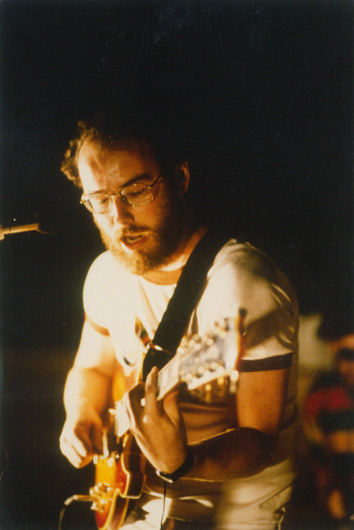
The Slunks (slunk is a cow's afterbirth, or an aborted calf covered in such) were a Mt Gambier party band in 1978, formed entirely so the members could learn to play. David Munroe (a.k.a. Dave Graney), an Aussie Rules playing timber worker, had travelled up the East coast of Australia, witnessing the nascent Sydney punk scene, and Rose Tattoo (and the Mangrove Boogie Kings). You can read about his impressions in his most entertaining memoir, 1001 Australian Nights. Having got a taste for the life he returned home and put together a vehicle in which to escape. The other players were Martin Wells on drums, Liz Dealey on bass and Steve St Stevens (a.k.a. Steve Miller) on guitar.
The Sputniks formed in Adelaide around April 1979 - Graney, Miller and Dealey having moved there and met up with Clare Millionaire (a.k.a. Clare Moore) on drums and Philip Marks (ex-Foreskins) on guitar. Over the next year, before a move to Melbourne, they proved themselves extremely hardworking and put together an impressive list of achievements.
Starting with a first gig in June they toured South (to Mt Gambier and Naracoorte), plus a Spencer Gulf tour with the Accountants, playing Whyalla, Port Augusta, and Port Pirie. Funded by proceedings from these tours, and live work in Adelaide, they recorded a single at Noumenon Studios in October. Our Boys / Second Glance was released in December.
Early 1980 saw the band getting a residency at the Union Hotel, where they endeavoured to get other bands to play, reportedly with mixed success. Live they played mostly originals, mixed in with Doors, Bowie (Queen Bitch), Buzzcocks (What Do I Get?), and 13th Floor Elevators (You're Gonna Miss Me) covers. Moore took front of stage for a version of In The Midnight Hour which was always popular. Admirably they had at least one new original every time they played.
March 29, 1980 saw their last Adelaide show, and in early April they moved to Melbourne. Gigs aplenty followed, amongst them The Bottom Line, The Exford, Paradise Lounge, Hearts and the Duke of York. Despite the year of hard work the foundations of the band proved shaky and by October Marks and Dealey had returned to Adelaide and the rest began to become the Moodists; starting with this ad in Juke magazine:
A fantastic Sputniks band photo can be seen here and the top few photos on this page are also our boys and girls. Graney and Moore's long list of musical collaborations is well documented elsewhere but you should also cock an ear to Dealey's later work, starting with the Acid Drops' brilliant Surfin' Prostitute Beat 7", through the stellar The Wailing House 7" with the Twenty Second Sect, who also put out several LPs.
But back to the Sputniks record. Played loose and sloppy, and with an endearing high energy, the rudimentary musical and songwriting skills don't stop this from being a great record. Of course, those deficiencies effectively add to its charm. In particular, Dealey's bass playing on Second Glance is a thing of joy; but the whole song is infectiously great from go to whoa.
The record was never issued in a sleeve but 100 copies were sold with badges attached to the diecut. We don't know how many different designs there were but feel obliged to show you this standout version:
The real it-never-ends action on this one revolves around the purple vinyl copies. In case we didn't mention it before, here at Wallaby Beat coloured vinyl rarely evinces much more than a shrugged shoulder; we just don't care. On the very odd occasion though it can cause us to break a mild sweat. The story went, and still goes, that a small batch of between 7 and 12 copies was made and circulated to the band's members and friends. Here 'tis:
And here are the two tracks. As always we thank Harry Butler's DNA fanzine for its excellent contemporaneous coverage of the early Adelaide scene - many of today's details come from Issues 4-16, and the Juke ad from issue 48.
Since most of you are SSL speakers, that's Strine as a Second Lingo, you'd be forgiven for missing the small ocker revival amongst tastemakers in recent years. The original Ocker was a character in the '60s TV show The Mavis Bramston Show, codifying the broad speaking, straight talking, piss taking, clever but smartarse bloke Aussies seemed to love to love. The genre never really went away, but it did start to seem less attractive as it morphed into the garden variety yob by the 1980s. Perhaps starting with the reissues of the Bazza McKenzie fillums, crate diggers started pulling a few old ocker classics out of bins country wide and proselytising their worth.
John Vincent was a South Australian DJ who put out many ocker novelty records, both under his own name and as the 'Ken Oath Ockerstra. We like this one in particular because of its links back to a cool earlier version from 1967. We'll get to that in a minute, but for now enjoy a bit of seasonal stupidity, with Thin Vin's approximate vocals taking centre stage.
The song has its roots in an earlier song, in fact Vincent's debut record, recorded with legendary Australian '60s band The In-Sect, whose I Can See My Love is rightly regarded as a classic of Australian '60s punk. As told by guitarist Frank Sebastyn to Ian Marks in the great recent book Wild About You, the In-Sect were the regular house band at the Arkaba Hotel in Adelaide, where they played six nights a week and an all day Saturday beer garden gig to 1200-1300 people.
I arranged that for John. He used to keep hanging 'round the Arkaba saying, 'Can I sing a song, mister?' And after weeks of telling him to piss off, we let him up on stage, and he did this song called 'Ow Ya Goin' which knocked 'em out. So I spoke to Ron Gillespie [from W&G] and he agreed to record him, too.
It goes on to tantalisingly say Ow Ya Goin' was "allegedly recorded in the lavatory at the Adelaide Railway station" with no further details!
Detailing the three stages of a standard piss up, the lyrics in total are:
'Ow ya goin'? Alright! Crack a coldie. You beaut! See ya later. Hoo roo!
Again for our SSL friends a few translation hints are in order: crack a coldie is "open yourself a cold beer from the esky"; you beaut is an exclamation of pleasure equating to "you little bloody ripper"; hoo roo they say is an archaic Australian farewell, but I've been hearing it all this weekend as I've done the rounds of family and friends. It's all helped along by a sterling performance by the In-Sect with loud drums, organ and some great guitar by Sebastyn.
Vincent and the In-Sect combined twice more, first on the Madge's Charity Badges / Choko Brandy 7" (RCA 101860, December 1968), then on the Ballad Of Andy Capp 7" on Adelaide label Gamba. Dean Mittelhauser said of the RCA record, "this was another of Vincent's terrible novelty songs, but the band's raunchiness is undiminished, particularly on the A-side where there is a truly fab guitar solo. It's absolutely boss, and makes Vincent's bad lyrics and even worse vocals almost bearable". It's a cool record and has been comped on the Australian psych CD, Datura Dreamtime.
Vincent revisited 'Ow Ya Goin' in 1973 on his only album. Without the In-Sect, and without '60s enthusiasm, it's reduced down to a pretty standard 12 bar blues workout. We include it for completeness. If you absolutely have to dig further into Vinnie's back catalogue we can perhaps suggest this approximation to Heads Down No Nonsense Mindless Boogie style satire from 1975, and again with a Ramones tribute band.
Think you know a lot about Australian records in the punk era? We promise to astonish you with stuff off everybody's radar. We apply quality control so our powerpop has power, our glam has prominent balls, our punk is spiky and our DIY is far, far out there. We'll also do it-never-ends exposés of sleeve variations and inserts you didn't know existed. Strap yourself in and enjoy the ride.




 The Slunks (slunk is a cow's afterbirth, or an aborted calf covered in such) were a Mt Gambier party band in 1978, formed entirely so the members could learn to play. David Munroe (a.k.a. Dave Graney), an Aussie Rules playing timber worker, had travelled up the East coast of Australia, witnessing the nascent Sydney punk scene, and Rose Tattoo (and the Mangrove Boogie Kings). You can read about his impressions in his most entertaining memoir, 1001 Australian Nights. Having got a taste for the life he returned home and put together a vehicle in which to escape. The other players were Martin Wells on drums, Liz Dealey on bass and Steve St Stevens (a.k.a. Steve Miller) on guitar.


 The song has its roots in an earlier song, in fact Vincent's debut record, recorded with legendary Australian '60s band The In-Sect, whose I Can See My Love is rightly regarded as a classic of Australian '60s punk. As told by guitarist Frank Sebastyn to Ian Marks in the great recent book Wild About You, the In-Sect were the regular house band at the Arkaba Hotel in Adelaide, where they played six nights a week and an all day Saturday beer garden gig to 1200-1300 people.


