We thought we'd throw you in the shallow end of Australian It Never Ends fanaticism with a trio of records the armchair collector can round up pretty easily. Auckland band the Scavengers first recorded True Love in 1978 and it appeared on the truly great AK79 compilation LP. In 1979 the band moved to Melbourne and changed their name to the Marching Girls. Their first single was a March 1980 re-recording of True Love backed with First In Line. This version is more toned down than the Scavengers, but it remains a superlative piece of pop-punk. Bruce Milne's AuGoGo records from Melbourne got the ball rolling putting the record out as their eighth release (ANDA-8, July 1980):
Next up was a New Zealand pressing - 400 copies on Simon Grigg's Auckland label Propeller (REV 4, August 1980):
Finally Bob Last's Edinburgh label Pop Aural got in on the action in June 1981 (POP 011) with a yellow wash over the background. This is the version that is slightly more elusive than the others, at least in Australia:
Like I said, you can complete this set fairly easily. Completism only gets harder from here on in.
Scavengers - True Love
Marching Girls - True Love
Marching Girls - First In Line
Marching Girls play Melbourne with a selection of local New Wave and pub rock bands, including our friends the Inserts
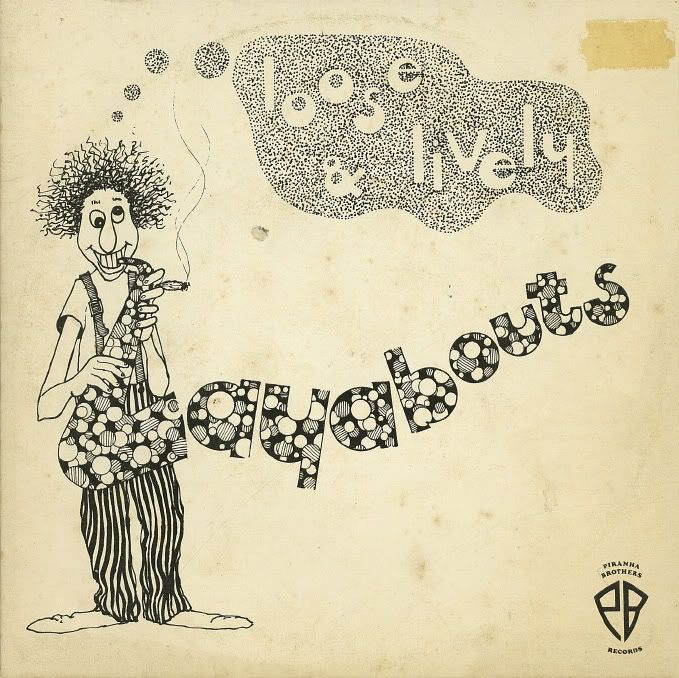
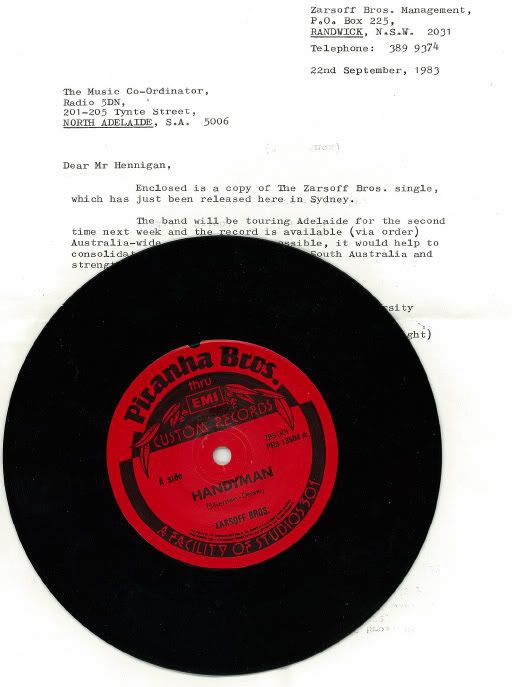
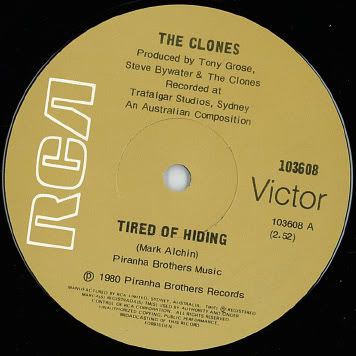
The Piranha Brothers, London extortionists with a fear of giant hedgehogs and a proclivity for nailing their enemies' heads to the floor, will be known to anyone familiar with Monty Python's Flying Circus. For some, the sketch has been killed by the tendency of Python dorks to quote it verbatim; for me, it's this malodorous Sydney label that has engendered eternal reluctance to revisit the adventures of Doug and Dinsdale. The label's general tenor should be fairly self-evident - nudge-nudge wink-wink dinosaur cabaret-boogie and flaccid comedy turd-rock. However, buried among the dross are a couple of noteworthy releases, namely a single (through RCA) by Sydney mods The Clones, and this underappreciated powerpopper by The Works.
Unlike The Clones, The Works evidently had a foot in both camps - that is, ties to the old guard (Captain Matchbox Whoopee Band) as well as the new (Numbers, Brave New Works). However, if there's any trace of Oz Rock in (You're Just A) Button On A Shirt, it's below the threshold of detection for these ears. Catchy, uncomplicated and with a neat guitar hook, the song drives along at a tempo and with sufficiently rough edges to leave you with some dirt under your fingernails. Good stuff.
A label retrospective CD has been cobbled together by Canetoad, where The Works and The Clones sit incongruously among the aforementioned turd bands, bullshit neo-rockabilly, and worse. Click here if you have a strong stomach.
That pic sleeve – wow. These guys heard Computer Games, foresaw the future of music, and didn’t like it one bit. Perhaps the matrix grid don't care, but Mighty Little certainly did - enough to respond with amps stretching over the horizon, helmed by a proto-King Diamond/evil monkey hybrid, staring down a bank of data tapes in a fight to the death (thus anticipating Japanese hardcore in the process). Bravo fellas, bravo.
For a record that states its intentions so boldly, the mix is a little on the tame side. The "full-frontal bass" (delivered by the remarkably vertical "Horizontal Smith") is just that, but the rhythm guitar really could’ve been brought to the fore. For the most part it’s all in the pocket, almost to the point of understatement - it’s not until the final bars that things start to get savage (unless of course you factor in the couplet that begins the first verse, which goes straight to the pantheon of sexist opening salvos). But in the end, the production shortcomings are overshadowed by the sheer meanness of the song. A tough guitar riff pinned down by a one note bassline is a defining element of '70s Oz hard rock, and this example holds its own against the best of them.
Equally, there's an Oz punk 'n' roll tradition of guitarists appropriating pop culture/TV themes as guitar solos (see Radio Birdman, Celibate Rifles). Here, axe-wanker Barrington riffs on Lawrence of Arabia, thereby lending the song its title. What this has to do with the musical culture wars depicted on the sleeve is anyone's guess.
There are at least three other singles on the Phoenix label, each worth hearing for the adventurous of spirit and/or low of standards. Variously, they are: shambolic, Raincoats-like all gal pop with shaky English and even shakier musicianship; oddball hard rock with mild overtones of Chrome circa Blood On The Moon (actually a reissue of The Flush 7” sans sleeve); and punky powerpop in the style of early Scientists. The likelihood that any of those reference points were intentional? Minimal.
Burning Sands Of Bondi
Is our man Barrington he of the post-Kuepper Saints?
Update 18 June 2011
Thanks for the comment Steve. Here's the Youtube video Steve mentions which has a more balls-out version of Burning Sands Of Bondi (with guitar up front, where it belongs), over some great rehearsal room photos. Not quite the Dunedin Sound.
Many years ago, when dinosaurs still roamed the earth, The Professor took time out from hunting woolly mammoths and working on his prototype of the wheel to carve these words on the cave wall that is the Australian punk discography. (These scratchings have, of course, been of great interest to subsequent generations of musical archaeologists. Perhaps someday he'll update the bloody thing. But I digress...). Despite the ongoing re-evaluation of records at the margins that has taken place since, the sentiment conveyed by those six words rings true today as much as it did way back when. The Replicas' sole 45 is a minor record. Still, it's a good one, at least if you're willing to recalibrate your expectations to the "minor record" sliding scale. Cool forceful drumming, no guitar, but bass way up front. Some keyboard noodling too, which somehow doesn't manage to ruin the whole shebang.
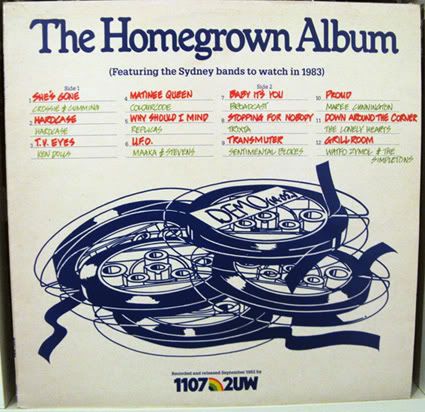
The Prof ended his assessment by saying that I Wanna Know The Truth "could use some guitar though". Now here I must beg to differ, for the evidence suggests that adding guitar was, in fact, a terrible idea. Try spinning The Replicas' only other vinyl appearance, a track on the Sydney local radio Homegrown Album sampler (1982), and see how long you can resist the urge to yank the record off the turntable and throw it out the window.
I Wanna Know The Truth
Some copies come with a screenprinted diecut sleeve.
The Professor: For a while there The Popes side of this got more column inches in Ugly Things magazine than did analysis of the Misunderstood's 1969 stool samples. Funnily though, while mentioned in dispatches on punk and DIY it didn't make the treatise on novelty punk, where it clearly belongs. I appreciate the Bonzo Dog Band moves but feel that it fails to rise to the hyped heights. Imagine my surprise though when the banner at my local newsagent screamed "The Popes Are Jackson Zumdish". There was a name I knew, and it meant they were Australian. It took me awhile to figure it out but it finally clicked that the Jackson Zumdish side had been played on 4ZZZ in Brisbane when I was growing up. After locating a copy of the record one play confirmed it, I was able to pretty much sing along to it.
We're stuck completely in novelty here, not a skerrick of punk to be heard. But the stupe vocals win me over every time.
Dr Who has some history as a punk rock reference point - see the Cybermen, the Daleks, Dalex, and Dalek I Love You, and the Art Attacks' I Am A Dalek for three examples (but not the K-9s). This is probably the only one to side not with the villains but with the good Dr himself. The idea of swanning around in space and time with a sonic screwdriver and a string of comely assistants does sound kind of appealing, at least more than being a shortarse half-flesh/half-machine foot soldier for a Philip Ruddocklookalike.
One last Aussie punk Dr Who tie-in - which Brisbane punk named his son after Adric, one of Dr Who's rare male acolytes?
Jackson Zumdish - (I Wanna Be) Doctor Who
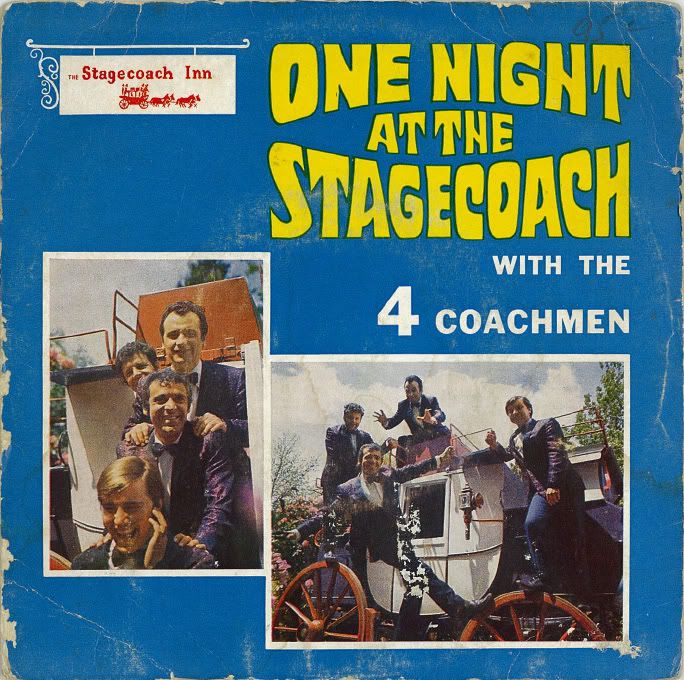
Born To Be Punched: Look, if you pitch a tent at the prospect of Strop fronting a Four Coachmen jam on Empire State Human, then clearly you and The Professor have a lot to talk about, and (I Wanna Be) Doctor Who will be the perfect soundtrack. Yes, Knup In Your Eye has been unequivocally overrated in some quarters. Yes, the back-spooling tape is a cheap gag that must make every studio engineer groan ("Oh wow, what was that you did there? Rewind the tape, you say? Sounds great, let's use it!"). And yes, dialling down the art student whimsy may have given proceedings more of an air of genuine dementia (yeah, we get it, you're referencing Napoleon and laughing maniacally while being taken away to the funny farm. Very clever). But here the band plays like there's at least one descended testicle between them, and on that criterion alone Knup In Your Eye takes the gong. Add to that the fact that the song ends with an explosion - one of my all-timefavourite(non)musical devices - and The Popes get a free pass from me.
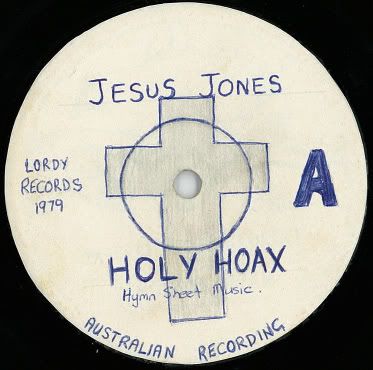
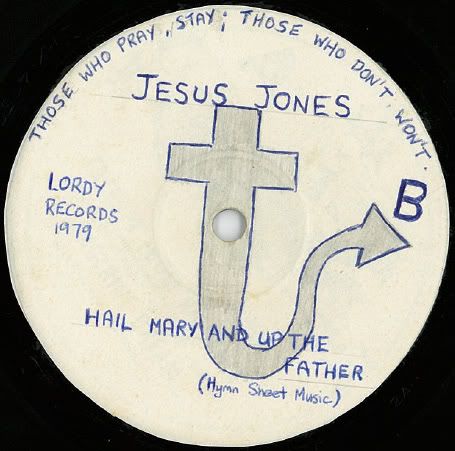
As you're putting fan mail on the collection plate at your local church next Sunday, you should probably also say a few Hail Marys and ask the bloke upstairs (or downstairs, doesn't seem to matter to these guys) for some assistance in finding this holy grail of Australian DIY. Musically, Jesus Jones owes a considerable debt to the Krautrock heavies, so perhaps it's fitting to invoke Tangerine Dream in saying the origin of this here supernatural probability is uncertain. Or in the words of another famous Jerry, I know nothing. (Just don't say that within earshot of the backing vocalists).
Here are the fruits of our painstaking research:
Melbourne. Almost certainly Melbourne. Probably.
Don't be fooled by the different A and B labels - this puppy plays the same on both sides, Desperate Bicycles-style.
We reckon the band members used pseudonyms. Pure speculation, though.
That's it.
Busy week here at Wallaby Beat HQ - barely enough time to wipe my own arse, let alone yours, so that means no mp3s for now (though this post may be resurrected later). Instead, we take great pleasure in teasing you with scans of one of the most God-like home-made sleeves from this part of the world. If anyone's more enlightened than us about this divine mystery, click on the comments link to make your confession.
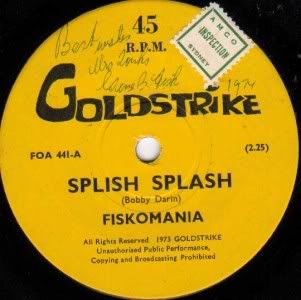
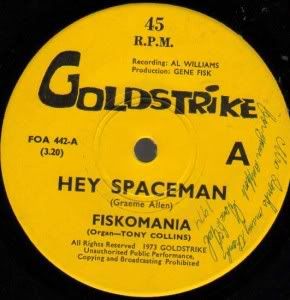
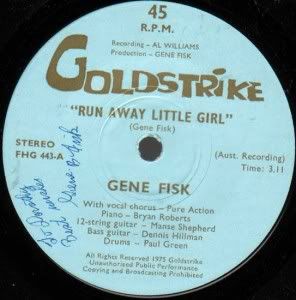
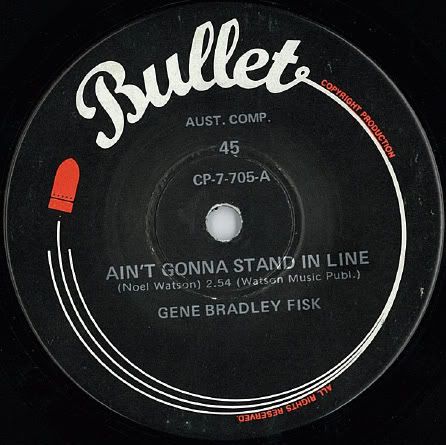
King Of The Block is no idle boast - our hero has been around it a few times. The magnificently named Rikk Krannium and the Smutorks (try spelling it backwards) is in fact highly regarded Australian country musician/broadcaster Gene Fisk, accompanied by his backing band at the time (the somewhat less imaginatively titled Gene Fisk Band) and some friends. Fisko's discography stretches all the way back to 1959, but the Rikk Krannium single is the last of four 45s released in the mid-'70s during his stint at radio 3BO, Bendigo (the others are worth hearing for those with an interest in slightly odd, pre-punk private pressings; see them here, here, and here).
Recorded live to two-track at the tail end of 1975, King Of The Block is an impressive stab at knuckle-dragging hard rock, with a rawness and energy that presages musical developments up north the following year. Sandwiched between screeching tyres and cop car sirens, the song is propelled by a driving, two-note bassline and some unhinged, wah-infused guitar. The band is nice and loose, the kind of performance that suggests supreme unfamiliarity with the material (in the best possible way), and you'd be hard pressed to guess that country and western was the principals' stock in trade. Only the harmonised vocal inflections at the end of each verse betray any country twang, though I'd be willing to bet that the axe-men are slingin' Telecasters, too.
Then there's the synth. Big, nasty, ballistic analogue synth blurts. For no reason. Great.
Imagine Fisko walking into Bendigo's High On Music and asking the clerk, "Just what do these EH driving long-hairs listen to?" And after internalising Paranoid and Machine Head, you can just see him pen in hand, lightbulb above head, pumping out this piece of genius in ten minutes flat. Thank our old mate Beelzebub (and Gabriel, both name checked) he did.
Fisk left Bendigo for a job at Melbourne's 3UZ shortly after the single's release in 1976. With no band to push the record, it fell off the radar almost immediately. Among country enthusiasts who did get to hear it, King Of The Block was not warmly received - entirely the wrong audience, to be sure. We hope it finds its rightful audience here.
After flirting with the dark side, Fisko then merged it with his first love, touring and recording with outlaw country bands over the next decade, first with the backing of Gunslinger, then reverting to nominal literalism as Gene Bradley Fisk's Outlaws. The Williams family took three generations to cover country, outlaw country and hard rock - let's salute a man who did it in one lifetime.
It's 1980 so now powerpop is allowed to have dismissive attitudes and metallic guitar tones, and why not, when the result is as super as this? A couple of things stand out - the infectious enthusiasm and the great, fluid guitar lines. The guy could play.
A stellar track delivered in a snappy red-on-white design by a short lived Melbourne group. Have a listen to Amateur Hour:
OK - how was that? Pretty good? You might wanna stop reading here because now reality bites.
There's a small but definable genre populated by new wave/oz rock bands that got lucky with one song - Personnel, Moral Support, DV8 and others. We didn't want it to be the case, because Amateur Hour is so great, but it would seem The Inserts also fit into this classification. The flipsides of this record (White Reggae [just imagine] and Bad For Me), and the video linked to below, project a band enamoured of crud like The Police and The Cars (if that smells like inner city snobbery so be it, we prefer it to the whiff of vin ordinaire). And with that perspective, Amateur Hour's ska-like middle eight, complete with mildly poxy octave bassline, seems like the band reverting to type rather than a momentary lapse in taste. To quote the notable scholar David St Hubbins, "too much fucking perspective".
Showing admirable adaptability our lead man went from: oz rock/new wave/pop (Inserts live in 1981); to the odious synthpop of Tin Drum (actually two of the Inserts; Amateur Hour is prophetic for this clip), oh dear; to the non-hair farmer in a latter lineup of heavy metal stars Bengal Tigers (who were pretty good in their day - another missing link between grillfat and LA glam metal?). But hey, the guy could play.
At various times the Real Traitors have been a hit in San Francisco (see below) and Hell, Norway, but remain practically unheard everywhere else, including their hometown of Sydney. The Kuge's "primitive shit music" nomenclature probably tells you all you need to know - the terms are even arranged in descending order of importance.
There's been much discussion between your humble correspondents about the influences at work here, but pinning them down feels like jamming a series of square pegs into frustratingly round holes. Can anyone name who these guys were channelling? Not us. One is tempted to dive down the rabbit hole of international DIY to contextualise this racket, but on the balance of probability, and given the year, our subjects were more likely spurred into action by the weirdness on the Bullshit Detector comps. Certainly the first (more, uh, "structured") side would not be out of place among the bedroom anarcho gurglings collected on those records. Early, dirgy Amebix with chromosome damage? Six Minute War (c. Slightly Longer Songs) trapped in a mine shaft? Sure. But then again, not really. The turd is polished with discernable influence from local heroes SPK - some white noise from Slogun here, a dive-bomb from Germanik there - but the strident, jackboot-wearing crunch of early industrial is conspicuously absent.
Things go off the deep end on the second side. You're on your own there.
Blackmailing You is the recommended starting point for those wishing to dip their toe in the cesspool - the band's murky, rhythmless riffing is at its most effective here. Still, as Jello rightly noted, this is not for the squeamish. For those with delicate musical palates, consider the first song title in relation to your bandwidth before downloading.
It's A Waste
Blackmailing You
Death Meaning
I Just Don't Know Where I'm Leading To
Jello Biafra reviews the Real Traitors EP, from Maximum Rock 'n' Roll #10, December 1983. We think the supplied address, the multi-storey terrace on the corner of Fitzroy St, was a squat back then.
Addendum 7 June 2011
As pointed out in the comments the Real Traitors were another fruitful Australia/New Zealand cultural merge. Ages ago Graham Osborne sent us the pertinent info, here it is:
The line-up was Max Katterns, Grant Freeman and Graham Osborne.
Since you asked, I think we were probably channelling LSD, but we had listened to everything around at that time and stretching back to the Velvets, Stooges, Eno, Can, Cale. We hardly ever recorded without acid, it was like a house rule, and we were evicted from one studio in Sydney when things got too weird for the engineer. We tried to play out just once, at the Kardomah Cafe in Kings Cross, I think it was, but the manager threw us out as we were setting up, saying "we don't like your attitude," which came as a complete shock because we hadn't even started playing. But we were tripping then as well and maybe he noticed we'd grabbed a carton of beer from behind the bar to try to ease the visions of blood dripping down his anxious face.
Two of us recorded some stuff in NY, then went to England and did some more over there. We had an album deal with Dan Treacy's (Television Personalities) label Dreamworld, which was distributed by Rough Trade, then just before it was due for release Dreamworld declared bankruptcy.
Labels - Graham's facebook is in the comments - let's get that unreleased LP out there.
Contrary to the one word review written on the label, Goodbye Judy is an astounding piece of pre-punk powerpop. I'm sitting here reading the Bomp powerpop issue from '78 and feeling this captures every element Greg Shaw talked about within: "short, catchy, hook-filled, built on bright uplifting major chords... the element of urgency, the possibility of (uncontrolled) violence". OK, while the beat is thuggish, there's little threat of violence (unlikethe other notable Judy from 1976).
But what is the story? Chuck Warner wrote eloquently in the Teenline liners on the genre's "basic mise-en-scène: a hopeful but hopelessly single guy, so, so alone in a world where, somewhere, inevitably lurks the perfect girl. It’s just that she’s already going out with someone else - or she’s one or more of the following: hiding, vain, spiteful, oblivious, older, unapproachable, unaffordable, too shy, too pretty…or simply a little too boy-crazy to settle for just our hero!"He stresses he's writing about America, 1973-80, and yes, we hope a band playing suburban Melbourne halls and high school dances was a bit tougher than that... our singer here has at least loved and lost. And while it's not exactly a put-down song at least he's showing a bit of spine and self esteem - it's her loss!
What about some of the musical and production elements? Horns, great multitracked vocals punctuating the lines, the whispered backing vox "Is that you?", the glorious "iiiiiiii, I don't want you" chorus, again - the keep-it-simple proto-thug drumming, and the delicate acoustic guitar under the third verse. All up a tip of the hat to the songwriters, producer and arranger.
While Judy is the undeniable hit, Paper Chains is no slouch either – great innocent 1970s pop, this time with a glammy, power-chord driven middle-eight stomp. Evocative of pashing your main squeeze after a spot of BMX riding in the bush near the creek. One can imagine this going over well on Beaut’s support slot for the Bay City Rollers’ November 1976 tour. Anyone willing to own up to being there?
Goodbye Judy
Paper Chains
Unfortunately, the second and final Beaut 45 (Infinity K-6715, 1977) doesn't match the success of the first (creatively, at least – I’m sure sales were roughly zero for both). The horns, piano, even the acoustic guitar embellishments of the first single are no more, in favour of more pared-back production. One can only speculate that the Infinity coffers slammed shut after Goodbye Judy bombed. Why Baby Why attempts to compensate for the lack of additional instrumentation with dense vocal harmonies and some interesting guitar interplay throughout the chorus. The problem is that it’s saccharine as all get-out – bittersweet, sure, but this stuff will rot your teeth. And let’s face it, the band’s balls aren’t exactly dragging on the ground in Goodbye Judy, but at least they’re not stuffed into a purse.
Over And Out is the stronger cut, and is the closest thing we have to the sound of Beaut belting it out live. Ordinarily something to be lauded, but one can’t help but wonder whether the production values of the first single would have elevated it to something special. Overall, the whole affair comes across somewhat flat, a bit of an afterthought. Still, a Burnett-Cutelle afterthought is better than many a band's A-game, and there's evidence that the suits at Festival had ongoing faith in our dynamic duo...but that's a story for another day.
Why Baby Why
Over And Out
A Beaut promo sheet for the Goodbye Judy single. There's another one floating around proclaiming Scheaut Beaut! Onto your playlist!. Wishful thinking, and dangerous waters for those with English as a second language.
Think you know a lot about Australian records in the punk era? We promise to astonish you with stuff off everybody's radar. We apply quality control so our powerpop has power, our glam has prominent balls, our punk is spiky and our DIY is far, far out there. We'll also do it-never-ends exposés of sleeve variations and inserts you didn't know existed. Strap yourself in and enjoy the ride.