Systematics are good and all, but their earlier records - the Pulp Baby EP on Doublethink and the Rural 12" on M-Squared - offer little for those of us who just wanna slam in the pit. Nice of 'em to rectify that deficiency with this fine stab at Metal Urbain via 2nd LP era Ultravox! from their last release, My Life In The Field Of Cows. Of course, this being M-Squared, the bass is a keyboard and the drums are a fucking robot or some shit, but who can hold it against them when the results are this impressive? Dig the outro from the choruses - guitar says up, synth says down; guitar says down, synth says up. It's like M-Squared's relationship with the post-Birdman Sydney scene encapsulated in two notes.
Mopsie (a.k.a. Elizabeth Ward) and Jerry Beans formed an ongoing creative partnership in the mid-'70s, the Conservatorium-trained Mopsie writing music and Jerry contributing some unique, funny and unmistakably Australian lyrics. The pair were genuine iconoclasts, especially in Sydney's western suburbs, around which they'd lug their own PA and set up DIY performances (literal train-spotters may recognise the old Blacktown station on the LP's front cover). Initially, Mopsie would sing and play live with keyboards and drum machines; later, backing tapes were introduced, allowing her to pursue an ever more theatrical performance style.
Almost inevitably, Mopsie crossed paths with the fledgling westie Local Label, which issued her One Out 7" EP in 1979 (Local MX189770). Though not our preferred Mopsie record, it does have its charms, and is said to have accrued some prominent supporters. The Introduction to Can't Kick the Sucky Tit and Other Cream Cakes, a self-published anthology of Jerry Beans's lyrics, notes that the EP received airplay from John Peel; over time, this has morphed into a claim that the 7" was one of Peel's favourites. Given its absence from the infamous record box, we'll charitably assign that one a yellow verdict.
Mopsie's next (and final) record, 1981's Appearances LP, may ring bells for eagle-eyed scholars of Incredibly Strange Music, thanks to an incidental, blink-and-you'll-miss-it mention by Jello Biafra in the second of those books. Jello likened the LP to Lady June's Linguistic Leprosy (well, vice versa, actually) - to us, Mopsie sounds more musically theatrical and less experimental, but we fully acknowledge that sans blogs or Youtube, it's not a comparison we'd ever be able to critique. Say what you want about Jello, but the guy was switched on.
Appearances is a bit of a mixed bag. Some of the more successful tunes, like L=E/R or Baby Romeo ("A sort of aging embryo"), are the kind of downer minimal electronics which would appeal to fans of the Denial single on M-Squared. Chaos, with its processed vocals, clunky drum machine and anti-rockist tendencies, should find favour with the more art-punk inclined. Elsewhere, however, things descend into absurdist, one-woman-band show tunes, but even then the music is odd and the lyrics unerringly eccentric.
After the LP, Mopsie pursued her interest in drama, directing and acting in plays which had evolved from Jerry's lyrics. A cassette with post-LP material - performed at the likes of Garibaldi's, Cabaret Conspiracy, Glebe's Toucan Cafe - was sold via mailorder, but we've been unable to locate a copy (drop us a line if you have one you'd part with). Mopsie maintained an involvement in the western Sydney theatre community up until her passing in 2007 - you can read an obituary at her posthumous Facebook page.
Chaos [Download]
Update: 29 June 2012
We're indebted to Roger Grierson for drawing our attention to an uncredited Mopsie Beans work. This advertisement for TDK, surely etched into the brains of most Australians born before 1980, might make Mopsie the most widely-heard performer featured on this blog.
Mopsie Beans (right), 1982
Lyrics for L=E/R (retitled Love Song) and Chaos, from Jerry Beans' Can't Kick the Sucky Tit and Other Cream Cakes (Mopubs, 1984)
For those who came in late (as the Phantom comics used to say), Plastic EP and the Records debuted in 1981 with a self-proclaimed "New Wave" record - in reality a great, punky DIY single, the product of a spontaneous creative process and a desire to capture the moment, warts and all. Resurfacing in 1982 under a more collective appellation, the EPs' second single shows them pursuing a musical direction befitting of the previous 45's product information message.
A very different proposition from its predecessor, the follow-up displays a greater degree of, dare we say, "professionalism". For starters, there are drum machines and sequencers all over this puppy, which have the effect of corralling the songs into much tighter structures. The songs are more fully developed, too (one gets the sense that the band is aided and abetted here by their producer, Rudy Brandsma), but still show telltale signs of the classic EPs minimalism - the intro/outro riff of Secret Love is Three Special Words in reverse! And of course, singer Plastic EP's trademark tendency to loiter in the vicinity of (but never actually on) the note is in full effect. Add some inexplicable sound effects - dogs barking, babies crying - and things are never in any danger of becoming too, uh, normal.
Before moving on, we note with interest that the labels credit "Eric" with videos for both tracks. The videos have so far eluded us - Eric, if you're out there, we encourage you to avail yourself of Youtube.
Secret Love
Forget All I Said
Secret Love was the EPs' last appearance on vinyl. As record collectors, it's tempting to view this single as the end of the story, when in fact it was just the beginning. The EPs continued on throughout the '80s, gigging sporadically, and even appearing on Hey Hey It's Saturday's Red Faces in 1987 (again, if anyone reading this has the segment on tape, Youtube awaits). With some line-up changes, the band still exists to this day, rehearsing and recording at its Melbourne home base. In our last instalment, we alluded to the fact that the 7" format enforced a certain quality control on the EPs' output, and noted that the culling process became less and less apparent over time. Taking their "record now, think later" MO into the digital age, the EPs' every fart is now documented and uploaded to the internet for the whole world to hear. At the time of writing, there were 100 albums - 100! - available for download, with more being threatened. Some of this material is self-described as "comedy rock", but it's often difficult to determine where the sincerity ends and the comedy begins. Where, for instance, does an amateur "Mega-Mix" of At Home fit in the scheme of things?
If Wesley Willis floats your boat, we suspect that there are some hidden gems awaiting you among the EPs' back-catalogue, but to find them you'll need to be made of stronger stuff than us. That being said, fans of the Secret Love single are advised to check out Make A Record, another early EPs composition which appears to have been recorded in the same session.
Addendum: 20 January, 2011
Ask and ye shall receive - The EPs on Red Faces, 19 September, 1987.
Many years ago, when dinosaurs still roamed the earth, The Professor took time out from hunting woolly mammoths and working on his prototype of the wheel to carve these words on the cave wall that is the Australian punk discography. (These scratchings have, of course, been of great interest to subsequent generations of musical archaeologists. Perhaps someday he'll update the bloody thing. But I digress...). Despite the ongoing re-evaluation of records at the margins that has taken place since, the sentiment conveyed by those six words rings true today as much as it did way back when. The Replicas' sole 45 is a minor record. Still, it's a good one, at least if you're willing to recalibrate your expectations to the "minor record" sliding scale. Cool forceful drumming, no guitar, but bass way up front. Some keyboard noodling too, which somehow doesn't manage to ruin the whole shebang.
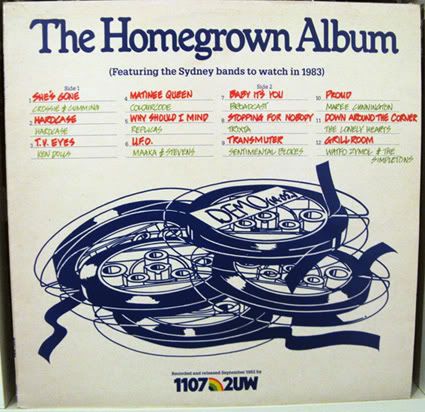
The Prof ended his assessment by saying that I Wanna Know The Truth "could use some guitar though". Now here I must beg to differ, for the evidence suggests that adding guitar was, in fact, a terrible idea. Try spinning The Replicas' only other vinyl appearance, a track on the Sydney local radio Homegrown Album sampler (1982), and see how long you can resist the urge to yank the record off the turntable and throw it out the window.
I Wanna Know The Truth
Some copies come with a screenprinted diecut sleeve.
Think you know a lot about Australian records in the punk era? We promise to astonish you with stuff off everybody's radar. We apply quality control so our powerpop has power, our glam has prominent balls, our punk is spiky and our DIY is far, far out there. We'll also do it-never-ends exposés of sleeve variations and inserts you didn't know existed. Strap yourself in and enjoy the ride.


 Almost inevitably, Mopsie crossed paths with the fledgling westie Local Label, which issued her One Out 7" EP in 1979 (Local MX189770). Though not our preferred Mopsie record, it does have its charms, and is said to have accrued some prominent supporters. The Introduction to Can't Kick the Sucky Tit and Other Cream Cakes, a self-published anthology of Jerry Beans's lyrics, notes that the EP received airplay from John Peel; over time, this has morphed into a claim that the 7" was one of Peel's favourites. Given its absence from the infamous record box, we'll charitably assign that one a yellow verdict.