Showing posts with label 1985. Show all posts

Sunday, 3 February 2013

It Never Ends: The Aberrant compilations

Looking back over Sydney fanzines from the '80s there was a hell of a lot of punk bands in the harbour city. A hell of a lot of bands who really didn't get around to documenting themselves. If it weren't for Bruce Griffiths' three Aberrant compilations even more of those bands would just be a faded memory.

The run started with Flowers From The Dustbin in November 1983, its title inspired by a line in God Save The Queen. Setting out to capture some of the bands who had been playing around that year it was successful, but as Griffiths later noted "a month after release just two bands remained and one musician was dead." While The Kelpies, Positive Hatred and World War XXIV would have more stuff released by Aberrant, and Box Of Fish went on to put records out on Method, this was it for Velocette, Queen Anne's Revenge (who became CHAOS) and What?!! (who only ever played one gig anyway!). The foldout poster sleeve for this was a real labour of love, with over 160 band photos, posters, lyrics and band histories.

Second was Not So Humdrum which aimed to use leftover Suicide Squad tracks from the first compilation, which had been mooted as a double at one stage, with some 1984 vintage bands. From memory the title was a riposte to Molly Meldrum's Humdrum segment on Countdown. If you were impressed by the sleeve layout on Flowers From The Dustbin then you were surely completely blown away by the sixteen page booklet sleeve for this record. Particularly strong on this record are the two tracks by the 1984 incarnation of Rocks, and special note must be made of Gavin Williams from WKOSA's "I Hate Oz Rock" t-shirt. The booklet also contains Griffiths' first Sydney family trees. Sitting here looking at them again for the first time in a few years I'm astounded by the amount of information on completely forgotten bands contained therein. "The Clits: Late '78. 1 gig in a chicken shed at a party on a farm". Amazing. Note that you need the stamped paper diecut sleeve to have a complete version of this release.

The third Aberrant compilation took a similar tack. Released in 1985, Why March When You Can Riot?, named after a line in the Rejex song Who Wants To March, mixes up '85 era bands like feedtime and Bedspreads, with early Hard-ons recordings, and late '70s tracks by Johnny Dole and the Scabs, XL Capris, X and Local Product. This was the first time that the X and Johnny Dole tracks contained were issued and they are fantastic. In fact this is musically the strongest of the LPs, though that may be our late '70s preferences showing through. Again the booklet (plus extra insert) is exceptional, with more photos, lyrics, interviews and family trees (pretty sure the only mention anywhere of pre-Nervous System band Farfisa and the Fucked Organs) than could fill yet another wet Sydney weekend.

So all up there's three essential records from which to garner more of an understanding of Sydney punk. There's an interview with Bruce by Steve Gardner that goes into details on how the records were put together, along with Griffiths' inspirations and philosophy - read it here. Everything from these records, plus an extra Kelpies track and the first Trousers In Action 7", was compiled on the Go And Do It double CD on Small Axe from 1996, which is still available here. When you've come back from purchasing it we'll get into the French issues.


All three albums were issued in France on the Ripost label: Flowers From The Dustbin in 1986, Not So Humdrum in 1987, and Why March When You Can Riot? in early 1989. The first contains a copy of the Australian sleeve as an "insert", while the second and third have cutdown 4-page inserts based on excerpts from the Australian booklets.

What we find most entertaining about these is the cover artwork, credited to Emmanuel on the first two, but we're pretty sure notre homme was behind them all. Manu burst out of the gates with three punk kangaroos going off. Some of the best punk novelty records and artwork originated from the French speaking world and the tradition is kept strong here with safety pins, mohawks, sunglasses, a chain necklace, and a midriff singlet emblazoned "FUCK". We're kinda partial to the zippered shut pouch, though.

We asked Bruce about these sleeves a few years ago.
Even having you remind me of that midriff top years later is making me cringe (as well as remember how much I cringed at the time) although I'd probably have enjoyed the zippered pouch had the other nonsense not been present. The extent of my memory is they wanted the covers to scream "Australian punk" so ditched the punk photos in favour of cartoon kangaroos with safety pins, which apparently the French would immediately 'get'. One of the covers isn't half bad, once you've adjusted to the whole, er, 'idea', but they're all pretty cheesy really. The backs they kept intact. 
[Wallaby Beat] As I remember you telling me you said "whatever you want" as long as there's no skulls or anarchy symbols and you were a mite horrified when you saw kangaroos with leather jackets and mohawks, and yes you're right - safety pins.
Ah, yes, you are correct. That's exactly what happened - I definitely specified "no skulls", and I strongly suspect I blacklisted the "(A)", and maybe that was it. I've remained partial to safety pins, so wouldn't have ruled them out, and leather jackets are harmless enough, but it never occurred to me they'd do cartoon kangaroos. I can only assume I didn't specify "no mohawks" (never liked them, so something I overlooked rather than consciously didn't do)... I wouldn't rule out zips either (pretty sure those kangaroos have many)... 
Emmanuel hopes the safety pins flying everywhere distract attention from the skull belt buckle and anarchy badge. The emu mic stand is kinda inspired though...
[Bruce] I don't mind the paratrooping one, in terms of the aggression, but if they'd said "We want kangaroos" I'd have done the art myself with a safety pin through a kangaroo's head a la Jamie Reid or somesuch, with infinitely more style and a nod to 'the master'. Ah well. Photo of kangaroo, pin through ear, zippered pouch, done. They sold out the pressings, so perhaps they knew what they were doing? 

As always we leave the real it-never-ends aspect to the very end. At some stage Ripost ran out of sleeves for Not So Humdrum. They recycled sleeves for Flowers From The Dustbin by turning them inside out and printing new Not So Humdrum artwork previously used on the labels of the three Ripost LPs. By now our only surviving kangaroo is looking bruised and battered and all the worse for wear after a night on the tiles. Not a single punk cliche to be seen though!


On the back of the sleeve for this one Emmanuel reveals his model for the kangaroos was rats, and rooting rats at that. I thought the tails on those paratroopers didn't look like roo tails!


Update 9 March 2013: Here is the xerox sleeve for Why March When You Can Riot mentioned in the comments. Used for 33 leftover copies of the record.

Sunday, 20 January 2013

Marching Girls - Plain Jane 12" RTC MG600, 1983


We've discussed before meta-topics like songs changing hands between bands. If you're fishing for thesis topics there's a need for a Carducci-like discursion on bands changing genre through their life, and the almost universal deleterious effect on quality. I mean, we wouldn't read it, but go ahead and write it. Here's our minimal datapoint contribution.

The Marching Girls were Kiwi transplants to Melbourne who recorded a pop-punk high water mark in 1980. Following a few years playing around they lost Brendan Perry, took on a new vocalist in Debra Schulze and set about changing their sound. The recorded result was a 12" laid down at Richmond Recorders in January 1983, and only released in New Zealand later that year. Despite leaving True Love way behind and generically falling in the new wave camp we can't hate it unreservedly. There are some good ideas at play on the record, nowhere more so than on track 3, Plain Jane. Slow tempoed, with interesting percussion and a pretty great refrain, we're happy to champion it. The rest of the EP is less to our taste, being more gothy, atmospheric and dare-we-say-it, dull. If so inclined, youtube is your friend.

Plain Jane (1983) [Download]


Plain Jane resurfaced in 1985 on an Australian 7" (EMI, EMI-1438). Re-recorded, and a minute shorter, points are deducted for the 1980's drum sound. On the plus side however the guitar under the chorus is much heavier, placing the song as a precursor to the sound labelled shoegaze in England some years later. The flipside of the 7", The Man Who Knew Too Much, appears to date from the 12" sessions, based on the production credits. It's an instrumental, and we'll leave it to you to search out. There was one further 7" in 1987.

Plain Jane (1985) [Download]


From the Marching Girls myspace(!) page.

Sunday, 28 August 2011

Rejected - First Offence 7" EMI Custom PRS-13775, 1985

To paraphrase Buddy Rich by way of Frank Costanza: Australian hardcore...this is not our kind of hardcore. We'll leave it to scholars of the genre to compile the definitive '80s hardcore punk world rankings, but Australia's output sits well behind that of heavyweights like the US, Sweden and Japan. Better than France? Not as good as Germany? Whatever our position in the league table, it's hardly a source of national pride.

There are exceptions of course, and some gems to be found among cassette releases, but in general the vinyl landscape of Australian hardcore is bleak. Some of this stuff has seemingly developed cachet in certain circles, but as support for our prejudices, we'll direct you to the back-catalogues of Cleopatra and Reactor Records as the last word in mediocrity. Not all of it is bad, necessarily, but at best it's undistinguished. In some cases the records simply haven't aged well; in others, it's clear that there wasn't much going on to begin with. And then there's the Crucified Truth EP, which flat-out sucks no matter how you slice it.

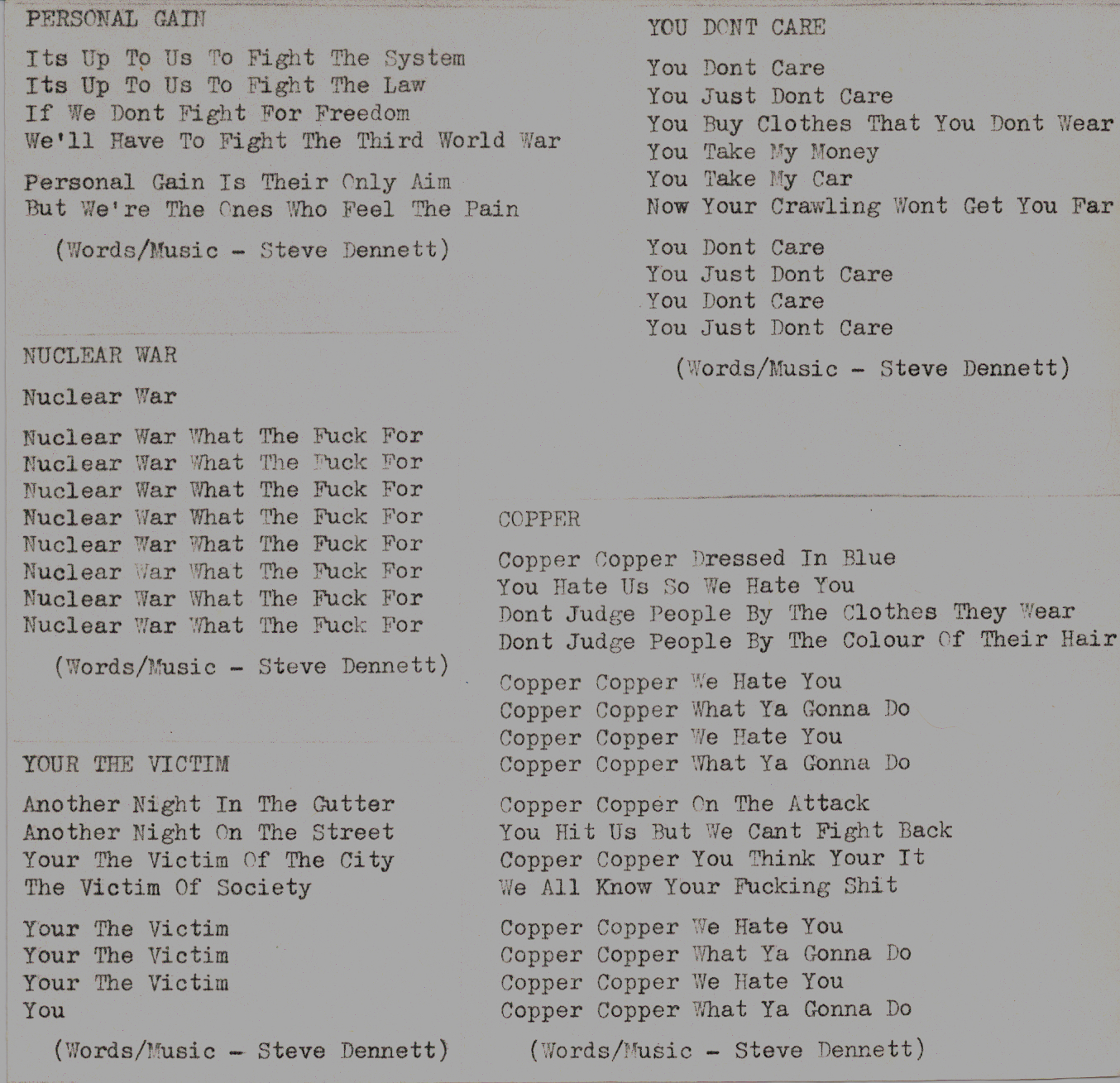
So what's so special about The Rejected, then? Well, at first glance, not much. Their First Offence EP from 1985, a 300-press EMI Custom job, is blighted by two elements guaranteed to sink any hardcore record: bad (i.e. good) production and cheater-beats. The clarity of the recording is problematic across the board, restraining the songs from achieving the requisite level of urgency, but it's Personal Gain and You Don't Care which are the main offenders in the cheater-beat stakes - drumming lost in the no-man's-land between traditional hardcore polka rhythms and blast-beats, minus the propulsion of the former and the BPM of the latter. Copper, which closes out the record, is Plod by name and plod by nature, and does little to redeem proceedings.

What is significant about First Offence is its use of the D-beat. For the benefit of anyone reading this from under a rock, the archetytpal D-beat can be found in the first seconds of the first song on the first Discharge record, and thereafter up to the crushing Why 12". Others may have beaten them to the punch, but there's a reason it has come to be known as the D-beat and not the Buzz-beat: Discharge delivered it with such conceptual singularity as to map out the raw punk blueprint for the next 30+ years. In other countries the D-beat was embraced as an important stylistic innovation, but Australians, it seems, were not early adopters. Similar impulses manifested differently in Seems Twice (more on them later), but there's scant recorded evidence of the kind of direct influence apparent in Scandinavia and beyond. Discharge was held in high regard here, as various covers of the era attest (Decontrol by Sick Things; Never Again by Public Nuisance; State Violence, State Control by Mob Vengeance), but those covers are telling in and of themselves - not a D-beat among them. And on the rare occasion that D-beats did show up in Australian hardcore songs, the effect wasn't particularly Discharge-like (check out this pretty good and relatively early example from End Result; various takes by Arm The Insane are also littered across their generally dire discography).

Nuclear War and You're The Victim are notable, then, for being Australian D-beat songs with a heavy Discharge influence in the structures, riffage, and lyrics. The slickness of the recording is still less than ideal, but the songs do have brevity on their side, and they're the definite highlights of an otherwise unremarkable record. Both songs would be re-recorded for The Rejected's subsequent LP, but disappointingly - much like Diamond Head's fate at the hands of some other band - D-beats were conspicuously absent on the new versions. Which means that our interest in The Rejected ends here. Gluttons for punishment may wish to track down their second (and final) LP, but with a pressing of just 69 copies, we wish you luck and a speedy recovery to full mental health.

Personal Gain [Download]


Nuclear War [Download]


You're The Victim [Download]


You Don't Care [Download]


Copper [Download]


Nuclear War, what the fuck is it good for?