Sunday, 6 November 2011

Armchairs - Party Time LP Reverse/Missing Link MLB002, 1980

As noted previously, Melbourne pub rock (a.k.a. the Carlton scene) has never been our bag. It was well before our time, but firsthand accounts from a punk perspective range from the dismissive ("flawed" and "an outgrowth of hippiedom" - Inner City Sound), to the antagonistic ("We were the exact opposites of the Carlton scene" - Ash Wednesday). But, all cultural prejudices aside, our main gripe has always been the music itself. The Prof summed it up best: "not enough stomp or belligerence". Still, re-evaluation of the Carlton bands has begun, albeit in a minor way, and in that spirit we too have started to dabble. We're not yet at the point of subjecting ourselves to Jo Jo Zep, but as time marches on, some of the scene's major players have begun to make more sense to us. Where Skyhooks once seemed wildly incongruous on the UK pressing of the New Wave LP (tellingly, a second Flamin' Groovies track was subbed in on the local version), they now seem only mildly incongruous; as we have aged to appreciate small doses of Elvis Costello and Graham Parker, a fresh listen to the Sports reveals that they may not have been so shitful after all. Even that first Dots single - a record that has perennially teetered on the edge of the "purge" pile - is starting to sound listenable. Come 2015, we may even upgrade it to "not bad".

Still, we cannot claim to speak with any authority on this scene. Indeed, the exact relationship of today's subject to Melbourne pub rock isn't entirely clear to us; however, given Inner City Sound's explicit exclusion of "the Carlton School", and the Armchairs' absence from that book, that's where they have been filed in the Wallaby decimal system. That said, as an example of Melbourne pub rock, the band does seem to represent a tangent with definite inclinations toward the new wave. At the Armchairs' core were Ian Stephen and Johnny Topper, with a revolving door of Melbourne musos fleshing out the band. Stephen will be known to readers of this blog as the vocalist on Marriage Is A Splendid Thing and Family Fun Parlour, the latter being one of the standout songs from the second Fred Cass and the Cassettes 45 (Fred/Lee Cass was also an early Armchair). On that record, Stephen mingles with the who's who of Carlton scenesters comprising Cass's band. Johnny Topper, on the other hand, should be familiar from his recurring role on the Fast Forward cassettes, the jokiness of which is carried through to much of the Armchairs' output. Both Stephen and Topper had previously released singles under their own names which the highly motivated may wish to seek out, but frankly, we'd advise against it.

The Armchairs' "new music" leanings are evident in the venue at which they debuted in 1979 (the Crystal Ballroom), and in the lyrics on their first single which rail against "that turgid crap that you hear on the radio" (the Ski Lo Lo 7", released on Stephen's own Reverse label, can be found here). The single is lightweight and light hearted, and much of the follow-up Party Time LP, originally written for a musical theatre production called The Zig Zag Follies, follows suit. Various internet sources tell us that the version of La Bamba which populates most of its B-side is either 17 or 20 minutes long, but we value 17 or 20 minutes of our lives too highly to settle that discrepancy. Among it all lie two songs of merit: the catchy if overly-long pub rock of Can You Guess? (with vocals by Graham Barker [sic]!); and Into The '80s, which has a certain punky attack in the drumming and guitars, and is our track of choice. It ain't The Now, but then again, not much is.

More detail about Ian Stephen's subsequent work (most notably with the Slaughtermen) can be found at his website. Allegedly, his latest release is a CD entitled This Is Really Gay, on International Art Wankers records. Johnny Topper can be heard each Wednesday as presenter of New & Groovy on Melbourne community radio station RRR.

Into The '80s [Download]


Sunday, 30 October 2011

Differentials - Thriving Metropolis 7" EMI Custom 13061, 1981

Record collector dreams, part 317. What if there was another Brisbane punk record? Maybe one from the fallow period between the giants of the late 70s and that short second period around 1982-3 (Public Execution, Mystery Of Sixes, Vampire Lovers). Wake up, daydreamer! Here it is.

The Differentials were a punk band who played around Ipswich and Brisbane from 1978 to 1983. Ted Elliott explains:
The Who's Who Of Australian Rock described us as Radio Birdman influenced. Not true. We played a couple of Ramones covers and very early Cure (10:15 Saturday Night) but mostly were a kind of pop punk outfit that eventually sounded like the Sunnyboys.
In 1981 the band recorded an EP and sent it off to EMI Custom for pressing. In a Spin̈al Tap-esque mix-up, when it came back from the plant the band's name failed to appear on the labels. Rather than print picture sleeves the band took the path of least resistance.
It was meant to be the name of the EP! 'Thriving Metropolis' by The Differentials. So the band changed their name to Thriving Metropolis for a couple of years.
While not an out-and-out classic, the record's a good'un, and a grower. The pick of the tracks is probably the Oi!-ish Think For Yourself with She's Nothing Special not far behind. All three tracks have a slow instrumental build before kicking in. Good, simple choruses all around though it must be said - some of the worst guitar solos you'll hear, and not in a good way. There are more Differentials recordings out there that it would be cool to hear some time.
I've got the (never-released) follow up EP on tape somewhere. I played a gig once with The Kremlin and a guy came up afterwards and told me he had heard a 'live' recording of us on 4ZZZ. I didn't know anything existed and, of course, I've heard nothing since.
This is the third record we've featured from Ipswich, all of them previously unknown and unheralded. We leave Ted with the last word on this small but happening scene.
Ipswich had a real band scene in those days and I always find it amazing that Gailes and Goodna alone produced The Upsets, The Differentials, Dumb Show, Limited Life, Resistance, The Fits/La Fetts and The Kremlin.

She’s Nothing Special [Download]


Don't Leave [Download]


Think For Yourself [Download]


Sunday, 23 October 2011

Finch - Stay / Roses 7" Eagle ES1001, 1976

In theory, Rose Tattoo and Lobby Loyde jamming out a tribute to the Hippie Love Weed* should be a stoner's wet dream. The reality is somewhat different; Realise Legalise's go-nowhere noodling is all leaf and stem, and - much like being dared to drink the bongwater - it'll leave you with a bad taste in your mouth. Fortunately, primo stoner grillfat is out there and findable if you have the right connections. Today, we open our secret stash.

Finch was active from 1973 to 1979, initially as Stillwater, then later as Contraband to avoid confusion with a similar ornithologically-inclined Dutch band. A number of releases document each phase throughout the '70s, but our focus here is on Finch's mid-period, a relatively brief window when three records were released on the band's own Eagle label. A debut LP, the well-regarded Thunderbird, appeared in May 1976, and was ushered in a month prior by a 45 with an album track as its A-side. Stay is not a bad song, highlighting the proggy tendencies noted elsewhere, but for Wallaby Beat purposes it's the non-LP B-side which delivers the goods.

Roses, an excellent sub-Quo dotted-rhythm crunch, first appeared in 1974 as one of three Finch contributions to the Drouyn soundtrack LP. The rawness of the original is appealing, but the re-recording showcases a more forceful performance from a band in its prime, captured perfectly by crisp and heavy production. Of course it's the lyrics, with their singular preoccupation and paranoia about the fuzz, which are the icing on the hash cookie. We can't vouch for the horticultural accuracy of the chorus, but there's no arguing the catchiness of its hook. And thankfully, the original's pre-solo declaration - one of grillfat's cooler exclamations this side of "Stick this in your fuse box" - is retained from the Drouyn version. Download it, pack it in your iCone, and get real, real gone for a change.

Roses (1976) [Download]


Roses (1974) [Download]


A second single from Finch's self-released era followed in December 1976 (Short Changed Again / One Nighter, Eagle ES 1002). Regular readers will know that we're as partial to the odd piece of long-haired misogyny as the next bogan, provided selves are not taken too seriously and sick riffage abounds. Alas, Short Changed Again falls at the first hurdle. Don't these dorks know that they'll keep getting cock-blocked until they learn to stop tripping over their own knuckles? As for the riffing, the song presages Finch's descent into mersh hard rock - decent enough, but proceedings would benefit greatly from knuckles and musical balls occupying adjacent real estate. Compared with Roses, you will certainly feel like you got less than you bargained for. A live version of the song, featured alongside AC/DC and Radio Birdman on 2JJ's Long Live The Evolution LP (AA9042, 1977), is included here for educational purposes only.

Short Changed Again [Download]


Short Changed Again (live) [Download]


After the release of Short Changed Again, Finch moved south to Melbourne and embarked on a tour with Supernaut. Line-up reshuffles ensued, including guitarist Bob Spencer exiting for Skyhooks (and, eventually, the Angels), and Mark Evans, freshly ejected from AC/DC, joining the fold. The new-look Finch released the major label Nothing To Hide LP in 1978, along with a number of singles. There are a handful of passable songs on the LP (Nothing To Hide, Leave The Killing To You; both issued as 45s), but on the whole it's characterised by a lack of inspiration and tepid production. 1979 saw more rotations in the line-up, the name change to Contraband and a final LP which continued the downward trajectory. Grillfat ultra-nerds can keep themselves entertained with pressing variations on these records, but that's a level of It-Never-Ends mania beyond even us. We'll leave the grilling to you.

* With thanks to The Mummies.


Form an orderly queue, ladies.

Saturday, 15 October 2011

Seven Ballerinas - Sometimes I Feel 7" Jump 13176, 1982


Last week's piece of Joy Division worship reminded us of another one from a more unlikely location - Queensland's Gold Coast, home of Surfers Paradise. The rock'n'roll history of this strip is short and uneventful. It didn't become much more than a holiday destination for Brisbanites until the '50s and its first dent in the collective consciousness of rock fans is when the Creatures, of Ugly Thing fame, set up shop there for a few months in the mid '60s. The locale is perhaps best known to readers here as the scene for the photo on the back of the Riptides' 77 Sunset Strip sleeve. Miami was also the home of the Magic Castle immortalised in a song on that 7".

Homegrown talent from the area is pretty thin on the ground. In the late '70s it was cover band hell, and although the OC hardcore sound and look took hold amongst the surf grommets in the early '80s, any punk bands that did form unfortunately never released anything, at least until Asylum in the mid '80s. There are only four (and a half) records from the Gold Coast from the era we cover, and only two we'd consider documenting. Apologies to the Ballistics, Sigh Of Relief and Squadron Leader. This 'un sees a band straddling Joy Division's transition into New Order. The vocals and guitar echoing the former, with the latter being represented by the strong rhythm section and the synth. "Hey, press that button that makes a sound like steam escaping again". We take the piss, but note that this one has survived the cull pile here on several occasions over the last few decades. Something keeps drawing us back. Needless to say it's not the further transition into new romantic horse shit evident on YouTube.

Sometimes I Feel [Download]

Sunday, 9 October 2011

Nervous System - Pied Piper 7" no label 13195, 1981

Readers with well-worn copies of Inner City Sound will know Nervous System from the tantalising description "raw, arty neo-punk", accompanied by artwork resembling a rejected SPK single sleeve. "Neo-punk" is evocative but, 30 years after the fact, a little ambiguous. The translation in the Who's Who of Australian Rock - "hard-edged new wave" - is more specific, but misses the mark somewhat. We prefer the summary of an anonymous 2JJ announcer: "More Joy Division than Joy Division".

Nervous System's core members - Anthony (vocals, guitar), Emmanuel (bass), and two Jameses on synth and sax, respectively - were arts students attending the same Sydney college in the late '70s. A year or so after the band's formation, drummer David completed the line-up. Throughout 1980 and 1981, Nervous System played a total of 13 shows in Sydney and Newcastle, supporting the likes of the Laughing Clowns and the Go-Betweens, as well as the usual M-Squared suspects at that label's residency at Brownies (the Paddington Green Hotel). The band recorded the three songs comprising their single at the M-Squared studio (see recent entries on the Sheiks and Seems Twice), prior to playing a final show supporting Models at the Trade Union Club. The 45 - an EMI Custom pressing - was released posthumously in December 1981.

Saxophobes should not be deterred by that instrument's appearance in the line-up, the honking being limited to just three notes on one of the tracks (the best one at that: Rendition). The Joy Division influence is pervasive - Rendition, for example, has overtones of Transmission, but elements of Unknown Pleasures are present throughout. Small touches, like the use of tremolo on the guitars, and indeed the sax, add some necessary points of differentiation.

Worthy of note is the single's excellent sleeve, a screen printed oversized envelope, with the band's name hand-written on the front and a contact address stamped on the reverse. It's a cover almost guaranteed to confound the condition-OCD afflicted collector - not only is it subject to the tattiness common to oversized sleeves, condition is further compromised by the envelope being sealed with the record inside. The precision with which original owners cracked the seal varies considerably.

After Nervous System disbanded, various members played in Idiom Flesh, 3 Musketeers and the Loop Orchestra. A 1985 Nervous System single (Stranded / Islanders, on Art & Graft Records) is the work of an entirely different Melbourne band.

Pied Piper [Download]


Last Avenue [Download]


Rendition [Download]

Sunday, 2 October 2011

Cartoons - Feel My Heart-beat 7" Ready Steady RSVP001, 1980


If you've ever sat and listened to us for long you'll know we require powerpop to have at least an inkling of power. Nasty Facts, Numbers/Riptides first, and similar are our reference points. Occasionally though we'll drop our guard and let something twee, sappy and lovelorn through our defences.

The Cartoons were an all-but-forgotten Sydney mod/pop band. We've never seen a record of them ever playing live. Neil Sheridan, Bruce Parker and John Voulgarakis popped into Basilisk Studio in 1980 to record their only 7". Of the two sides Watchout! Beware! is the weaker, the TVPs style vocals offset by some almost jazzy guitar playing.  Feel My Heart-beat is much stronger - a few cool melodic ideas and the counterpoint backing vocals under the chorus revealing a songwriter willing to try a few things. Perhaps his efforts are only let down by the song's length, proceedings going on a tad too long. Remember, aspiring pop song writers, to take a tip from the strippers' handbook - leave 'em wanting more.

Feel My Heart-beat [Download]

Sunday, 25 September 2011

Seems Twice - Non-plussed 7" Doublethink DTDT 12, 1980

In the spirit of today's subject, we'll keep things short and to the point. Salient features:

  1. Average song length = 25 seconds.
  2. There are more building blocks on the front cover than are used in the construction of each song.
  3. Like the Sheiks single, excellent production comes courtesy of Scattered Order and the M-Squared studio.
  4. Heavy influence is drawn from Wire, whose 106 Beats That was covered live. 
  5. Conversely, approximations of the D-beat found in Salient Feature and Warhol are less a direct influence than a shared response to a technical limitation (viz. independent coordination of right hand and right foot).
  6. Check out that guitar sound - monstrous, like nuclear stockpiles; enormous, like a door slamming in the depths of hell. Grown record collectors are said to weep at the guitar sound on certain DIY records. As we drop the needle on side 1, we laugh at those crybabies and proceed to trash our living rooms when the descending riff kicks in.
  7. A live cassette was released on the 2 Tapes label from Wollongong. To maintain the self-contained conceptual integrity of the 7", don't click here. 
  8. Play loud.

Salient Feature [Download]


Wish It Is [Download]


Non-Plussed [Download]


Side Effects [Download]


Column One [Download]


Warhol [Download]


No Clear Ideas (Absorption Retention) [Download]


Real Arafat [Download]


Metropolitan Recluse [Download]


Look At It [Download]


Abrupt Alteration [Download]


Anglican War [Download]


Saturday, 17 September 2011

The Dri Horrors - In The Day The World Ended 7" Horrible HOR-001, 1982

Syzygy is the longest singular word in English with no vowels. So I remember my mum telling me back in the early '80s. Now nearly thirty years later I find out why the word was even in her mind.

On Wednesday, March 10, 1982 the planets of our solar system came within 91 degrees of each other, all on the same side of the sun; a state of syzygy. Astronomers tell us this is a very rare event. Funnily enough it brought out the end-is-nigh crackpots.

That same night freaks of a different kind were drawn en masse to French's Wine Bar, a dingy and much loved basement venue on Oxford Street, Darlinghurst. The event was a celebration by the Dri Horrors of the potential end of the world.

The story of kiwi legends Toy Love's time in Sydney has been retold several times - see the epic Chris Knox interview in Forced Exposure 18, or Stranded In Paradise, or parts of the Toy Love website. Towards the end of their time here drummer Mike Dooley expressed a desire to switch to guitar. The band decided it was all too hard to continue, and to incorporate this change. They secretly broke up, telling no-one until they completed a short New Zealand tour. Dooley returned to Sydney and started a twin guitar band with our man Paul Cupples of The Sheiks.

The tale of the Dri Horrors is told here by Dooley in much more entertaining fashion than we can conjure. In summary, they got together, gigged a bit, recorded this EP and an unreleased album, booted Cupples, recruited half of Proud Scum then broke up after the death of their drummer Animal.

What we find interesting is the incursion of the famed New Zealand sound on an Australian record (recognising of course that three of the players are ex-pat Kiwis). We'll leave it to listeners to decide if it's the Dunedin, Wellington or Auckland variant on show here. It's most evident on Drown Or Swim and Maybe Next Time - downbeat, repetitive strum giving a drone-y effect, with a bit of the angular approach favoured by Wellingtonians. Sing Me A Song shows the most similarity to Cupples' earlier efforts in the Sheiks - a bit shouty, the guitar strokes dramatic. Part Of You has a jaunty, bluebeat rhythm (the other six letter word in English with no vowels) that we can't quite come at.

Part Of You [Download]


Maybe Next Time [Download]


Drown Or Swim [Download]


Sing Me A Song [Download]

Sunday, 11 September 2011

Sheiks - Ten Times Around 7" Standard SINGLE 1, 1980

You may have read some hype about the Sheiks' first single, released in 1979 by our old friend the Local Label. Well, someone's wallet was lightened to the tune of 110 bucks to find out what we can tell you for free: it sucks. Two parts whitey blues and one part Dylan cover will always a turd cocktail make, and no amount of comparison with Dr Feelgood can render it any more palatable. As with past cases of seller-generated hype, emptors should consider themselves caveated.

The real three-figure Sheiks record is the second single, though Popsike and the unclaimed copy in the Wallaby Beat trade pile might argue otherwise. Perhaps listening to Ten Times Around - which we invite you to do at the link below - will help to redress the balance. Hard to know what happened in the year between records to prompt such a drastic reorientation, but we suspect that the release of Entertainment by Gang of Four might have had something to do with it. The perfectly mid-fi recording (courtesy of Scattered Order and M-Squared) works in the song's favour, and the forcefulness with which it's delivered makes its dissonance sound less "post-" and more "punk". Rondos fans are unlikely to be disappointed.

In fairness to the first single, there are microscopic traces of Ten Times Around in one of its four songs (When You Bring Home Your Pay). Not enough to elevate it beyond being passable - we're talking a generous C-minus here - but just enough to connect the dots. Similarly, Ten Times Around's less strident flipside signposts singer/bassist Paul Cupples' next outing - we continue that story next week.

Ten Times Around [Download]

Sunday, 4 September 2011

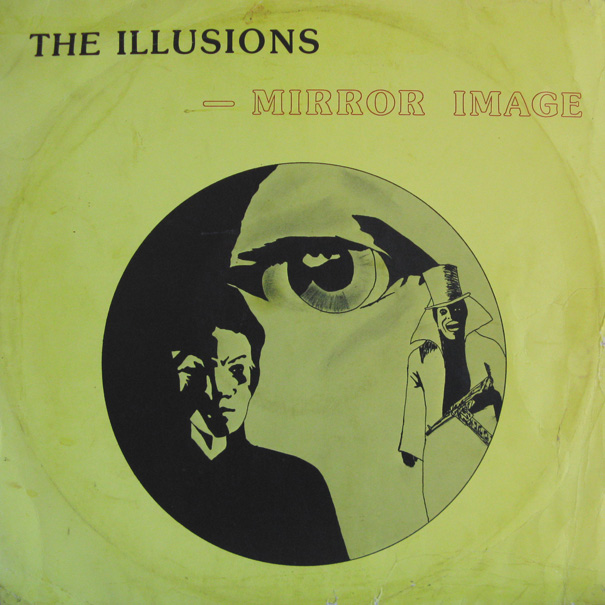
The Illusions - Mirror Image LP Shark SF359, 1981

Looking like an unknown Music De Wolfe library LP, the eye you see peering over Bruce Lee and Geoffrey Holder's shoulders on the LP cover above is one you're unlikely to have seen staring at you from any record stacks before. An obscure Melbourne powerpop record that truly sank without trace - it has literally taken us over a decade to track down a copy. More on that later.

The Illusions were a pop band from the Blackburn and Box Hill suburbs in East Melbourne. Members were Mark Davis on vocals, guitar and bass, Phil Tregonning on vocals and guitar and Peter Allan on drums. We caught up with Mark recently to get the skinny on their sole LP Mirror Image.
Phil, Peter and I went to school at St Leo's senior school together and in about 1971 I started to learn guitar. I just loved music. The Monkees in particular appealed to me - catchy, fun songs with great melody lines. We got together by chance in Form 4, 1973 I think, and started jamming in a mate's dad's shed, he was a ham radio expert and built us some little amps. We called them the rats' nests due to all the wires amongst the valves. When we left school we would practise songs most nights and weekends, as well as going to see bands like The Aztecs, Madder Lake, Red House Roll Band etc.

As we all worked days we decided that rather than play live at night, that we would do a Beatles and record our songs at night after work. In 1981, we found a studio called Labsonics in South Melbourne run by Gerry Duffy (Labsonics still exists in Sydney today). We would go about twice a week for about two months to put down the tracks. He had a 24 track two inch tape machine which was really cool, as being a three piece we liked the idea of overdubbing a lot to fatten up the sound.

The backwards guitar on Gone Too Far really stands out. How did that come about?

This was an idea I had as I read somewhere back then that the Beatles did it. We just put the tape reels upside-down, played the lead break as normal and once played the correct way that's what comes out. That's my favorite memory of the studio time: beer and experiencing a bit.

I played a 1972 Fender Mustang through a Gibson amp with distorion and chorus pedals and Jazz Bass on all the songs. Phil used his Fender Telecaster. Drums were Ludwig.

The name Illusions was my idea as we were a band that did not play live much, but locked ourselves away in the studio. Mind you, the cost was difficult to maintain as studio time was expensive and all paid for by the band.

We were never a punk band - that scene came a bit later, we preferred our own songs, but loved going out to see all the other groups around. Bands that influenced us? Lots: The Gentrys; Shocking Blue; The Beatles; The Monkees; Suzi Quatro; The Aztecs; The Who; Humble Pie; Madder Lake; ELO; Badfinger; Jo Jo Gunne; The New Dream.
Despite the diverse list of musical mentors perhaps the biggest influences that can be heard on the album are at the poppier end of the spectrum: The Beatles and Badfinger. Given there are only eight tracks on the LP, one problem is that the songs are all a bit long. Nevertheless, there are lots of good ideas at play. Mark is humble about the LP.
I thought only two or three songs were any good: Say It Isn't True, Gone Too Far, I Was There. These songs were written about things I was feeling emotionally at the time. They were personal things. Say It Isn't True for example is about the death of John Lennon. I Was There is about being pushed into a law degree I could not cope with...I wanted to be in a rock band.
You only pressed 100 copies of your 7" Empire Builder, how many copies were pressed of the LP?
Fifty.
Come again?
The reason we only made fifty copies was that I was was not sure how the LP would go. We went to all the radio stations and labels we could find to give our records to - Au Go Go, Missing Link, 3RRR, 3CCR, EON FM, Molly, Deluxe Records, Mushroom, etc. Only 3RRR gave us a chance. I was very disappointed we couldn't go further, but Phil and Peter really didn't have their heart in it after a while. I did some solo stuff but it never made it to vinyl.
No wonder this was tuff to track down. We teased you with a 69 copy pressing last week but as always we like to one-up ourselves from week to week. Here's our and Mark's favourite two tracks.

Say It Isn't True [Download]


Gone Too Far [Download]


Update: Download the whole LP at Girls From Tahiti.