Sunday, 5 June 2011

Invader - Don't Blame It On Me / Anastasia 7" Machine Gun Rock 13084, 1981

This biker band verges into punk territory with impressive results. One might think that there are lots of similar hard rock/punk crossovers from this period. There aren't.

- sleeve notes from the No One Left To Blame comp LP
For a country with such a strong track record in both kinds of music (punk and hard rock), Australian collisions of the genres were surprisingly rare. Yes, we have our proto-punkers; our pub, glam, and hard rockers who jumped ship; and our teen grillfat so amateurish as to achieve a punky edge. That's not what we mean. We're talking about wilful, artful combinations of punk and hard rock conventions, hybrids that have equal footing in both camps. Songs that can hold their own when viewed through the lens of either tradition. Though the opening quote was penned for Cleveland's Strychnine, it applies equally to anomalous Sydney Westies Invader, and their standing among the early Australian punkers. (It's just a happy accident that both play the Blame game).

In Don't Blame It On Me, the superficial trappings of genre cross-pollination are obvious - the Pistols' Submission re-routed through Marshall stacks. But if there's one characteristic that exemplifies the no-man's-land between punk and hard rock, it's the drumming. (If the mechanics of punk drumming make your eyes glaze over, you might want to skip ahead). Inherited from the likes of Slade, the four-on-the-floor drumbeat - in which every beat in the bar is accented by the kick drum - became a staple of Oz hard rock (check in here at around 1:55, or here at 4:13, or here whenever you damn please). At this tempo, it's usually accompanied by eighth-notes on the hi-hat - that's two hi-hat hits for each thump of the kick drum - propelling the song and, when played slightly behind the beat, making it "swing". Not here. Invader's four-on-the-floor lumbers instead of swings, delivering the sort of heavy-handed quarter-notes reserved by punk drummers for tempos of twice this speed and beyond. Ordinarily, a rhythm stripped of feel and pace is a bit like a gluten-free vegetarian pizza - what's the point? - but here it's perfect. Hey, true art ain't always pretty.

Don't Blame It On Me


For years, Invader was among the coldest of cold cases. Then, in October 2008, this website appeared out of the blue, prompting conniptions among collectors prone to daily Google searching. Suddenly, the mystery unravelled before our eyes. We'll hand over to Invader's Noel Thompson (guitar/vocals) to take us through the who/what/when/where/why:
Invader was a 3 piece outfit, the bass player was Jon Wilson and the drummer was Peter Borg. Jon played both a Rickenbacker and a Fender Precision bass and Peter, from memory played a Ludwig kit. I had a 1975 Gibson SG.

I hadn't played professionally in any band before Invader. I had auditioned for about 5 or 6 bands but none of them played the hard heavy stuff that I was interested in. I decided to form my own band. This was about 1978. I advertised in the newspaper for band members and got a response from Jon first. We both lived in the western suburbs of Sydney and so we joined up and then auditioned drummers and singers. We finally got Peter as the drummer who was an excellent fit for what we wanted to do. Singers were difficult and in the end I decided to take on the singing role myself. So the band eventually got up and going about late 1978, early 1979. We played around the pubs in Sydney and were particularly popular at two biker pubs. The bikers like their music hard and loud.

We recorded the single at Albert Studios in King Street Sydney on the [Australia Day long] weekend of January 24-25 1981. I wrote Don't Blame It On Me in 1979 and Anastasia in 1980. We were playing the songs live long before we hit the studio so we knew them backwards by the time we got to Albert's. The recording was done to try and attract some attention from the higher echelons of the recording industry. The record was a limited pressing of about 100 or 150, I can't recall the exact number. [The confirmed pressing size is 250 - Ed.] It was pressed at EMI. We sent them to many radio stations and music management companies. I have no idea which radio stations actually played the record but did hear that it got some airplay on the BBC in London.

I deliberately set out to write Don't Blame It On Me as a Sex Pistols style song. I really dug the Sex Pistols and all three of us liked our rock hard and heavy. Jon and I particularly liked and were influenced by Black Sabbath. Jon was a Geezer nut and I was an Iommi fan (hence the SG).

Noel Thompson with the SG, c.1979 (more here)

Saturday, 28 May 2011

It Never Ends: Lipstick Killers - Hindu Gods (Of Love) 7" 1979

For most record collectors it-never-ends is a stock-in-trade, a rule-of-thumb, a goddamn fact-of-life. For others though, like us for example, completism is not an unobtainable goal but the level to be met in every instance. Another such person is Mark Taylor of Sydney band Lipstick Killers and more recently the collector behind the conceptual greatness of the G45. Are you familiar with the G45? It is a compendium of US '60s garage 45s ordered by a three pronged ranking system. You can view the list in all its glory here.

In the G45 ranking the R factor (Rarity) and the S factor (Sonics) are more-or-less explanatory, but the groundbreaking aspect is the third rating, L for Legend. Like the number zero (or nihil) for ancient mathematicians, this gives us a new way of understanding the ebb-and-flow of records and why some are more desired at certain times than others. In the spirit of that, today we cover the ins-and-outs of the first Lipstick Killers 45 - Hindu Gods (Of Love) / Shakedown U.S.A.

The Lipstick Killers' story has been told at least thrice - in B-Side fanzine, then in Prehistoric Sounds, and then for the worldwide audience on the i-94 freeway. Let's recap:
  • post (our Wallaby Beat forebears) the Psychosurgeons' breakup the band morphed almost immediately into Lipstick Killers, final singer Stan Armstrong being replaced by Filth's Peter Tillman, and Kim Giddy coming in on bass. David and Mark Taylor on drums and guitar made up the rest of the band;
  • in 1979 the original rowdy, high-energy line-up recorded their debut single, Hindu Gods (Of Love) with Steve Harris of the Visitors on piano and Deniz Tek behind the desk;
  • a year of growing popularity in Sydney based on legendary live performances followed;
  • encouraged by Greg Shaw's enthusiasm the band moved to L.A. in late 1980 for a year and, while they played several shows, nought was coming of it so they broke up, eventually returning home.

Hindu Gods (Of Love) / Shakedown U.S.A (AUS Lost In Space, PRS-2661, 1979) S3/R3/L3
The first issue was an Australian EMI Custom press in a handsome picture sleeve. This one is elusive (especially without ringwear) and has maintained its legend status over the years, probably due to the sonics. Great songs, great riffs and strong vocals. Only the fact that the songs don't unhinge themselves keep it from reaching the rarefied heights of the S4s and S5s. 1000 pressed.

Hindu Gods (Of Love) / Shakedown U.S.A (USA Voxx, 45-1003 1980) S3/R1/L1
The first US pressing appeared on Bomp side-label Voxx. First presses come in the Blow Your Mind - Go Voxx! / Join The Voxx Rebellion company sleeve. The label font size is smaller, the Bug Music Group publishing credit is on one line, and the matrices read "Hindu" and "Shake". This variation is slightly harder to track down than the next though let's not pretend much teeth gnashing will occur before you get any of these. It appears the company sleeve can still be obtained on other 45s at the Bomp Store.


Hindu Gods (Of Love) / Shakedown U.S.A (USA Voxx, 45-1003 1980) S3/R1/L1
The second Voxx pressing comes with a redesigned label - larger font size, Bug Music Group credit over two lines, and more mundane catalogue number matrix etchings. The company sleeve too is redesigned, a less imperative, more self-referential "The spirit of the 60s, the sound of the 80s." This would appear to be the most common version.


Hindu Gods (Of Love) / Shakedown U.S.A (USA Voxx, 45-1003 1990?) S3/R2/L1
At some stage a third pressing took place, this time on silver labels. Somewhat surprisingly, given the perfunctory nature of much of their work, Bomp/Voxx added a lurid red picture sleeve for this actually quite seldom seen version. We vaguely recall this appearing for a few years on Bomp catalogues from about 1990. Unheralded at the time, and barely mentioned since, I can't imagine not wanting to own it.

The rest of the Lipstick Killers discography varies from a walk in the park (Inner Mystique comp 7", Mesmerizer variations), to the mildly sweat inducing later 7"s.

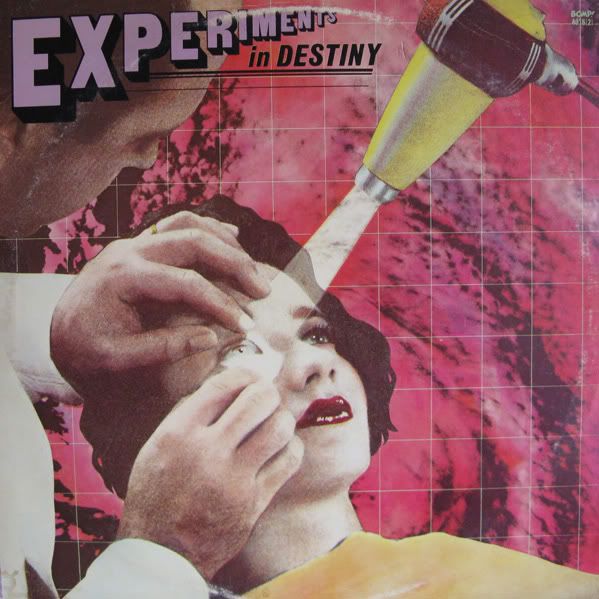
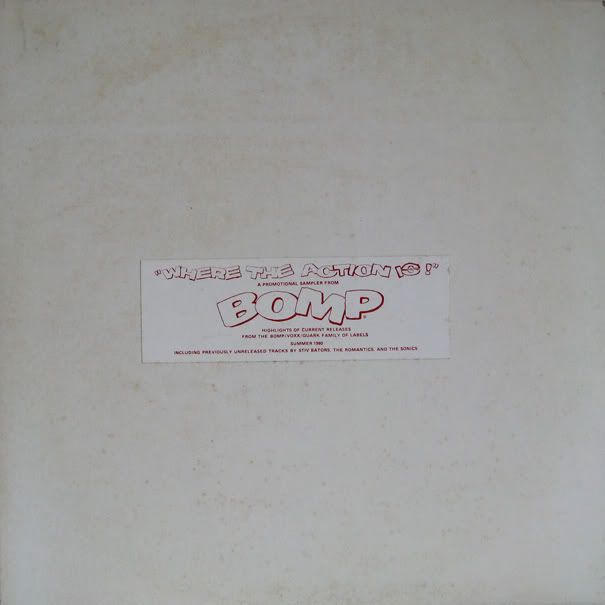
Hindu Gods (Of Love) also appeared on two Bomp compilations, the Experiments In Destiny double LP (Bomp! BLP-4016) and the Where the Action Is! promo sampler LP (Bomp! BLPR-3001, 1980).

No music today, surely these songs are either known to you or easy enough to get by dragging your sorry arse to a record shop mouse to an online purveyor of musical items. The songs are readily available on several recent CD compilations - Hindu Gods (Of Love) on Do The Pop! and Tales From The Underground, and Shakedown U.S.A. on Do The Pop! Redux Part One.

Update March 2013 This typed insert surfaced recently.


Sunday, 22 May 2011

Makeshift - Love Is Everywhere? / Joke 7" NRG 13037, 1981

We have a tendency to go on a bit when it comes to records we're enthused about. Perhaps you've noticed. Today, though, the facts we can relay aren't commensurate with our enthusiasm for this obscure DIY punker. Makeshift made a great record, and we know bugger all about it. But, as believers in the scientific method, allow us to propose some hypotheses which fit the available data:

  1. This is a Sydney record (we presume as much because our copies were found there);
  2. Paul Makeshift, one-time drummer for the Babeez, is no relation (see hypothesis 1);
  3. Listening to the sound file below will lead to the prompt addition of this 45 to your wants list.

Alternatives to our H0s about location and membership are welcome - info that leads to acceptance/rejection of the null even more so. After all, our prevailing theories about this record haven't always been well-founded. For example, our presumption that Makeshift was a one-man show doesn't stand up to closer scrutiny - there are at least two distinct voices orbiting the melody as Love is Everywhere? concludes.

Which leads us to the song in question, something of an unheralded classic of Australian DIY, making hypothesis 3 a no-brainer. The singer's a conflicted young chap, caught between wanting to live life at full speed and knowing he'll only be punished with bloodied knees and wounded pride when he does. Which of course is a metaphor for his form with the sheilas. Love is everywhere; he can feel it in his extremities, just not in the anatomy that counts, and since he's "not vicious enough to be Casanova" he only has himself to blame. The vocal performance contributes to the tension between bitterness and resignation played out in the lyrics ("sigh...here I go again"), as do the assertive downstrokes and contrasting tentative guitar fumbling which drive the song. Then there's the relentless drum machine, which stops for nothing short of the volume control on the mixing desk (there's a lesson there for our protagonist). In short, a loser rant propelled by amateur guitar hacking and an in-the-red Dr Rhythm - "an NRG release", indeed.

A second single exists, though we can't recommend it. Makeshift seemingly evolved into a real band playing real songs, recorded at a real studio with a real producer. It's a real bummer.

Love is Everywhere? [Download]


NRG: beating The Able Label at its own game.

Addendum, 24 May 2011
Price in pencil on the label + big circular sticker stain + frayed top edge + instant dust cloud when removed from the sleeve = Gould's Book Arcade.

RIP Bob Gould.

Saturday, 14 May 2011

Terryfoot - Surfside 6 7" Rev PRS-2774, 1980

It's a while since we've proffered a piece of pure powerpop here. Probably because previous posts from that genre haven't garnered the hits. But what the hell, you'll eat your vegetables as well as your meat.

Terryfoot (Terry Foot on the labels) were an obscure and short-lived Sydney band comprising Bruce Bellingham on guitar and vocals, Ian Hill also on guitar and vocals, Carl May on bass, and Zol Almady on drums.

As you would hope, Surfside 6 is an infectious pop track propelled by a hooky riff. Thematically - with surfing, girls, their tight jeans and the way they "smell so good" - we're also in the right place.

Bruce Bellingham has lobbed up more recently as Eric Mackenzie. Life's too short to figure out which is his real name so we'll just quote from his various bits and pieces on the net.

On making his first record:
I remember sitting outside the door of the studio at Double J in Kings Cross in the early '80s and the DJ looked out, saw me and said "come in, what have you got there?". I was promoting a single by my first band Terryfoot which had been pressed at the EMI plant. I would run into Roger Grierson who was up to the same thing with his band, EMI was one of the few places you could get 45s pressed. The DJ invited me in, we had an interview, the song got on "A" rotation. We used to wait at The Sandringham Hotel for the manager to turn up on his motorbike with the keys to the PA cupboard so we could play. It's still going. I hope to play there in the next few months.
On the footsteps in which he followed:
I have been into the sounds of the Stones of the '70s and early '80s, the glam and punk movements, Mick Ronson (David Bowie), The Pistols and The Ramones, pop rock from the '80s of the Cars and Billy Idol/Steve Stevens, some of the very early grunge of Neil Young and Crazy Horse, also Aussie bands AC/DC, The Angels and The Church.
With those influences, it's a pity Terryfoot didn't try to pull off a glam/punk blend à la Supernaut or Branded, but 1980 wasn't 1978. Again, you'll eat what you're given.

Surfside 6 [Download]

Sunday, 8 May 2011

Die Dancing Bears - Drug Dance / New York Valentine 7" no label MX59905/6, 1982

Die Dancing Bears' beginnings were in Adelaide, where vocalist Lynton Cox had gigged with Recoil, a training wheels punk band playing a few originals interspersed among Ramones and Stranglers covers. After the band's demise in March 1980, Cox dallied briefly with Cracked Actors before forming Die Dancing Bears in October with Daryl Champion (bass, ex-Void/Art Vandals), Liz Neat (drums), Kathryn O'Neil (keyboards), and Kym Tonkes (guitar). The band released a self-titled cassette the following year, before upping stumps and moving to Sydney where, in May 1982, this single was recorded with a slightly altered lineup - Neat (who found the band's music too depressing) having been replaced, initially by Iva Malone (who also found the band's music too depressing), then by Michael Waniarcha for the recording. Waniarcha found the band's behaviour depressing and was replaced by John Burgess after the single was recorded.

Drug Dance/New York Valentine was released in October, around the same time as Madroom's Cruelty of Beauty 12", making it among the first Australian records to veer self-consciously into UK-influenced goth-punk territory (though beyond Box of Fish, Club of Rome, Dorian Gray and perhaps Marble Soldiers, we can't think of too many others that fit the bill from the class of '82/'83). Goth, like Melbourne pub rock, is not our strong suit. Our experience extends about as far as TSOL's Dance With Me LP, which is to say, not very far; intentions of educating ourselves for this post fell by the wayside with the realisation that, ultimately, life's too short. That said, New York Valentine's sound is faster and more aggressive than we'd typically associate with the likes of Bauhaus and Southern Death Cult. Its pace, ascending riff, and discordant guitar clanging make it more akin to the Dead Kennedys' Bleed For Me, though given that it was recorded a month prior to Plastic Surgery Disasters, the DKs are an unlikely influence. We're on firmer ground in drawing a line to the Birthday Party's live run-through of Loose, and noting Cox's Cave-like vocal yelps - dig that opening scream.

The band continued into 1983 with additional line-up changes, but no further records would emerge. Tonkes later joined Madroom, vastly improving their sound on 1984's I Am For An Art... LP. Cox eventually returned to Adelaide, becoming a morning DJ on community station Three D. Sadly, he passed away in 2005.

New York Valentine [Download]

Sunday, 1 May 2011

Yettis - Ray Price's Injuries 7" Not Those Records PK 01, 1986

This week we venture north of the early-'80s for a rare foray beyond the Wallaby Beat temporal remit. Timeless classics are few and far between, but today's subject certainly qualifies (if "timeless" connotes the amount of time invested by the artist, that is). If you share our view that Purple Vulture Shit represents a high-water mark of human cultural endeavour, then comrade, have we got a treat for you.

As an AFL man, the full impact of Ray Price's proclivity for doing himself a mischief is somewhat lost on me, but I suspect that making light of it is about as tasteful as a joke about Barry Cable's leg. The lowdown on Mr Perpetual Motion's tenure with the Parramatta Eels can be found here (we recommend scrolling down to read the recollections of Johnno from St Ives). Alternatively, you can listen to the Yettis' touching tribute to the great man, which pretty much covers all of the essential bases. As you do so, we suggest casting an eye over Ray's likeness, lovingly reproduced on the insert - a piece that sits comfortably alongside works by the great visual artists of our time (Faxed Head, Unholy Swill, Psycho Sin, the Drills, this guy). A whole lot better than the whatchamacallit outside Parramatta stadium, at any rate.

The Yettis connect the dots.

Musically (I use the term advisedly), Ray Price's Injuries out-Black Eyes Waste Sausage with improvised flailing and feedback, and a walkman-level recording quality which makes Real Fucking Idiots sound like Radiohead. Wait, maybe it's the other way around.

Unfortunately, the credits give no clues to the Yettis' identity - personnel are listed as Kaptain (guitar), Standard Practice (guitar, harmonies), Hosey Funicello (guitar, harmonies), and Flatty (vocals, drum...yes, singular). Someone by the name of Doc is also credited with "nothing". However, some telltale slide guitar tacked on as the song's outro lends weight to our suspicion that the Yettis were the Painkillers in disguise, a theory which Tim Yo clearly shared (see below).

And just who were the Painkillers? Their songs comprise two-thirds of this disc, but beyond that we can tell you nothing. There was a Painkillers on the One Stop Shopping cassette from 1980, but the name is too common to conclude that there's a link. Nor is there any connection to the current gig for Mr James Baker, esq. The only person with a normal name on the entire record is drummer Barry Jones, but since he's not returning our calls, this one remains in the open case file. For the record, the Painkillers' contributions (Spider, Train Song) are post-Blood Red River, sub-Crampsian swamp rock in the vein of La Sect Rouge. Like the Eels' cheersquad, a pleasant enough diversion, but a mere warm up for the main event.

Ray Price's Injuries [Download]


Tim Yohannon connects the dots (from Maximum Rock 'n' Roll #49, June 1987), while the sceptics at Trousers In Action act like Yettis don't exist (#13, 1986).

Addendum, 7 June 2011
This just in from Mr E (a.k.a. Peter from the Painkillers), via Bruce Griffiths of Trousers In Action/Aberrant Records. Our thanks to them both for the info, and in particular to Peter for having the vision to preserve Ray Price's Injuries for future generations.

The Painkillers and the Yettis were two completely different bands. The Yettis were friends of ours but they wouldn't let any Painkillers play with them because we knew how to play our instruments and they didn't. They had a couple of electric Hawaiian guitar type things that they had bought from garage sales, an amp or two, a guitar, a drum and a microphone and although they couldn't play they liked making sounds (noise) out of them, but normally only did so in private. They did play a couple of times at Painkillers house parties and in general people hated them. However, as Bruce may recall, I had a certain fondness for chaos and decided to put Ray Price's Injuries on our record, because, after all, I was paying for it.

Yettis:
Flatty (Mike)
Standard Practice (Chris)
Kaptain (Gary)
Hose (Andy)

The Doc was sometimes their singer but didn't make it to the recording session of Ray Price's Injuries, which was recorded in Flatty's garage. A small portion of the tape was damaged so I cut and pasted on the outro, which is in fact the outro from the same session, to cover the damaged bit. You can hear Chris protesting "stop stop" etc. and the distinctive sound of the Hawaiian guitar. Ray's injuries are for real, and were taken from magazine and newspaper articles at the time that the Yettis had collected. They weren't actually footy fans but liked absurd things. I think the sketch of Ray Price was probably done by Kaptain but Andy may have embellished it.

On the other hand the Painkillers were a group of school friends from Linwood High in Christchurch, NZ, that one by one ended up in Sydney. We played only a couple of times in Christchurch, twice ending in riots, and then eventually played maybe about 100 times in Sydney and environs. Musicianship was lacking, but we were more about grasping the moment. It took its toll.

For the most part in Sydney the Painkillers were:
Vocals: Phil
Guitar: Dutch (Rimu)
Guitar: Prutts (Neil)
Bass: Mr. E (Peter)
Drums: Barry Jones

Neil is not on the record, he had gone to Perth or London at the time, and now lives back in Christchurch. Dutch died not long after the record was released. He fell from a train coming back from Queensland to Sydney. Barry Jones went into hiding in Queensland to get away from some bad people. Phil formed a band called the Hub, but has since died from an asthma attack. And I still live in Sydney, producing corporate videos for a living.

At the time, I took a bit of flack for putting the Yettis on the record, but I knew I had done the right thing when TripleM played it in a segment called "The Worst Records Ever" - not once, but twice. The fact that my non-musical mates jamming in their garage could be played on commercial radio warms my spirit to this day.

Sunday, 24 April 2011

Guest Stars - Don't Wait For The Album 7" One Hit Wonder PRS-2892, 1980

We are of the general opinion that band interviews are as boring as bat shit. (More boring, if anything. Can you make gunpowder from 90 gsm offset?). That being the case, we're not inclined to make the Q&A a regular feature. However, we are fond of this back-and-forth between the Guest Stars' David Guest (guitar) and Tony "AJC" Cahill (vocals), mostly because its tone so closely matches that of their record, a seldom-seen three-tracker pressed through EMI Custom in 1980. Just like the single, the duo's conversation is peppered with in-jokes (which, on our watch as sub-editors, will stay as such) and literary references ("I was rereading Miller's Sexus the other day and noticed the lyrics to Come On Everybody transcribed on the back page"). Even more prominent is the same self-deprecation which produced a record called Don't Wait For The Album on One Hit Wonder Records.

Following up his summation that the Guest Stars "sucked", David Guest notes that "I still think there is some merit in the songs and real musicians may have been able to do something with them". Real musicians did do something with the Pynchon rip that year, but with a running time of 78 seconds (and a guitar with just the right amount of out-of-tuneness), Bean Bag Charmers wins out as a mixtape staple for your attention-span-challenged correspondents. Those who share our aversion to band interviews can scroll down to assess its merit for themselves.

-----------------------------------------------------

David Guest (DG): Our first public appearance was entirely unpremeditated and unrehearsed and occurred at an intervarsity dance in Melbourne in approximately 1979. I just happened to know the chords for Wild Thing and She's So Fine and I wrote out the lyrics for AJC ten minutes before we then had the gall to front the band that was playing, borrowed a guitar and their bass player and drummer and proceeded to bring the house down. Naturally we should have quit then but we didn't and paid the price.

Tony Cahill (AJC): I remember you telling me that The Clash couldn't play an instrument which seemed a good enough reason to start a band. I had no musical pedigree prior to the Guest Stars. My musical education and interest in new wave music came from listening to your records when we were living in the flat at Randwick (Sex Pistols, the New York Dolls, New Rose, the Ramones!). Our routine was to listen to "What's On" on Triple J as we were driving back from Hensley Athletic Field late on a Saturday afternoon and decide who we would see that Saturday night. Ian Rilen's band X was a favourite. When out and about you wanted to be careful of the punks, not that we were afraid of them but you never knew when an ashtray might come whizzing about your ears. They were very much into uniform and looking surly, though I would have thought there wasn't much about life in Sydney in the Seventies that could genuinely create angst and anger in a young man. Our interest was in indie bands but we did see the bigger bands; Skyhooks when they played at the University, AC/DC at the Lifesaver etc.

DG: My memory and AJC's don't always converge but what is not in dispute is that AJC and I were the band such as it was and we variously used bass players and drummers as required.

AJC: Warren Hansford bought a drum kit on the cheap and you and I used to go to his garage to rehearse. His level of ineptitude on the drums was quite staggering and he didn't last long.

DG: We scratched around a bit over the next year or so without enduring too much humiliation but then came the infamous Law Ball at the Hilton Hotel.

AJC: We were sabotaged by your mates, the Lonely Hearts.

DG: Contrary to AJC's self-serving assertion the Lonely Hearts did not sabotage us, we (known then as Ray Rice and the Bubbles) were woeful enough to do that ourselves. After that train crash AJC and I emerged as the Guest Stars with a couple of new musicians and played at the Manly Vale where we actually supported the Lonely Hearts and the Farris Brothers, soon to become INXS. My abiding memory of that night was (sorry to speak ill of the dead) that prize prat Michael Hutchinson [sic] dripping in to the dressing room and asking Mick Rooney of the Lonely Hearts "had we seen their axes?", to which Mick of course responded, "No axes man but there are some guitars over there that aren't ours"...AJC then put up the money and we recorded the single. That was about it for the Guest Stars - we now had incontrovertible evidence that we sucked.

AJC: I don't know why we made the record. I had left University and was punting and must have come into some money. Life was all a bit random in those days, if something seemed like a good idea I would do it. Maybe 500 copies pressed? Not many copies sold, I would give copies away rather than ask people for money. I don't remember much about the recording session. We didn't record any other songs than those on the record. I have done nothing musical since.

DG: The lyrics to Bean Bag Charmers are a mish mash of thoughts inspired by Gravity's Rainbow but Thomas Pynchon pulled the right rein when he wrote liner notes for Lotion and not us. I generously granted a song writing credit to AJC...from memory I think he contributed the word "snowstorm". [After the Guest Stars] I dallied with the Lonely Hearts and the Lime Spiders, again, without ever really learning to play an instrument...amazing what you can get away with.

Bean Bag Charmers [Download]


Come On, Everybody [Download]


Success [Download]

Sunday, 17 April 2011

Black Chrome - Australia's God / We Are Tomorrow 7" Tomorrow MA7202, 1978


When we get our time machine working, Adelaide 1977 is pretty far down our list of destinations to visit. Despite being home in the '60s to a vibrant beat scene, Adelaide seemed to have well and truly shot its load by the time punk reared its ugly head (in contrast to Brisbane whose relatively moribund '60s and early '70s scene gave way to a thriving 1977). Hopped up on goofballs in Rundle Street in 1977, and wanting to avoid hippie, folk and boogie rubbish, you didn't have a lot to choose from. Maybe Phantom, a lively pub rock band led by an AWOL American Vietnam deserter, Irving and the U-Bombs, or... Black Chrome.

It must be said that of all the original 1977 Aussie bands Black Chrome are the one most shrouded in mystery. The single remains unheard, uncomped (but not unloved) and the facts we can report are scant. The original lineup was Simon Stretton on vocals, Simon Dillon on bass and Andrew Griffiths on drums. By 1978 it was Mike Flash on bass, Tony Techno on drums and Simon Stretton on vocals. No guitarist is credited anywhere. Stretton resurfaced in Ungrateful Children around 1980 (one track on the 5MMM compilation). And, um, that's it.

So to the record, perhaps the most singular sounding of the first generation Australian punk records with its restrained fuzz, and strange (moaning?) backing vocals. It's in the lyrics where the punch is packed - cut out the lyric sheets below and sing along.

Tomorrow also released the Bohdan X 7" of course. Black Chrome and Bohdan (in JAB) shared stages in Adelaide in 1977. Of note were the Bijou concerts, a movie of which was shown at the 2010 Adelaide Fringe Festival - you can see a tantalisingly brief glimpse of Black Chrome at 00:40 at this promo clip. A DVD of the movie is available from Patrick O'Grady at PO Box 336, North Adelaide, SA 5006.

Australia's God


We Are Tomorrow


30 April update:
Thanks to an anonymous commenter for this video. Fantastic Black Chrome footage and interview, and an interesting insight into some radio's resistance to punk in Australia in 1977. When we wrote this post we were gonna link the phrase "boogie rubbish" to the great original clip of the 1976 Angels (who were from Adelaide). Note the slight similarity between the Australia's God intro and bridge (around 2:05-2:15 of the mp3) and the bedrock riff of Am I Ever Gonna See Your Face Again (around 0:10-0:20). Now notice the alarming similarity between the Black Chrome singer's collar and Doc Neeson's raised jacket collar!

Saturday, 9 April 2011

Henry Vyhnal - Punk Power 7" Corporate CHS 607, 1979

One micro-genre we're gonna cop to not knowing everything about is Melbourne pub rock. Too many pairs of ill-fitting jeans for us, not enough stomp or belligerence. All is not lost though - borntobepunched recently started his PhD on unstudied Wallaby Beat and the literature search has unearthed three or four pretty good tracks out of the scene which we intend to spotlight later this year. For now though here's a track from one of its protagonists who did cross over and put out a pretty fine pop punk record.

Henry Vyhnal (real name, it's Czech) learnt violin from his classical musician father. You can read his full CV in the insert reproduced below, but in short he played the traps in the Sharks, the Pelaco Brothers and Millionaires, where he performed as Jimi Tomorrow.
Jimi Tomorrow was a character I invented just for the band. Captain Sensible did a similar thing in The Damned. In my mind, Jimi was a futuristic young punk...never a part of the status quo because he was in another time zone (the immediate future). He knew what was going to happen but nobody else did - and that was his alienation. The sort of 'punk' that Jimi was based on was more the James Dean/Marlon Brando sort of punk rather than Johnny Rotten. To me at the time punk was an attitude not a sort of music of costume.
Fast forward to 1977 (Jimi was already there) and a new kind of punk was everywhere. Henry could be found playing guitar and violin in the Babeez, on the Boys Next Door's Door, Door LP and Shivers single, and even (uncredited) on the Desert Rat LP.

The Babeez gig, as detailed at the link above, went for a while through 1977 and 1978. Vyhnal's interest in punk was sincere.
I wanted to see the movement happen. I saw it as a way of being involved in the scene and helping it along the way.
During this time (the Babeez pages say early 1977 - see Extracurricular work), he recorded his own 7", backed by Jarryl Wirth from Babeez/News on guitar, and Ash Wednesday and Johnny Crash (Janis Freidenfelds), both from JAB, on bass/synth and drums respectively. The single wasn't released until mid 1979.

Leaving aside the ballad A-side, Punk Power is an infectious, energetic piece of poppy punk, driven along by some great News-esque guitar. The song was actually written while in the Millionaires, and performed by them:
Punk Power was Jimi's attempt to tell people living in the present what was going to happen next. As it happened, it was a song about punk that predated its introduction into the mainstream.
Henry/Jimi is glorifying youth, while also warning the know-it-all punk kids that life gets hard as "hair falling out, teeth falling out, friends falling out" take their toll. Giving the kids guns is duly noted as a good idea. There is an intentional nod to the new punks with "we really mean it, man" a direct reference to God Save The Queen. This gives us another clue to when it was recorded, the Sex Pistols track coming out in May 1977.

Punk Power

Eagle eyed readers of the Desert Rat post may notice that the label and catalogue number look familiar. The single was intended to come out on Champagne but that label went into liquidation so a little rejigging of the label design was in order.

An insert came with some copies.

Jesus Jones aside, we don't endorse much krautrocky activity from Australia (and no prog with saxes), but we thought you should see this suitably mad Cybotron video from the mid '70s. Henry Vyhnal also played on some sessions with the band (or more precisely drummer Steven Maxwell van Braund) but not on this.

Saturday, 2 April 2011

Credits - It's You / Fazed Dazed 7" Thunder FV001, 1979


The Survivors were one of the surprisingly few Australian sixties powerpop bands plying their trade in 1977. We're talking about bands paying homage to their sixties forebears via covers, equipment and approach. We'll leave their full tale for another day, but in 1979 bassist Jim Dickson had decided to try his luck in Sydney (ending up playing in the Passengers), so guitarist Greg Williamson and drummer Bruce Anthon spent that year playing around Brisbane as The Credits.

Their only 7" presents as a nice mix of sixties lyrics and sound with a punky energy. Hanging around in the corner is a dash of that striped sunlight sound; that mix of shyness and brashness, innocence and knowing that permeates Brisbane records.

It's You is a cover of an Aussie 60s rave-up by Terry Dean, originally realeased on the Go!! label from Melbourne in 1965. Here the Credits credit it to Unknown. Mr or Ms Unknown was certainly prolific in the Brisbane punk scene - you might remember them from such songs as Wild About You on The Saints' (I'm) Stranded LP, or from the great (Mystery-Unknown) credit for the Bodysnatchers' Mystery (Solve It).

Apart from Anthon and Williamson, the record sees the recording debut of Tony Robinson, who you may know better as Tony Robertson from the 31st, the Hitmen, the first New Christs line-up, etc. "***" who is credited with vocals is actually Bruce Anthon too. Then there's "Spider" on lead guitar. Thirty years later the Brisbane mafia isn't letting on who this is, so we'll posit a theory. The address on the back is the original Adelaide Street address of Rocking Horse Records, where Anthon worked for many years. The Rocking Horse crew always had a strange fascination with Spider Sabich, shot by Claudine Longet in 1976. Maybe it's an in-joke; maybe it was someone else from Rocking Horse; maybe Williamson overdubs; maybe even Bruce himself, again.

We're not sure of the significance of the Yves Montand card from 1970 French flick L'Aveu, displayed on the cover. It's a film about imprisonment under a totalitarian regime. But these are songs about girls, not Task Force - perhaps it's the tyranny of love. Our comments are open if you can help.

It's You


Fazed Dazed


Update April 23: L'omerta has been broken and Peter Mengede has been fingered as Spider. Mengede, then working at Rocking Horse, where he was known as The Dude, reached fame in Helmet ten years later. This makes for a more auspicious recording debut for him than the usually quoted Watusi Now.