Saturday, 5 February 2011

The Brats - Life On The Dole from 5MMM's Compilation Of Adelaide Bands 1980 LP MMM01, 1980


Q: Is Fraser on the fucking dole?
A: No, I don't think so

In every scene there's a band that seems to have a bristly relationship with other parts of the scene. In the case of Adelaide punks The Brats, that included an impressive list including themselves, promoters, venues, journalists, radio stations and political parties (though not the one you might expect from the above lyric).

Starting in May 1979, the band for the first seven months was Bruce Brat (bs), John Brat (dr), Paul Brat (gtr) and Peter Brat (keyb, voc). Bruce (aka Bored Bruce) got bored and was replaced by Stan Brat, and John also left to be replaced by someone named Sticks. All had histories going back to the late '60s and early '70s. Of particular interest are Stan's sojourn in politically inspired Adelaide band Glass Web, whose 1970 7", In A Year Or So, is an early anti-Australian-presence-in-Vietnam song. Their second 7" from 1971, National Hero, reiterated their opposition, this time with striking graphics of military tombstones. Peter had been in Rashamra, who had two singles out in 1972. Look past the band's name and the flute at the start of Antelope to hear some good tuff riffing.

Unusual in punk circles the band also had female backing vocalists, the B-Side Bitches, the roll call of which included Annalissa Vague (also from Rashamra), Brenda Brat, Carol Brat (later Cazzby Brat) and Gay Brat (later remonikered as Gay Wales, one of the great punk names).

So to the feuds. The band's first gig was at a Cannabis Law Reform Society party. On the back of that the Australian Marijuana Party, for which Gay worked as a volunteer, booked them and the Accountants for a benefit gig in July 1979. The potheads then decided punk bands would harsh their mellow and cancelled the whole thing. Major bummer, dudes. A storm in a teacup really, but enough acrimony was generated to break up the band.

In August they reunited and over September and early October headlined five weekly gigs at the Austral Hotel. Now, the Austral was a hangout of the Iroquois bikie gang, and as a result promoters and venues elsewhere in the city branded The Brats a "bikie band" - hence no bookings, anywhere.

In November they did score bottom of the bill at a Scientists show. Nick Pervert (a friend, and guitarist with Exhibit A) got pissed and threw a bottle which hit Peter Brat. Local newspapers reported the story and The Brats were now seen to "have a violent following". While on the media, Roadrunner magazine was also perceived to have dissed the group. "Punkoid thrashers in the style of the Accountants" is the quote which the band felt misrepresented them. Listen to the interesting, jazzy chords driving Life On The Dole and you might admit they may have had a point.

Since no-one wanted to touch the band, their next gig was a self-organised show in January 1980 in a fully lit basketball stadium at a juvie institution called McNally Training Centre. All went well and the kids loved it.

Over Easter, the band recorded six tracks at Noumenon Studios - Life On The Dole / 1, 2, Truro / Explosions / Nobody (Is Really Where They Wanna Be) / Hoodlums / 2002. The tracks were released as a cassette. Life On The Dole had been noticed as the band's strongest track right from the early gigs, and comes across as a piss-taking reflection on the somewhat realistic potential, in 1979, of a life spent on welfare:

I'm gonna go from from the dole to an old age pension,
I wanna be a government sponsored institution,
And when I die, my last cheque,
Will be cashed, and completely spent.


Life On The Dole


Not quite Supernaut's take on things...

Due to their various reputational difficulties the band was also viewed unfavourably by community radio station 5MMM (one of a string of "public radio" stations, set up as a Whitlam government initiative, which had only started broadcasting in 1979). They wouldn't play the tape. Since this was the band's only realistic chance of local airplay the entire band fronted for a meeting with station management. They managed to nix all the station's objections to the band, most based on rumours and hearsay, and as a result got valuable airplay and gig bookings through the station.

Life On The Dole thus became a local hit, reaching number 2 on the station's charts. 4ZZZ in Brisbane also played the track a lot, as did 2JJJ in Sydney, and in later years the band was told it had also received airplay on Californian college stations. Eventually, it saw vinyl release on 5MMM's imaginatively titled 5MMM's Compilation Of Adelaide Bands 1980.

The gigs came through too, starting with a 5MMM night at the Tivoli in May 1980, where the band finally started to see some live success, with good crowd feedback. The black ban lifted, more gigs followed. This included support for the Ramones, following a push from Roadrunner and 5MMM. The promoter refused to pay the supports, and the band had to join the Muso's Union to get them to fight the case, successfully.

In the end, having challenged rumours and perceptions, and achieved local success, it all suddenly didn't seem worth it. Too poor to move to Melbourne or Sydney, the band broke up, members moving off to Darwin, New York, and their own homes. Apart from a one-off 1985 reunion, that was it for the Brats, though Peter did surface recently to cut a new version of Life On The Dole with the Moulting Vultures.


This month at Wallaby Beat is Malcolm Fraser month, where we feature songs that mention Australia's conservative prime minister for pretty much the period this blog covers. He was named caretaker PM after the Dismissal in November 1975 (then won the followup election in December), and his Liberal Party lost the March 1983 election to Bob Hawke.

Australian bands never really played the name and shame game for our punk-era conservative heads-of-state that the US (Reagan), UK (Thatcher) or the Netherlands (van Agt) did for theirs. But old Malcy-walcy did inspire a few missives - and we'll cover them this month.

At the time this song was written the unemployment rate in Australia was at the mid-range of the historical scale, though it had risen from the postwar average of around 2% (from 1945 to 1974) to around 6% in 1979. Under Fraser and his Treasurer John Howard ("Is Howard on the dole?") it would then rise to 10% by the 1983 election, hence the popularity of the song Australia-wide in the early 80s.
Howard would of course later become Prime Minister, and drag Australia hard to the Right, including work for the dole. In a sense he made the Fraser years look quaint in their conservatism.

Thanks to Harry Butler's DNA fanzine for the photo and for all scurrilous rumour information in this piece.

Sunday, 30 January 2011

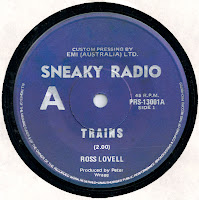
Ross Lovell - Trains / Long Distance Calls 7" Sneaky Radio PRS-13001, 1980

Judging by the number of hits for the last three posts y'all just can't get enough of the approximate vocals which dot the DIY landscape. In which case, have we got a treat for you! Ross Lovell manages to take Plastic EP's rank long hops and bottom edge them into his stumps. For the cricket non-inclined, he makes Plastic sound like Glenn Danzig. Having said that, this one's gonna test even our most diehard followers. All we can say is put it in your personal music device and give it a couple of chances. As much as we are fans of being grabbed by the gonads on the first listen, this one repays more constant attention.

A friend of mine once described Father Yod as Homer Simpson doing Jim Morrison. Here, we have Homer doing, what? Graham Parker? (Wave era) Patti Smith? Video Nu-R? Jerry Rooth? Whatever the influence, there's a magnificent set of lungs bellowing here. We leave it up to the listener whether this kind of thing inspires giggles or awe. We tend to fall on the side of the line that says untutored, outsider art is sincere, and intended to be treated as such, and it's just a happy accident that it comes out so mind-bendingly awful/awesome.

The musical backing here is more than proficient, especially the bass and drums, which scream session muso. The way the guitar gently wails away in the background, and then more forcefully over the rhythm bed for the last minute, is undeniably cool. We're guessing, given the photo below, that Rosco is the guitarist. His playing is pretty good, so it's not as if he doesn't have a musical bone in his body, but that voice...

Long Distance Calls


Like a modern producer pushing a pudgy Dannii wannabe onto Auto-tune, we imagine producer Peter Wragg saying gently, "Why don't we try the vocoder on the next track?". So, on Trains, we have Homer doing Electric Light Orchestra (our first guess, Neil Young's Trans, wasn't out for another year or so). In a bizarre twist, in another decade and a half, Homer himself paid tribute to Styx's vocoder led Mr Roboto. Hard to decipher the lyrics here but we guess the song is about standing on Albion overpass watching trains, or as Ross would portentously have it, "The Trains" da dum da dum da dum.

Trains


Interestingly, the only search engine hit on Ross Lovell in Brisbane lists a contact for a men's choir. Part of us hopes he took lessons to harness and sculpt the magnificent wind coming up from his thorax, but a larger part hopes it still flies forth as free as when he laid down Long Distance Calls.

A few years ago a promo copy of sorts emerged from a Brisbane rock critic's archives, nestled inside was a photo of Ross sitting beside his phone, waiting for that long distance call.

Sunday, 23 January 2011

Plastic EP & The Records - Well You Want To Make A Record / I'm Not Coming Back (unreleased 7", recorded 1981)

Plastic EP and the Records in 1981 (l-r): Craig, Wally, Chris, Plastic EP

After our initial feature on Plastic EP and the Records' fantastic 1981 single, the band's frontman, Plastic EP, used the comments section to drop a bombshell: Recordings exist for an unreleased second 45. Not only that, the songs were purported to be in the style of that first single, rather than the more polished direction of its follow up. As EPs über-fans, our reaction was predictable: Holy. Fucking. Shitballs.

With thanks to Plastic EP, we're proud to present the songs that would have made up that second 45. The songs were recorded in 1981 - after the session, the band was told to return to the studio at a later time to pick up a master of the final mix. For reasons unknown, the studio never compiled the 1/4 inch master tape, the original reels disappeared, and plans for the single were shelved. ("Isn't it ironic, we recorded a song called Make A Record and we couldn't actually make one", says Plastic EP). Thankfully, the band had the foresight to record rough mixes onto cassette before leaving the studio - that cassette is all that survives from the session, and is the source of the sound files below.

The songs are even more raw than the first single, attributable in part to the unfinished nature of the recordings, but also due to a positively rude guitar sound, courtesy of new member Craig (tremolo is featured heavily on both songs to great effect, and Make A Record's guitar solo is, in a word, savage). In some respects, the recording also represents a transition between the styles of the official singles, most notably in the replacement of At Home's drummer, Brendon Pearse, with a Boss Dr. Rhythm drum machine. With the tempo set just right, there is also that same freneticism that marks so much drum machine driven French punk (Metal Urbain, Dements Tragiques (human drummer, we know), Bla Bla Schmurz Group, etc., etc.).

The band considers Well You Want To Make A Record to be the stronger track - it was the first song co-written by Plastic EP and bass player Wally, and as noted elsewhere, was revived in numerous versions over The EPs' career. Indeed, it's the more immediate of the two songs, but we're hesitant to downplay the merits of I'm Not Coming Back. Its chiming piano lines are an undeniable highlight - in fact, the song is not a million miles away from The End by Just Urbain in its instrumentation and minor key. 

Well You Want To Make A Record


I'm Not Coming Back


As a bonus, here are versions of At Home and Three Special Words with different vocal takes to the ones included on the first single. The released versions feature re-recorded vocals; here, we have rough mixes of the original takes. Both have some on-the-fly lyric reshuffles, but At Home is notable for including those "Na na na" lines we love so much, which were replaced with inferior real English language words in the final mix. And dig the DIY Internationale intro to Three Special Words: "Just do it!".

At Home (original vocal)


Three Special Words (original vocal)


Craig flies the flag at Plastic EP and the Records' first gig, Coburg Scout Hall, 1981

Saturday, 15 January 2011

The EP's - Secret Love / Forget All I Said 7" EMI Custom 13369, 1982

For those who came in late (as the Phantom comics used to say), Plastic EP and the Records debuted in 1981 with a self-proclaimed "New Wave" record - in reality a great, punky DIY single, the product of a spontaneous creative process and a desire to capture the moment, warts and all. Resurfacing in 1982 under a more collective appellation, the EPs' second single shows them pursuing a musical direction befitting of the previous 45's product information message.

A very different proposition from its predecessor, the follow-up displays a greater degree of, dare we say, "professionalism". For starters, there are drum machines and sequencers all over this puppy, which have the effect of corralling the songs into much tighter structures. The songs are more fully developed, too (one gets the sense that the band is aided and abetted here by their producer, Rudy Brandsma), but still show telltale signs of the classic EPs minimalism - the intro/outro riff of Secret Love is Three Special Words in reverse! And of course, singer Plastic EP's trademark tendency to loiter in the vicinity of (but never actually on) the note is in full effect. Add some inexplicable sound effects - dogs barking, babies crying - and things are never in any danger of becoming too, uh, normal.

Before moving on, we note with interest that the labels credit "Eric" with videos for both tracks. The videos have so far eluded us - Eric, if you're out there, we encourage you to avail yourself of Youtube.

Secret Love


Forget All I Said


Secret Love was the EPs' last appearance on vinyl. As record collectors, it's tempting to view this single as the end of the story, when in fact it was just the beginning. The EPs continued on throughout the '80s, gigging sporadically, and even appearing on Hey Hey It's Saturday's Red Faces in 1987 (again, if anyone reading this has the segment on tape, Youtube awaits). With some line-up changes, the band still exists to this day, rehearsing and recording at its Melbourne home base. In our last instalment, we alluded to the fact that the 7" format enforced a certain quality control on the EPs' output, and noted that the culling process became less and less apparent over time. Taking their "record now, think later" MO into the digital age, the EPs' every fart is now documented and uploaded to the internet for the whole world to hear. At the time of writing, there were 100 albums - 100! - available for download, with more being threatened. Some of this material is self-described as "comedy rock", but it's often difficult to determine where the sincerity ends and the comedy begins. Where, for instance, does an amateur "Mega-Mix" of At Home fit in the scheme of things?

If Wesley Willis floats your boat, we suspect that there are some hidden gems awaiting you among the EPs' back-catalogue, but to find them you'll need to be made of stronger stuff than us. That being said, fans of the Secret Love single are advised to check out Make A Record, another early EPs composition which appears to have been recorded in the same session.

Addendum: 20 January, 2011
Ask and ye shall receive - The EPs on Red Faces, 19 September, 1987.

Sunday, 9 January 2011

Plastic EP & The Records - At Home / Three Special Words 7" New Wave SF 350-A/B, 1981

The graphic design clusterfuck to your right has created a great deal of confusion among punk collectors and Australian music discographers alike. Is it the Plastic EP by New Wave and the Records? Or New Wave by EP and the Records? No, no, and no to the other more creative permutations that have circulated, Chinese-whispers-like, among the small cadre of enthusiasts aware of this 45's existence. Plastic EP is a pseudonym adopted by the band's vocalist (a.k.a. Daniel Samargis), an homage to the four-tracks-at-45-rpm 7" format embraced by Australian record companies in the '60s; the Records is his backing band. "New Wave", it seems, was either their label or a misguided attempt at consumer advice.

Contrary to the Sydney locale documented in the Who's Who of Australian Rock, the EPs (as we shall refer to them for brevity) were Melbourne-based. Formed in late 1979 or early '80, the EPs' main inspirations were the bands that popularised their namesake format - the Monkees, the Beatles, the Yardbirds et al. It's no surprise, then, that the band existed in isolation from the Melbourne punk and DIY scenes; what is surprising is the choice of direction for their first release (pressed in a quantity of 250, and distributed locally to friends and gig attendees) - a deliberate stab at UK punk.

Naturally, a vinyl-derived band moniker (so nice, they named it twice) delivers brownie points right off the bat, but there are other admirable qualities on display here which appeal to our more conceptual sensibilities. For starters, we are big fans of the EPs' spontaneous approach to song writing - hit "record" and see what happens. "Some of our best songs have been written in under five minutes", explains Plastic EP. "I can write a song from a drum beat and sing the song from start to end without any words written down...it's more important to get the whole song down as a whole than to record a perfect song". Obviously an inherently hit-and-miss technique, here the band wisely distils the hits at the expense of the misses (an approach that was subsequently abandoned; more on that next week). Whether the attempts at UK '77 were a stylistic success is open to debate, but both songs are undeniably catchy, and performed with commendable energy and disregard for technical precision. At Home opens with a gangbuster intro, among the best in Australian punk, before settling in to a more straightforward, '60s-inspired 12-bar punker. Three Special Words more obviously displays the EPs' "make it up as you go" ethos (Can't think of what to sing next? Nonsense syllables are an acceptable substitute for words!), and is arguably the stronger track.

An additional appeal is that nobody here is playing with a full deck. Plastic EP's inability to sing a note, combined with the rudimentary lyrics and musicianship, lend proceedings an air of the mentally deranged, only adding to the EPs' standing in the Wallaby Beat canon. Things would only get stranger over time - we pick up the trail next week.

At Home

Three Special Words

Saturday, 1 January 2011

Danny Decay & The Molars - If The Dentistry Is Right 7" Republic 13267, 1982

Summer has finally arrived down here. So here's a good summer record - breezy, unaffected, fun. Like this year's summer though it's a bit all over the place - poppy, punky, even a bit Oz rocky in the full-frontal basslines. You will certainly wish that the guitarist put a bit more grunt into his sound, but all four tunes are good, the energy level is high, the voice distinctive and the lyrics odd. The punkiest track is Johnny Was A Rock Star which also features a touching tribute to Ian Krahe:

Ian was the X guitarist,
He never got to be 21
I read about it in the papers
Them bastards dragged him down
Never saw him, never heard him
I never really cared
But two bottles and a couple of belts of scag
Didn't seem to me very fair


We'll mark this one as a Sydney record, though we're not 100% certain. It was recorded at Paradise Studios which at the time, December 1981, was in Kings Cross. Then there's the mention of surfing at Cronulla in Go For Broke. Then there's the "thanks to the boys at Stead Bros", a metal and rubber stamp factory at Rockdale. Hmmm, the stamped labels are quite fancy, maybe the guys worked there. Ok, ok, it's a Sydney record. Someone once told us 200 pressed, though that's still hearsay at this stage.

The band appears to have resurfaced in the last decade. A CDEP called Scales And Scrapes was released.

Go For Broke


Adelaide


Johnny Was A Rockstar


Tripping In Taree

Saturday, 25 December 2010

Fred Cass & The Cassettes - Xmas In America (Australian Branch) 7" Fred Cassette Co 00002, 1981

Hmmm, weekend is here and we're low on inspiration. "What about Fred Cass's great At The Weekend?" said the Professor at the weekly meeting. Alright! Then we remembered it's been blogged elsewhere. Oh, no! We scrambled, and here's Fred's second 7". It's not weekend-themed but we hope you'll find something on it for today.

On this one Fred (a.k.a. Lee Cass) is again backed by various members of the Sports (and their daughters), News, Skyhooks and Schizophrenias. Yong Talent Team Xmas 2001, a medley of Rudolph The Red-Nosed Reindeer and Jingle Bells, is a cool piece of seasonal kiddie punk. Fans of At The Weekend might also wanna check out the Soft Boys/Heartbreakers-style rave-up of Family Fun Parlour, and fans of Let's Get Married should also like Fred's satire on Australian coupling rituals.

Yong Talent Team Xmas 2001


Merry Xmas Merry Christmas


Family Fun Parlour


Marriage Is A Splendid Thing

Sunday, 19 December 2010

Bad Habit - Stormchild LP EMI Custom YPRX-1424, 1977

As promised in our recent screed on Ipswich nogoodniks the Upsets, here's another barnstormer (literally!) from the same locale.

Like many bad habits, this one was formed as a product of teenage boredom - a 15 year old Neil Coombe (g) and buddies Paul Wilton (b,v) and Neal Ward (d) first began making a racket together in 1975. By 1977, after a couple of years of gigging (including a support slot for AC/DC at Brisbane's Festival Hall), Wilton had been replaced by Steve Arthurson (v,g) and John Pankof (b), and the expanded line-up retreated to a rural chicken barn to record Stormchild, Bad Habit's one and only LP.

An online bio of sorts fills gaps in the timeline and provides more detail about the recording of this LP, including the factoid that vocal takes were often ruined by the sound of gumnuts falling from an overhanging tree onto the barn's tin roof (from the sound of Arthurson's voice, those were the only dropped nuts in the vicinity of the vocal mic). It also promulgates some outrageous hyperbole about the record's punk-ness, the most noteworthy claim being that Stormchild was one of only two '70s Queensland-recorded punk LPs ((I'm) Stranded, of course, being the other). To our ears, the teenage amateurism and lo-fi recording herein certainly warrant the adjective "punky", but only as a qualifier to "hard rock". If these kids had heard the Sex Pistols, or ventured in to Corinda to catch The Saints, then it didn't osmose into their own efforts. Tsk tsk, TrippyHippy, if indeed that is your real name.

Punk rock or no, there is much to appreciate across Stormchild's ten tracks, which showcase a fairly advanced sense of composition for those so young. There are quieter passages and lengthier songs - all worthy, mind - but to comply with the Wallaby Beat remit we focus here on the most straight ahead rockers. The astute listener will note that all three songs plunder the same basic chord progression, yet each is distinct in its own right. To a degree, this is testament to the band's creativity in making the most of a limited palette, but the inventive lead work of guitarist Neil Coombe is deserving of particular credit. Coombe's playing runs the gamut from tasteful economy (the stellar dual lead interplay in Don't Touch) to tasteless bombast (see Burning Yearning, surely the most effective use of the chipmunk guitar solo this side of the Bob Seger System, and a WTF? moment that surpasses even our old friends Toxic), but is never anything less than great.

Neil Coombe himself is dismissive of Stormchild and his own contribution to the record:
"It's far from being my best work (I was 17) and I never know what to make of it...it was far down the track before I thought I did anything 'great'. It was my first album and I always dismiss it, but apparently there are some people out there who took to it...Truly bizarre".
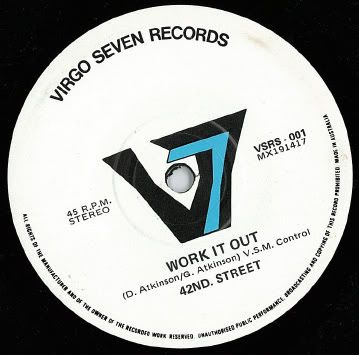
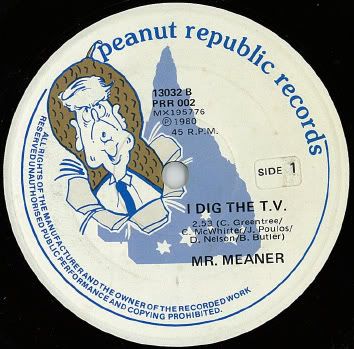
Coombe subsequently played with the likes of 42nd Street and Mr Meaner. Though both have their appeal, we respectfully disagree about their relative merits vis a vis Bad Habit (nothing personal - as a general rule, musicians are the last people we trust to appraise their own work).

Scum stats: either 250 or 300 copies (depending on who you ask) pressed through EMI Custom, but it's more elusive than contemporaneous records pressed in one third of that quantity. Where did all of those records go?

Burning Yearning


Don't Touch


Leave It Up To Rock & Roll

Sunday, 12 December 2010

It Never Ends: Celibate Rifles - But Jacques, The Fish? 7" EMI Custom,1982

After a few years learning the trade at parties and school dances around Sydney's North Shore, The Celibate Rifles (one of a bunch of one-off party names that stuck) progressed to playing pubs and getting a record out - and what a record! But Jacques, The Fish? is just about the finest record to ever emerge from up that way. Four great songs, some hilarious lyrics, and a frustrating set of sleeve colour variations.

As a rule we don't cross the bridge for nothin'. Every few years though one of our scouts up on the North Shore sends a telegram saying another colour scheme has surfaced and we don our radiation suits, jump in the Wallaby Beat detective van and head up there to bring it home. Now, twenty-eight years after this disc first appeared we think we can close the case on it, so welcome back to another it-never-ends session. There's been several years of does/doesn't it exist to and fro-ing with various parties, now let us supply some clarity.

The first pressing was organised by the band and appeared on EMI Custom labels in late 1982, with catalogue number 13355. EMI Custom pressings appear in one of two colour variations which we'll call black-on-white and white-on-black. These sleeves are different to the later pressing in that the sleeve is flapback - the folds are glued outside the sleeve on the back.

Note also that the colour scheme for these is repeated on the back of the sleeve; black-on-white is black-on-white on the rear (seen to the above right), and white-on-black is white-on-black on its reverse.

It's an odd sleeve in some ways - the iconography is from nowhere: a free-standing ewe with a tied off rifle, a foot on a stick with a tapping toe; and But Jacques, The Fish? You might be tempted to start to align our boys with surrealism and dadaism but we won't make the mistake of previous generations and link the motivations of suburban oicks with French philosophers. Just a healthily odd sense of humour, and a certain iconoclasm which came to characterise, and perhaps plague the band's output as time went on. Ultimately, the rarely seen heavy metal umlaut-ed Ä is probably gonna get you closer to the mark.

There are no mistakes to be made about the music though. All four tracks on here are absolutely great. The influences were Radio Birdman and the Saints - not just lazy pick-a-soundalike by us, but admitted by bassist Michael Couvret and lead guitarist Kent Steedman in several interviews (in Away From The Pulsebeat fanzine for example).

Kicking off with Kent's Theme (They Don't Listen) we have one of the band's earliest songs, dating back to their original singer Ian Martin. A comment on smoking and conformity with the great refrain "doesn't listen to the doctors advising, all she hears is the advertising" leading into the lead break appropriating the Marlboro theme. As we mentioned before, local guitarists love themselves some thematic "references".

Next up is possibly the highlight of the EP, Let's Get Married, a song that never fails to bring a smile to our faces, not just from the ferocious wah-wah solo and group-chanted chorus but mostly from the hilarious lyrics penned by vocalist Damien Lovelock.  We particularly like the line "you must be okay coz you went down on my brother". Lovelock's vocals are excellent across the whole EP.

On 24 Hours the band kick back a bit with a more personal lyric. On this side of the disc the band really start sounding more like Radio Birdman, particularly in the guitar licks and backing vocals. Tubular Greens is the band's first surf themed song, a connection they continued occasionally, as detailed by Stephen McParland in Waltzing The Plank. Amongst other things this included pseudonymous gigs as Sandy Pile and The Beach Bums at Mambo's surf band battles, where they did T.V. Eye as Seaweed Eye. Anyway, cool song, great handclaps.

The EMI Custom EP was distributed by Hot Records. By 1983 Hot Records formally became a label and we have a second pressing of But Jacques, The Fish? as HOT 702. The same stampers were used, but the label is completely different and switches to an alternative spelling of Jacques. The sleeve artwork is the same as the earlier issue. The minutiae are as follows:
  • there is no longer any flapback - the folds are glued inside the sleeve;
  • there are four variations: red-on-white, white-on-red, blue-on-white, white-on-blue;
  • the back of the sleeves standardise - the red sleeves both have white-on-red reverses, and the blues have white-on-blue;
  • interestingly (come on, you've read this far) blue-on-white opens to the left, all other schemes we have seen have the more regular right hand side opening.
As far as rarity or otherwise goes, the EMI Custom pressings are harder to find than the Hot. We can't really divine any relative scarcity amongst the Hot sleeve variations - we'll just report that white-on-blue was the last one to land in our laps.

The lyric/info insert comes on white, blue, green, yellow, red or pink paper. Maybe others too. We haven't been able to find any variations on the inserts between pressings, even the handwritten extra phone number seems to be the same on all copies we've seen.

Finally some music - we've decided to just feature one track, the "all samples not cleared" Kent's Theme. 24 Hours, Tubular Greens and Let's Get Married saw release in the UK on What Goes On on the Quintessentially Yours LP. Kent's Theme was on a UK 7" on Shigaku Records backing Pretty Pictures and also made one of the early punk reissue compilations - Back To Front Vol 6 in 1995. All four tracks are on the Platters Du Jour double album/CD compiling the 7" tracks up to 1990. Go get it. Oh and report any other variations (with documentation please!).

Kent's Theme


February 2012 update Two more variations in hand: EMI Custom with black-on-white front and white-on-black rear; Hot red-on-white front with a red-on-white rear.

Sunday, 5 December 2010

Little Bands 7" EMI Custom PRS-2675, 1980


Plenty of cities had a pick-up scene parallel to their more formalised band scenes. Vancouver's fuck bands for one example, and the messingly incestuous London DIY scene. In Melbourne the Primitive Calculators and Whirlywirld solved the venues' requirement of having to fill a certain number of minutes with support bands by mixing and matching members and swapping instruments. Add a loose rule that each band could only have three songs and only perform twice, and the Little Bands were born. 

Pretty much the only contemporaneous document was this 7", issued with blank black labels in 1980. 

Later the scene extended to a regular night centred around the Champion Hotel in Fitzroy. A lynchpin of the scene was Alan Bamford, who organised and faithfully documented proceedings. 


Ronnie And The Rhythm Boys - Hey Joe

Absolutely brilliant one note feedback version with dual vocals and localised lyrics. A mix-tape favourite of ours. Stuart Grant and Denise Hilton (Primitive Calculators), Jules Taylor (Thrush and The Cunts).


Morpions - Point Blank
Great distorted guitar over a monotone beat and distracted vocals. Short and to the point. Lee Smith (Bowie-esque guitarist-around-town, also played with early Lisa Gerrard bands), his girlfriend Wendy (Joy) Morrissey, and Stuart Grant (Primitive Calculators).


The Take - Summer
A more straightahead song style here, but the guitar 'solo' is cool. Frank Lovece (Primitive Calculators), Marisa Stirpe (Thrush and The Cunts), Tom Hoy.


Too Fat To Fit Through The Door - Flintstones, Meet The Flintstones
Tomfoolery (as you may have guessed), idiocy, directionless art. Lots of fun. Marcus Bergner (artist/filmmaker/poet), Marie Hoy and Ollie Olsen (see Forced Exposure #14 for a rundown), Michael Buckley, Stuart Grant and Dave Light (Primitive Calculators).


There are plenty of tapes from this scene still extant - the 2010 exhibition at the Potter Gallery in Melbourne temptingly had them under glass, so here's a gentle push to those with access to get them out there. After all, we've lived with the teasing listing of the unreleased No Sin Like Dancing double LP in Inner City Sound for nearly three decades now. Put us out of our misery.

In the meantime you can hear some of the later Champion Hotel era Little Bands on the Terse Tapes One Stop Shopping cassettes which are in most households. If you want to hear some Thrush and The Cunts (and if you don't, what are you doing here?) then check out Chapter Music's Primitive Calculators And Friends CD (which also includes this EP and some Prim Calcs throwaways). Or, go and see the concept live - it's still kicking on!

Finally, a bonus - more Ronnie And The Rhythm Boys from Fast Forward 007 cassette magazine:

Ronnie And The Rhythm Boys - I Wanna Be Your Girlfriend